

Cover image source: AI-generated editorial illustration. The unbranded chair and studio are conceptual.
Executive summary
Choose a Taiwan office chair manufacturer for an OEM or ODM program by verifying its ability to deliver your approved product configuration repeatedly, at an agreed commercial cost, with evidence that matches your intended market. A useful supplier evaluation connects product fit, engineering responsibility, testing, production controls, delivery planning, and service support.
These criteria should be defined before suppliers submit quotations, so commercial comparisons reflect equivalent products and responsibilities.
This white paper presents a practical selection framework for international furniture brands, importers, distributors, and contract procurement teams considering manufacturing partners in Taiwan. It uses OASYS as a documented supplier example and draws on public guidance from standards organizations, workplace ergonomics authorities, and trade institutions.
The procurement procedures and decision tools are recommendations developed for this paper. They are not findings from a comparative factory audit or a statistical study of Taiwanese manufacturers.
The central recommendation is to qualify the product and the operating relationship together. An attractive chair sample establishes a starting point. Approval for an ongoing supply program requires a controlled specification, applicable evidence, accountable production processes, and a clear method for managing changes after launch.
Define the sourcing brief
- Application and target market
- Opening quantity and reorder scenario
- Approved configuration and mandatory features
- Development responsibility and intended launch date
An office chair sourcing program begins with a business requirement. A brand developing a distinctive task chair faces different decisions from an importer extending an existing assortment or a project buyer furnishing a training facility. Start by documenting the application, intended sales markets, expected users, sales channel, and service model. Then translate that brief into measurable product and supply requirements.
For an existing platform, the initial decision may concern upholstery, armrest options, packaging, and private labeling. For a new product, it may involve industrial design, mechanism selection, new tooling, and repeated engineering revisions. These programs should not be compared through the same quotation template without identifying their different development obligations. Otherwise, a low unit price can conceal an incomplete scope.
Write a short purchasing brief that states what success means. Include the planned launch date, opening order, reorder assumptions, target selling position, and acceptable development investment. Distinguish firm requirements from preferences. A buyer may require a particular seat adjustment range while remaining open to different backrest constructions. This distinction gives the manufacturer room to propose workable alternatives without weakening the purchasing specification.
Taiwan is a sourcing location, not a substitute for supplier qualification. Evaluate the legal entity, actual production sites, subcontracting arrangements, and responsibility for the finished product. If manufacturing origin is material to the buying program, request a documented production map and the origin evidence relevant to the destination market. Do not infer the origin of every component from the location of the supplier’s headquarters.
OASYS describes its business as a Taiwanese office and home furniture manufacturer founded in 1992, offering OEM and ODM services from development through mass production. This public description supports an initial discussion about manufacturing scope. The buyer should still establish which activities, facilities, and product configurations are included in the proposed engagement.
Choose the development model and assign responsibility
For this paper, OEM describes a program in which the buyer provides substantial product definition and the manufacturer produces against that definition. ODM describes a program in which the manufacturer contributes an existing design or significant development work. These are working procurement definitions. Individual suppliers may use the terms differently, and a project may combine both models.
An OEM relationship can suit a brand with approved drawings, established design ownership, and engineering resources capable of resolving specifications. An ODM relationship can suit a buyer seeking to adapt an available product platform. The appropriate choice depends on where the design work sits and how much differentiation the market requires. The label alone does not determine tooling ownership, exclusivity, or development risk.
Create a responsibility schedule covering industrial design, structural engineering, component sourcing, prototype fabrication, validation, packaging, and production release. Name the party that approves each deliverable and the evidence needed for approval. Where a supplier proposes a design adjustment, record who evaluates its effect on appearance, usability, testing, and commercial claims.
Clarify intellectual property and tooling arrangements before paying for development. The commercial agreement should address existing designs, newly developed work, buyer supplied drawings, mold maintenance, access to tooling, and the circumstances under which production could move. An ODM platform may remain available to other customers unless the parties expressly agree otherwise. Product exclusivity should identify its territory, duration, configuration, and commercial conditions.
Ask the supplier to distinguish development fees from recurring product costs. Identify which prototype rounds, engineering revisions, and tests are included. A program with an apparently modest development charge may require additional payments whenever the configuration changes. A clear scope allows the buyer to evaluate the full development commitment and allocate approvals without delaying the launch.
Evaluate fit testing and quality
The word ergonomic does not establish whether a chair will fit the intended users. The Canadian Centre for Occupational Health and Safety explains that suitability depends on a person’s dimensions, workstation, and task, and that a chair marketed as ergonomic may still be inappropriate for an individual (Canadian Centre for Occupational Health and Safety [CCOHS], 2021).
Procurement specifications should therefore describe usable adjustment ranges and the working environment.
Record seat height, effective seat depth, seat width, armrest spacing, lumbar adjustment, and the permitted recline functions. State the measurement method and configuration. A seat height value can be misunderstood if one supplier measures an unloaded cushion and another measures under a defined load. Consistent measurement conventions make competing samples and production checks easier to assess.
The Occupational Safety and Health Administration’s chair guidance emphasizes back support, adjustable seating, suitable armrests, and coordination with the desk, keyboard, and monitor (Occupational Safety and Health Administration [OSHA], n.d.). For a sourcing program, this means evaluating the chair within a representative workstation.
A functional adjustment may have limited value if the user cannot reach its control or if the armrests prevent an appropriate position at the desk.
Develop a sample trial that reflects the buying application. Include users with different body dimensions, the intended floor surface, and typical work tasks. Document where an adjustment reaches its limit and whether users understand the controls. Treat this exercise as a structured fit assessment. Do not present it as proof that a chair prevents injury or delivers a quantified productivity improvement.
OASYS lists adjustable lumbar support, alternative armrest options, and mechanism features for its Ultimate chair. These details help buyers formulate configuration questions. The purchasing specification should identify the exact option combination being ordered rather than assuming that every feature on the product page appears in every version.
Match testing evidence to the ordered configuration
A credible testing document review starts with the applicable product category, standard, edition, and market requirement. BIFMA’s public overview describes ANSI/BIFMA X5.1 as addressing general purpose office chairs and explains that it contains multiple test procedures (BIFMA, n.d.-b). Buyers should establish whether that standard is appropriate for their particular product and intended application rather than treating any reference to BIFMA as interchangeable evidence.
Request the complete relevant report, or a controlled review arrangement if confidentiality limits distribution. Examine the tested model identification, photographs, sample construction, component descriptions, test dates, and results. Compare these details with the proposed bill of materials. Ask the laboratory or responsible technical specialist to resolve uncertainties about configuration coverage, especially when the ordered chair differs from the tested sample.
Changes to a base, caster, mechanism, armrest, structural material, or other component may affect the applicability of earlier evidence. The manufacturer should provide a technical explanation for relying on an existing report. Where additional evaluation is necessary, identify its scope, cost, and timing before approving the change. A supplier assurance without a documented basis leaves the buyer unable to substantiate its own product claims.
A claim that a chair was tested to a BIFMA standard and a claim of participation in BIFMA Compliant should be checked separately. Request the current program rules and verify any claimed product registration directly. The purchasing record should distinguish the test report from the registry entry and identify the exact model and configuration covered.
Maintain an evidence register for the purchasing program. For each claim, record the configuration, supporting document, responsible owner, and review trigger. Avoid translating a test load into a marketed user weight limit without an appropriate technical basis. Similarly, do not use a mechanical safety report to support unrelated claims about emissions, fire performance, or clinical benefits.
Evaluate the quality management system and its scope
ISO 9001 concerns a quality management system. ISO’s public description identifies requirements for establishing, maintaining, and improving that system (International Organization for Standardization [ISO], 2026). Product testing addresses a different question: how a defined sample or configuration performs against specified requirements. A purchasing program benefits from understanding both forms of evidence and their respective boundaries.
Request the supplier’s certificate and check the legal entity, covered locations, stated scope, edition, issuing body, and validity. ISO explains that it develops standards but does not issue certificates; certification is performed by external certification bodies (ISO, n.d.).
Verify the issuing body’s information rather than relying solely on a logo in a brochure. Where a standard has been revised, confirm the certificate’s validity and relevant transition arrangements with the issuer.
The useful audit question is how the system governs the proposed order. Ask to review an example of document revision control, a rejected incoming component, and a corrective action record with confidential information removed where necessary. Follow one approved specification through purchasing, production instructions, inspection, and shipment release. This exercise reveals whether staff use the same current definition of the product.
Inspect how deviations are authorized. A material substitution should identify the affected orders, technical assessment, buyer approval requirements, and updates to product evidence. Verbal approval between sales staff is an inadequate basis for a change that could affect structure or market claims. Define who can release the product when engineering and commercial considerations conflict.
Review manufacturing and sample approval
- Identify operations performed directly and by subcontractors.
- Trace the approved drawing revision into work instructions.
- Request defined acceptance criteria for dimensions appearance and functions.
- Review the response when an incoming or finished part fails.
A factory equipment list is useful when it explains how the proposed chair will be made. Begin with the product process: structural parts, molded components, upholstery, finishing, assembly, and packing. Identify which operations the supplier performs directly and which it purchases. Then ask how outsourced work is specified, inspected, and traced into the finished product.
For structural parts, discuss the dimensions that govern fit and assembly. For upholstery, examine approved appearance samples, seam placement, tension, and the method used to handle material variation. For final assembly, review the sequence, fixtures, fastener controls, and functional checks relevant to the approved design. The objective is to understand how a repeatable result is produced, rather than simply counting machines.
OASYS describes C-GEX as an upholstery and sewing technology intended to improve those processes, and separately describes laser cutting equipment in its manufacturing news. These disclosures provide specific topics for a technical discussion. They do not establish an independently measured defect rate or prove that every customer program uses those processes.
During a factory review, ask the team to demonstrate the route for a representative chair. Compare the workstation instructions with the approved specification. Review how parts are identified between operations and how staff prevent mixing similar components. A process can appear orderly while still allowing an incorrect caster, mechanism, or upholstered part to enter a finished unit.
Request a production control plan for the actual configuration. It should identify the checks, acceptance criteria, frequency, records, and response to failure. Different characteristics need different controls. Cosmetic appearance may require a visual reference, while an assembly dimension requires a defined measurement. Agree on these methods before the first commercial batch so inspection disagreements do not emerge at shipment.
Qualify samples and manage production release
- Appearance prototype: review styling and record temporary components.
- Engineering sample: assess intended construction and controls.
- Production representative sample: assess the planned manufacturing route.
- Approved reference: link the sample to drawings materials packing and release records.
Use different samples for different decisions. An appearance prototype can support design review while still using temporary components. An engineering sample should demonstrate the intended construction. A sample made through the planned production route can help evaluate readiness for repeat manufacture. Label each sample’s purpose and record any differences from the proposed commercial product.
Establish a controlled reference sample after the configuration is approved. Link it to drawings, the bill of materials, approved finish and upholstery references, packaging instructions, and assembly documentation. Keep corresponding references with both parties where practical. Photographs can support communication, but they may not capture texture, gloss, stitching, or the feel of an adjustment accurately enough to resolve every dispute.
A pilot order should answer specific questions before volume increases. Can the supplier assemble the product consistently? Does the packaging protect it through the agreed distribution route? Can the receiving team identify the parts and complete assembly using the supplied instructions? Record the findings, assign corrective actions, and define which issues must be closed before production release.
Separate the approval of the sample from approval of the shipment. A correct sample does not show that an entire batch conforms. Agree on shipment inspection arrangements, product checks, sampling methods, and defect definitions with the responsible quality specialist. The inspection plan should reflect the application and contractual requirements; this paper does not prescribe a universal sample size or acceptance threshold.
Use a release checklist with named owners. Confirm that the specification, test review, material approvals, packaging, labeling, and open deviations have been resolved. If a conditional release is considered, state the condition and affected quantity explicitly. Production pressure should not turn an unresolved engineering issue into an undocumented commercial decision.
Compare cost and delivery
Normalize the quotation before comparing prices. Confirm the chair configuration, upholstery grade, mechanism, armrests, casters, packaging format, spare parts, and included documentation. Specify the currency, quantity, quotation validity, and delivery basis. Where one supplier excludes testing or tooling and another includes it, bring those obligations into a common comparison.
ICC explains that Incoterms 2020 allocate costs, risks, and obligations between buyers and sellers (International Chamber of Commerce [ICC], n.d.). Record the selected rule, named place, and edition precisely. Have the logistics team verify how it applies to the transaction. Separately document payment terms, product acceptance, warranty, and other commercial provisions rather than expecting a delivery term to describe the entire relationship.
Build a landed cost estimate that includes the quoted product, relevant freight and handling, insurance, applicable import costs, receiving, and assembly. Add development expenditure separately so it remains visible. Request assumptions from the appropriate logistics and customs specialists for the destination market. A sourcing decision should use current transaction specific inputs instead of an unsourced tariff or freight estimate.
Consider operating costs over the intended service period. Assembly errors, missing parts, field repairs, and replacement shipping can reduce the value of a low purchase price. Model scenarios using the buyer’s own experience where available. Identify the assumptions and avoid presenting a hypothetical service rate as a demonstrated supplier performance result.
Packaging deserves a commercial and operational review. Compare carton dimensions, packing configuration, container loading assumptions, damage protection, and assembly workload. A higher loading quantity may reduce freight allocation per unit under certain conditions, while shifting work to the receiving operation. Evaluate that tradeoff through the actual distribution model. Do not treat a published container quantity as a guarantee for every customized configuration.
Verify delivery capacity and control changes after launch
Ask the manufacturer to explain the proposed lead time through its dependencies. The schedule should distinguish specification approval, material procurement, tooling or development work, testing, production, inspection, and shipment readiness. Identify the event that starts the quoted production period. A timeline measured from receipt of an approved order differs from one that includes unresolved engineering work.
Review capacity against the intended opening order and reorder pattern. Discuss the operations most likely to constrain the schedule, the availability of bought in components, and the impact of custom materials. Request a practical recovery plan for a delayed component or a failed inspection. The plan should name decision points and responsibilities without promising an outcome that the parties cannot control.
Compare supplier performance information only when definitions match. Ask how on time delivery is measured, which date is used, whether partial shipments count, and what period the data cover. A headline percentage cannot resolve these questions. If the supplier shares records, assess their relevance to programs of similar configuration and volume while respecting customer confidentiality.
After launch, establish a written change notification process. The supplier should identify proposed changes to materials, components, production location, tooling, or packaging and explain their implications. The buyer should decide which changes require approval, new samples, additional testing, or updated marketing information. Record implementation by order or batch so the field service team can identify affected products.
Maintain a regular review proportionate to the program. Track delivery exceptions, recurring defects, overdue corrective actions, and unresolved engineering changes. A concise set of records tied to specific orders is more useful than a general assurance that the relationship is performing well. The aim is to detect an emerging problem while the scope remains manageable.
Plan service and environmental evidence
Service support should be agreed before the first order. Request an illustrated parts list, identification codes, replacement instructions, warranty terms, and a process for diagnosing field issues. Establish which parts the buyer will stock and which the supplier will provide on request. Clarify the treatment of discontinued components and the notice period for changes that affect compatibility.
Evaluate repairability through an actual service task. Ask how a damaged arm pad, caster, upholstered seat, or other serviceable component would be replaced on the selected model. Confirm which tools and skills are needed and whether replacement work affects any warranty conditions. Where a task involves a safety critical assembly, require manufacturer approved instructions and an appropriately competent service process.
CCOHS includes maintenance and repair costs among chair selection considerations (CCOHS, 2021). For a commercial buyer, this supports including service arrangements in the purchasing decision. It does not establish that a particular repairable design will automatically deliver a longer useful life. The benefit depends on parts availability, appropriate maintenance, field conditions, and the economics of the repair.
Environmental claims require evidence appropriate to the specific statement. FTC guidance cautions against broad, unqualified claims such as eco friendly and calls for clear, substantiated qualifications (Federal Trade Commission [FTC], 2012). A buyer should request the basis for claims about recycled content, packaging reductions, or other attributes and distinguish information about a component from information about the complete chair.
Ask what the evidence measures, which model it covers, and who maintains it. A packaging reduction should identify the comparison baseline. A recycled content statement should define the relevant material and calculation basis. Treat repairability, emissions, recycled content, and carbon performance as separate evaluation topics. Only make the environmental statements that the available evidence supports in the intended market.
Score the supplier using reviewed evidence
Use mandatory qualification conditions before applying a weighted score. Examples include an acceptable evidence review, an approved configuration, a workable delivery plan, and agreement on change control. Define these conditions for the project. A high commercial score should not compensate for an unresolved requirement that the buyer considers essential to product release.
The following matrix is an illustrative evaluation tool developed for this paper. It is not a validated industry benchmark. Buyers should adjust the weights to their application and score the quality of the evidence rather than the confidence of the sales presentation.
| Evaluation area | Illustrative weight | Evidence to review |
|---|---|---|
| Product fit and engineering | 25% | Approved specification and sample assessment |
| Testing and quality controls | 25% | Applicable reports and production records |
| Delivery and supply planning | 20% | Dependency based schedule and capacity discussion |
| Commercial scope and cost | 15% | Normalized quotation and cost assumptions |
| Service and documented environmental attributes | 15% | Parts terms and claim specific evidence |
Score each area from zero to five using definitions agreed before evaluation. Zero can indicate missing evidence; five can indicate that the requirement is fully supported by relevant reviewed documents and samples. Intermediate scores should describe the remaining uncertainty. Multiply each score by its weight and retain the supporting notes so the final number can be explained.
Review the result with purchasing, engineering, quality, and logistics personnel. Discuss major assumptions and unresolved items before making the award. A supplier with the strongest score may still require a conditional development agreement before it can accept a commercial order. Record the actions, owners, and deadlines needed to move from selection to release.
Questions to resolve before the order
What information belongs in an office chair RFQ
Use the office chair RFQ checklist to provide the intended market and application, drawings or reference platform, configuration, materials, quantity, launch timing, testing requirements, packaging needs, and delivery basis. Identify unknowns separately. Ask the supplier to list exclusions and assumptions so the buyer can determine what the quotation actually covers.
Does ISO 9001 establish that a chair passed product testing
No. ISO 9001 addresses the quality management system, while a product test evaluates a defined sample against specified requirements. Review the certificate’s scope and the chair’s applicable report separately. A buyer should be able to connect the tested construction to the configuration being purchased.
Can one chair report support multiple customized versions
That requires a documented technical assessment. Request the report, identify the differences, and obtain appropriate laboratory or technical guidance on coverage. Do not assume that changing an armrest, structural material, mechanism, or base leaves the evidence applicable. Record the decision and any further evaluation required.
How should buyers choose between an OEM and an ODM program
Choose according to the location of design responsibility, required differentiation, development resources, and commercial ownership arrangements. An existing platform may reduce some development tasks, but the exact configuration still needs approval. Define deliverables and rights in the agreement instead of relying on the program label.
What should be approved before mass production
Approve the specification and reference sample, relevant testing review, material and finish references, packaging, labeling, inspection arrangements, and release responsibilities. Close the issues that could affect the ordered product. Where an exception remains, document its scope and obtain approval from the accountable decision maker.
Begin the sourcing discussion with an evidence based brief
A manufacturer should be able to explain how it will translate the buyer’s requirements into a controlled, serviceable product. The strongest sourcing discussion therefore begins with a defined use case and a request for evidence. It gives both parties a practical way to identify gaps before committing to tooling, volume, and a launch schedule.
For buyers considering OASYS, start with the company’s documented product range and OEM or ODM service positioning, then request configuration specific information. Bring the proposed market, user requirements, opening quantity, and development scope to that discussion. Ask for a quotation supported by a specification, an evidence review plan, and a delivery schedule with stated assumptions.
The outcome should be a purchasing decision that another team member can review and understand. Every major claim should have an identified basis, every material assumption should be visible, and every unresolved requirement should have an owner. This provides a sound foundation for the first order and for the product changes, reorders, and service needs that follow.
Normalize the supplier comparison with a cost bridge
A supplier evaluation becomes more useful when each scored capability has a corresponding delivery obligation. For a chair program, the engineering record should identify the mechanism, mounting interfaces, foam and cover, base, castors, hardware, packing state and evidence package.
A factory photograph can establish what is visible on that date; it cannot establish the acceptance limits for those interfaces. Connect each critical requirement to a sample, drawing or usable record, then score the response against that specific obligation.
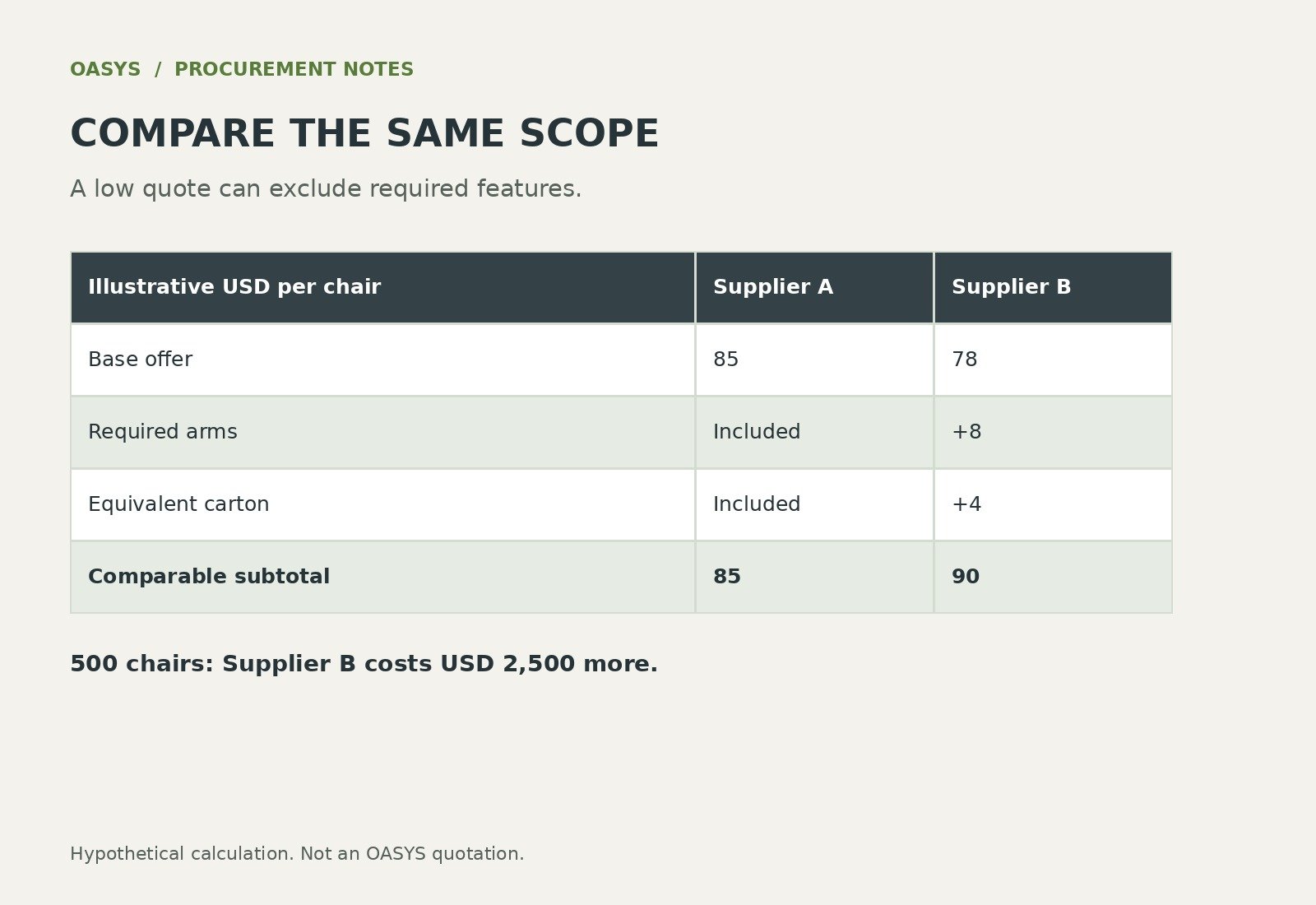
Consider a hypothetical purchase of 500 chairs. Supplier A quotes USD 85 per chair including the specified arms and carton.
Supplier B quotes USD 78, then adds USD 8 for the required arms and USD 4 for equivalent packaging. With those two scope differences normalized, B is USD 90 and A is USD 85.
The apparent USD 7 saving becomes a USD 5 premium, or USD 2,500 across the order. Freight, tax, installation and any differences in validation remain separate inputs.
These figures demonstrate quote comparison and are not OASYS quotations.
Use the cost bridge during the supplier interview. A line described as included should identify its configuration and quantity. An omitted item should remain visible until a supplier prices it or the buyer formally removes it from the brief. This process also protects the technical evaluation: the preferred factory should be assessed on the configuration that actually enters the commercial comparison.
| Hypothetical line item | Supplier A USD | Supplier B USD |
|---|---|---|
| Chair scope before normalization | 85 | 78 |
| Required arm option | Included | 8 |
| Equivalent packaging | Included | 4 |
| Comparable unit subtotal | 85 | 90 |
For the next procurement step, use the office chair RFQ checklist and furniture quality test documents to connect these requirements with supplier selection and quotation review.
Discuss your office chair project with OASYS
Share your target market, application, proposed configuration, quantity and launch requirements with OASYS. A useful inquiry identifies which requirements are approved and which need engineering or commercial input.
Explore OEM and ODM services · Review manufacturing capabilities · Contact OASYS
References
BIFMA. (n.d.-a). BIFMA Compliant. Retrieved October 11, 2026, from https://www.bifma.org/page/bifma-compliant
BIFMA. (n.d.-b). BIFMA standards overview. https://www.bifma.org/page/standardsoverview
Canadian Centre for Occupational Health and Safety. (2021, January 7). Office ergonomics — Ergonomic chair. https://www.ccohs.ca/oshanswers/ergonomics/office/chair.html
Federal Trade Commission. (2012, October). Environmental claims: Summary of the Green Guides. https://www.ftc.gov/business-guidance/resources/environmental-claims-summary-green-guides
International Chamber of Commerce. (n.d.). Incoterms 2020. https://iccwbo.org/business-solutions/incoterms-rules/incoterms-2020/
International Organization for Standardization. (n.d.). Certification. https://www.iso.org/certification.html
International Organization for Standardization. (2026). ISO 9001:2026 — Quality management systems — Requirements [Standard overview]. https://www.iso.org/standard/9001
Occupational Safety and Health Administration. (n.d.). Computer workstations: Workstation components — Chairs. https://www.osha.gov/etools/computer-workstations/components/chairs