

Cover image source: AI-generated editorial illustration. The unbranded chair and studio are conceptual.
Executive summary
An office chair RFQ checklist defines the product, the purchasing conditions, and the evidence required to approve supply. It gives the manufacturer enough information to identify a configuration, estimate development work, and distinguish a firm quotation from a preliminary budget. The objective is comparable proposals that can be converted into a controlled order.
Start with the intended application and the exact chair configuration. Add quantities by variant, material requirements, functional expectations, testing requirements, packaging, delivery terms, and sample approvals. Where a decision remains open, describe the required outcome and ask the supplier to propose alternatives. An explicit uncertainty is more useful than an apparently complete specification containing assumptions nobody has approved.
This paper provides an original RFQ framework for furniture brands, importers, and commercial procurement teams. The numerical examples are hypothetical planning examples, not OASYS quotations or recommended universal limits. The framework should be adapted to the buyer’s market, project maturity, and approval process. Its central principle is simple: every important comparison must refer to the same product and the same supply scope.
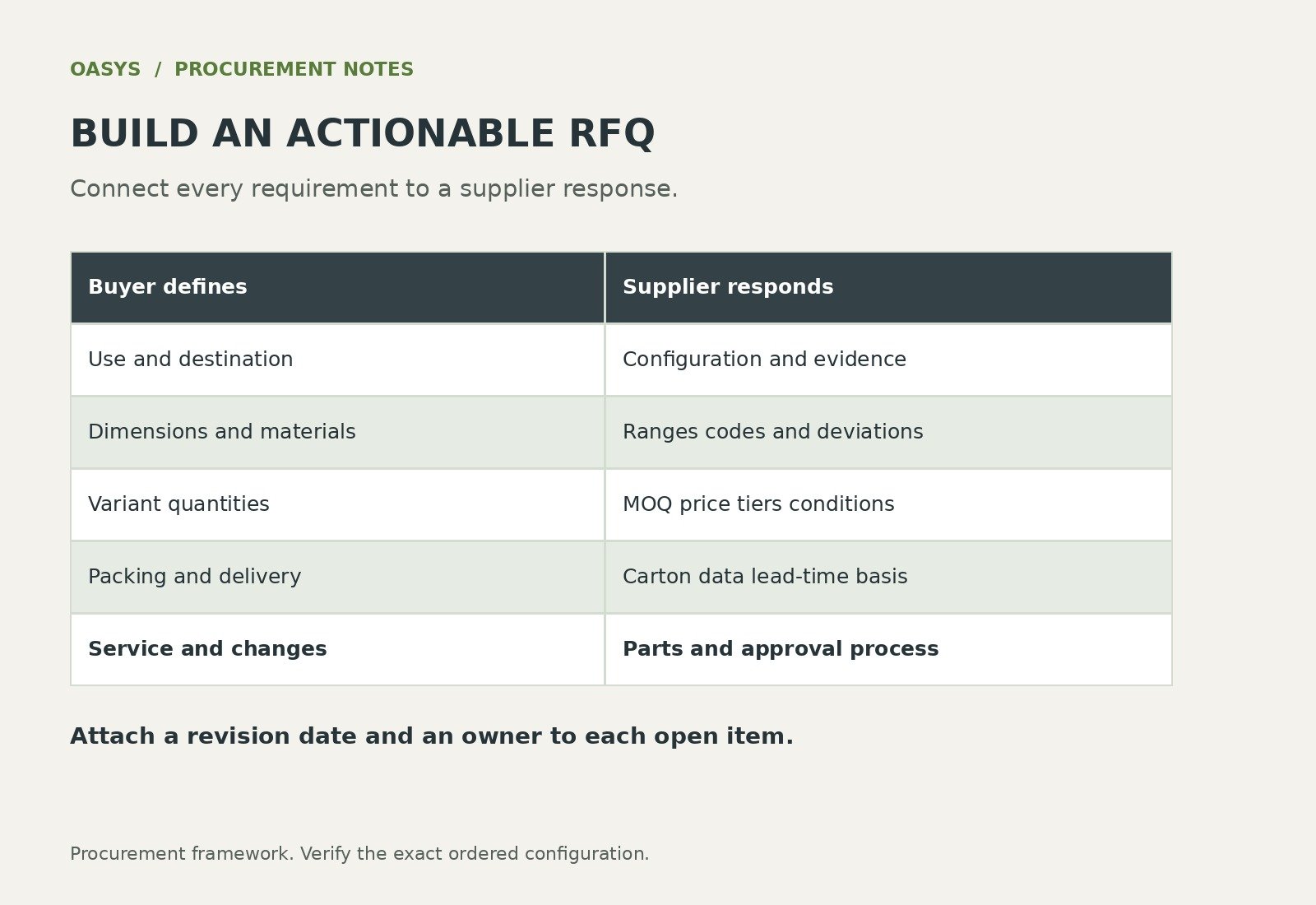
Office chair RFQ checklist at a glance
| RFQ field | What the buyer supplies | What the supplier confirms |
|---|---|---|
| Application and market | Assigned or shared use and destinations | Applicable configuration and evidence |
| Configuration | Back seat mechanism arms base castors | Order code options and deviations |
| Dimensions and materials | Measurement state material codes color reference | Ranges proposed tolerances technical sheets |
| Volumes | Variant quantity opening order reorder scenario | MOQ price tiers and conditions |
| Development and evidence | Approval gates and required reports | Itemized scope costs dependencies |
| Packaging and delivery | Assembly state distribution route named place | Carton data loading assumptions lead time |
| Service and changes | Spare parts and approval responsibilities | Parts schedule substitution notice process |
Establish application and configuration
Begin the RFQ with a short project description. Explain whether the chair is intended for a branded retail collection, a corporate workplace, a distributor assortment, or a specific installation.
Identify the expected buying channel and the principal reasons customers will select the product. Use the office chair manufacturer selection guide to qualify the supplier alongside the product.
A supplier can propose more relevant options when it understands whether compact packaging, visual differentiation, easy adjustment, or maintenance access drives the project.
Describe the user’s work and the surrounding furniture. A chair intended for shared workstations may require clear controls and repeatable settings. A chair for a training room may face different movement and storage requirements. Avoid converting these observations into unsupported claims about health benefits. Their role in an RFQ is to establish the use conditions against which a configuration will be evaluated.
State the destination markets and who will determine applicable requirements. The manufacturer needs this context to discuss evidence and labeling, but the buyer should not assume a general export history establishes compliance for every destination. Identify an accountable buyer contact for regulatory and technical questions. This reduces the risk that sales staff make decisions that require specialist review.
Define the configuration as an orderable product
- Backrest seat and upholstery codes
- Mechanism gas lift base and castor or glide configuration
- Arm and headrest options shown separately
- Drawing revision color reference and approved quantity by variant
Use a configuration schedule rather than one photograph. Identify the backrest construction, seat type, mechanism, gas lift, base, casters or glides, armrests, headrest, and upholstery. Include the supplier’s component codes where available. A model name may cover several combinations, so the RFQ should make the proposed order distinguishable from other versions in the same family.
OASYS’s product directory separates task chairs, ergonomic chairs, stools, and visiting or stacking chairs. This is a useful starting point for an inquiry, but category names do not replace the configuration schedule. Ask the supplier to identify the exact proposed version and any options included in the price. If a catalog image shows optional accessories, confirm them individually.
Include controlled drawings or annotated images when they clarify requirements. Label dimensions, interfaces, and areas needing customization. Identify the revision and date of every attachment. The quotation should refer to those revisions so a later design update cannot silently change the basis of supply. Retain the original files in the project’s shared document system.
Separate mandatory requirements from preferences
Classify requirements before requesting price. Mandatory characteristics are necessary for the project to proceed. Preferences can be evaluated against cost, availability, or development effort. Open items require a supplier proposal. This classification helps the manufacturer avoid spending time optimizing a feature that the buyer would readily exchange for a more valuable capability.
For example, a hypothetical buyer may require a particular packaging envelope for its delivery network while preferring a custom arm pad color. The first condition belongs in the compliance response. The second can be quoted as an option. Treating both as equally essential could hide a commercially useful standard configuration or cause the supplier to decline a feasible project.
Ask suppliers to respond to requirements individually. A response of confirmed, proposed alternative, or pending clarification is easier to assess than a general statement that the chair meets the brief. Require deviations to be visible in the quotation. Silence should not be treated as agreement when the product, evidence, or commercial implications remain uncertain.
Specify dimensions functions and materials
Record the dimensions that matter to the application. These may include seat height, usable seat depth, seat width, arm spacing, armrest height, overall width, and the chair’s occupied or reclined envelope. State the position in which each dimension is measured. An overall depth measured in one recline position is not necessarily comparable with another supplier’s upright measurement.
For adjustable features, request the range, the adjustment steps where relevant, and the relationship between controls. Distinguish a nominal catalog dimension from a production acceptance limit. Ask the manufacturer to propose tolerances appropriate to the feature and process. Do not invent precision requirements that provide no practical value but complicate inspection or cost.
The RFQ can include a dimension diagram and a measurement record template. During sample review, the same convention should be used to record actual results. This creates continuity between specification, quotation, approval, and incoming inspection. If a dimension cannot yet be finalized, identify the trial or engineering review that will resolve it.
Describe functions in observable language
Translate feature names into actions. For a tilt mechanism, specify what the seat and back should do, how resistance is adjusted, and what locking positions are required. For armrests, identify the actual movements and required ranges rather than relying solely on a dimensional marketing label. For lumbar support, explain the intended adjustment and how its operation will be evaluated.
An observable requirement might state that the evaluator must be able to locate and operate the seat height control while seated. That is more useful than requesting an intuitive chair without defining how intuitiveness will be judged. The RFQ should identify any user trial and the people responsible for accepting the result. Avoid suggesting that a short preference trial proves long term durability.
Ask the supplier to provide operating instructions with its proposal. Reviewing the control sequence can reveal discrepancies before samples are ordered. It also allows the buyer to estimate training and customer support needs. Functions should be understandable in the language and presentation format planned for the destination market.
Identify materials beyond generic descriptions
Names such as mesh, premium fabric, high density foam, or metal base are insufficient for a repeatable order. Request material identifiers, relevant supplier specifications, color references, and the properties important to the application. Ask what evidence will accompany the proposed material and what information remains confidential. The buyer needs enough detail to distinguish the approved material from an unreviewed substitute.
Upholstery should be specified with reference to its construction and intended use. ACT’s performance guidelines organize evaluation across several properties rather than abrasion alone (Association for Contract Textiles, n.d.). In the RFQ, ask for the relevant technical sheet and method identifiers. Set project acceptance criteria through appropriate technical review instead of copying an isolated test value from a competing product.
For color, identify the approval method. A digital image can communicate intent, while a physical swatch or approved assembled sample may be needed for acceptance. Explain whether adjoining materials must match or deliberately contrast. The supplier should know which surfaces the customer will compare and which variations require buyer approval.
Price quantities and development work
Distinguish the initial order, forecast demand, and future potential. An annual estimate does not automatically mean the buyer will place one production order of that size. Give quantities by configuration, upholstery, color, and destination where possible. The manufacturer can then identify how purchasing and production assumptions change across the assortment.
Use a hypothetical schedule to make the distinction clear. A program might forecast twelve hundred chairs over a year but begin with three hundred chairs across two upholstery options. The opening order determines immediate material commitments and manufacturing preparation. The annual figure supports discussion of capacity and future pricing, subject to the assumptions agreed by both parties.
Ask for minimum order requirements at the relevant level. A chair assembly, special textile, custom color, or dedicated component may have different purchasing constraints. Request an explanation of how these constraints interact. This helps the buyer decide whether to simplify the assortment, share materials across models, or hold additional inventory deliberately.
Define customization and development deliverables
Create a customization list that identifies each changed element. Separate branding and packaging changes from material substitutions, geometry changes, new components, and new tooling. Ask the supplier to identify engineering work, samples, tooling, and evidence review associated with each item. This prevents a request for customization from being priced as an undefined bundle.
For new development, state what the buyer expects to receive. Deliverables may include drawings for approval, prototype samples, a component schedule, assembly instructions, and an agreed production specification. Define the approval purpose of each deliverable. A visual prototype may support styling review while remaining unsuitable as evidence of production construction or performance.
Request itemized development charges and the assumptions supporting them. Discuss tooling ownership, maintenance, access, and future modifications through a separate commercial schedule reviewed by the appropriate advisers. The RFQ should expose these questions early without attempting to resolve every contractual issue inside a product specification. A clear list of decisions improves the quality of the subsequent agreement.
Request evidence and approve samples
- Standard and edition for the intended application
- Report identifier issuing laboratory and sample identity
- Match between tested construction and quoted configuration
- Documented assessment of substitutions and optional components
Describe the evidence required for the ordered chair. Identify the intended test standard where the buyer has determined it, and ask the supplier to explain applicability when it has not.
Request the report identifier, issuing laboratory, standard edition, sample identification, and the relationship between the tested construction and the proposed configuration. Use the furniture test document review guide to check evidence before the buyer makes a compliance claim.
BIFMA’s public standards overview identifies different furniture test standards and their applications (BIFMA, n.d.). It does not establish that a particular chair or option has passed. In the RFQ, ask for product specific evidence rather than a generic statement that the supplier follows BIFMA. Proposed substitutions should also trigger a discussion of whether existing evidence remains relevant.
Distinguish product testing from management system certification and material testing. Each answers a different question. Keep those requests in separate rows of the evidence schedule. This makes it possible to identify a missing product report even when the supplier provides a valid organizational certificate and detailed upholstery data.
Establish sample approval stages
State which samples are required and what each review will decide. A material sample may resolve color and texture. An engineering prototype may resolve geometry and controls. A production representative sample may become part of the acceptance reference. Combining these purposes in one informal approval can leave uncertainty about which characteristics the buyer actually accepted.
Define feedback timing and the method for recording decisions. Ask evaluators to describe the location, observed condition, and required change rather than sending only an overall preference. Maintain a consolidated response so the manufacturer does not receive conflicting comments from different departments. Identify who can approve revisions and who is consulted for specialist issues.
Record the approved sample’s identity and limitations. If a sample uses temporary upholstery or prototype tooling, document that fact. Its approval should not authorize a final material or production process by implication. The next stage should explicitly close the remaining conditions before the sample becomes a basis for commercial supply.
Plan packaging and commercial terms
- Assembled partly assembled or knocked-down delivery state
- Confirmed carton dimensions net and gross weight
- Labels instructions hardware and tools included
- Distribution route and packaging evaluation responsibility
Explain how the chair will move from the factory to the user. Container shipment to a warehouse, parcel delivery to individual customers, and delivery to a project site impose different operational needs. Identify whether the chair is shipped assembled, partly assembled, or knocked down. State who performs final assembly and what tools or instructions must be included.
Request carton dimensions, gross and net weights, packing configuration, labels, and handling instructions. These details allow the buyer to estimate storage and transport requirements. Ask whether figures are preliminary or confirmed on the approved packaging. Do not treat an illustrative container loading quantity as a guaranteed shipment plan without confirming the actual configuration and loading conditions.
Define packaging evaluation separately from chair performance testing. The supplier should explain how the proposed protection will be assessed for the intended route. Agree on how packaging changes are approved, especially if the buyer’s selling channel has dimensional or labeling constraints. The package is part of the supply specification because damage, assembly confusion, and missing hardware affect the delivered product.
Request transparent commercial terms
Ask for the unit price by configuration and quantity scenario. State the currency and request quotation validity. Identify whether samples, development, tooling, testing, packaging changes, and service stock are included or separate. This structure makes the proposal assessable without assuming that the lowest visible unit price covers the same obligations as another offer.
Use an agreed delivery rule, named place, and edition. ICC describes Incoterms 2020 as allocating specified obligations, costs, and risks (International Chamber of Commerce, n.d.). The RFQ should also request payment terms and identify matters requiring a separate agreement. A shipping rule should not be treated as the complete definition of product acceptance, warranty, intellectual property, or payment.
Request a lead time with a stated starting condition. The manufacturer may need a deposit, approved specification, confirmed materials, or final packaging artwork before the quoted period begins. Ask for those dependencies to be listed. A date becomes more useful when the buyer understands which actions it must complete to make that date achievable.
Define inspection service and change control
Describe the proposed inspection process before placing the order. Identify who performs inspection, which references will be used, and what records must be available. Define how dimensions, functions, appearance, labels, packaging, and quantity will be reviewed. If a formal sampling plan is required, have a qualified person establish its method and acceptance criteria for the project.
Do not use an informal sample size as proof that every chair is conforming. The RFQ should ask how the supplier controls production in addition to the final inspection. Request a description of relevant process checks and traceability. The buyer can then evaluate final inspection as one part of an overall control plan.
Define the response to a nonconformity. The supplier should know whether affected goods are held pending a decision, reworked, replaced, or considered for a documented concession. Identify who has release authority. A written disposition linked to the affected quantity is easier to manage than an ambiguous message saying that the shipment is acceptable.
Plan warranty and service support
Ask for the proposed warranty terms and the process for making a claim. Identify the required information, response contact, and treatment of parts, labor, transport, and replacement. A broad duration statement provides limited value if the buyer cannot explain how a user will obtain service. Discuss exclusions and operating conditions in language suitable for the destination customer.
Request a spare parts schedule for the proposed configuration. Include part identifiers, ordering quantities, expected availability, and compatibility information. Ask whether any assemblies require specialist replacement and whether instructions will be provided. Service access should be evaluated while product choices remain open, because a unique component may create obligations beyond the initial order.
Agree on how discontinuation or component change will be communicated. A buyer managing several production releases needs to distinguish compatible parts from similar looking alternatives. Ask how configuration records will be retained and how service teams can identify the version supplied to a customer. This turns aftersales support into a practical purchasing requirement.
Compare supplier responses
Provide a response template with clearly separated technical, evidence, commercial, and open issue sections. Ask the supplier to reference each requirement rather than rewriting the entire brief. Request a configuration schedule and a deviation list with every proposal. This makes review faster while preserving the details necessary to compare supply scope.
Create an internal evaluation process before quotations arrive. Assign technical review to people able to assess the specification and evidence, and commercial review to the people responsible for cost and delivery. Confirm that mandatory requirements are satisfied before using a weighted comparison of preferences. A low price should not compensate automatically for an unresolved mandatory condition.
Maintain a clarification log. Number the questions, record each answer, and identify whether it changes the quotation or specification. When the preferred proposal is selected, consolidate the agreed answers into the purchase documents. Leaving important commitments scattered across email threads makes the final order harder to administer and future reorders harder to reproduce.
Use a hypothetical comparison to expose hidden scope
Consider two hypothetical proposals for the same branded chair. Supplier A quotes a lower unit price with standard upholstery and its usual carton. Supplier B includes a specified fabric, a different caster set, and additional packaging work. Comparing the totals directly would reward the proposal with less scope, even if both quotations use the same model description.
Normalize the proposals by resolving differences. Ask Supplier A to price the specified material and delivery package, or determine whether its alternatives meet the mandatory brief. Ask Supplier B to separate optional improvements from essential requirements. The purpose is to understand the tradeoffs rather than force every supplier into an identical manufacturing approach.
Then compare the unresolved commitments. A firm price with a pending test report may carry a different approval burden from a preliminary price supported by relevant evidence. Record these distinctions explicitly. The selected proposal should be the one the buyer can convert into an order with clear acceptance conditions and a manageable level of remaining work.
Questions that improve the first discussion
Ask which requested features are already available and which require development. Ask the manufacturer to identify the configuration it believes the brief describes. Differences between that interpretation and the buyer’s intent should be resolved before quotation work proceeds. This short discussion often prevents several rounds of price revisions caused by an unclear starting point.
Ask which information is missing for a firm proposal. A supplier may need a material approval, destination requirement, carton constraint, or quantity split. Request a provisional answer where appropriate, with the assumption clearly stated. The buyer can use that answer to prioritize the decisions that have the greatest effect on scope and cost.
Ask how the approved configuration will be protected during repeat orders. The response should describe revision control and substitution approval. Finally, ask what service information the buyer will receive. These questions test whether the relationship can support a product program beyond the first quotation and the opening shipment.
Release a controlled RFQ
The final RFQ package should be understandable to someone joining the project later. It should show what is required, what remains open, which attachments control the product, and how the supplier must respond. A concise master schedule supported by detailed attachments is usually easier to maintain than a long document in which important requirements are repeated in different wording.
Before requesting the final quotation, review the package for contradictions. Check quantities against variant schedules, material names against sample approvals, and delivery assumptions against packaging. Confirm that the buyer’s contacts and approval responsibilities are current. This review is an operational recommendation intended to improve consistency; it does not replace specialist assessment of applicable technical or legal requirements.
For an OASYS inquiry, provide the intended application, selected platform or design brief, variant quantities, and the decisions requiring manufacturer input. Ask for an itemized proposal tied to a controlled configuration. A well prepared RFQ gives both parties a stronger basis for engineering discussion, commercial negotiation, and repeatable supply.
Turn quote differences into a deviation schedule
A useful RFQ makes suppliers quote an orderable configuration. Separate model identity, mechanism, arms, upholstery, base, castors, hardware, evidence and packing state. For each field, the response should say whether it conforms, deviates or remains unresolved. This gives the buyer a consistent way to compare engineering scope and reduces the temptation to select a headline price before checking what will arrive.
Use a hypothetical two offer comparison to test the response format. An USD 85 offer includes the required arms and carton.
An USD 78 offer excludes both; completing it adds USD 8 and USD 4. Its normalized price is USD 90.
Across 500 chairs the resulting gap is USD 2,500. A quote comparison that records only the first number would point in the wrong direction.
Label delivery and validation costs separately, because their inclusion can change the conclusion again.
Ask for both unit and program charges. A supplier may price one material at a volume available only across several colors, while your order splits that volume into small variants.
Request the quantity basis for every price break, the cost of sample revisions and the effect of changing an approved part. The RFQ should produce answers the purchasing team can carry directly into a controlled order record.
| Response field | Required supplier answer |
|---|---|
| Configuration | Named parts and revision |
| Quantity basis | Units by color and release |
| Deviation | Difference and proposed alternative |
| Price boundary | Included and excluded work |
| Validity | Currency date and expiry |
For the next procurement step, use the office chair manufacturer selection guide and test document review guide to connect these requirements with supplier selection and quotation review.
Discuss your office chair project with OASYS
Share your target market, application, proposed configuration, quantity and launch requirements with OASYS. A useful inquiry identifies which requirements are approved and which need engineering or commercial input.
Explore OEM and ODM services · Explore furniture resources · Contact OASYS
References
Association for Contract Textiles (n.d.). Performance guidelines. https://contracttextiles.org/performance-guidelines/
BIFMA (n.d.). BIFMA standards overview. Retrieved October 11, 2026, from https://www.bifma.org/page/standardsoverview
International Chamber of Commerce (n.d.). Incoterms 2020. https://iccwbo.org/business-solutions/incoterms-rules/incoterms-2020/