
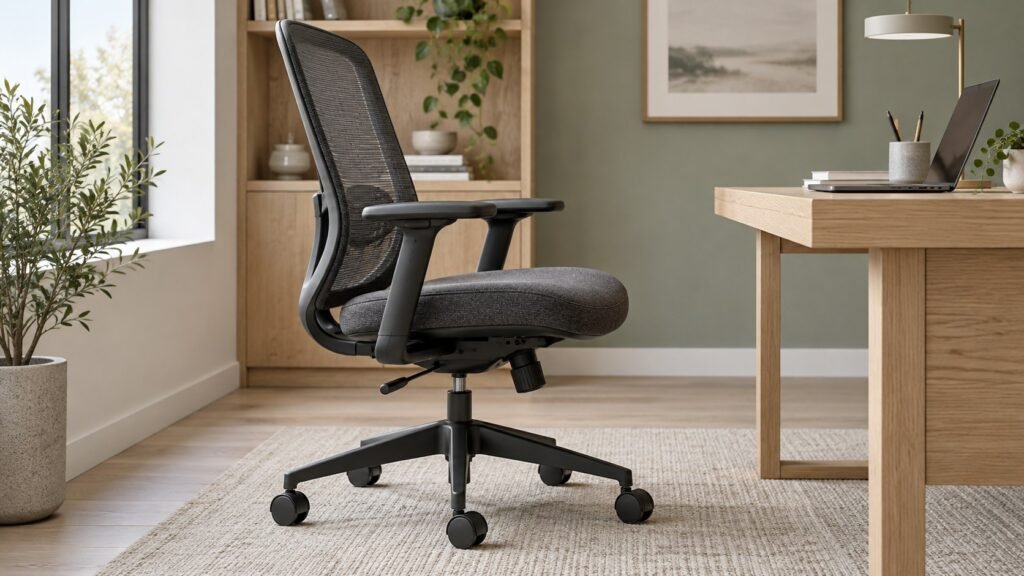
Cover image source: AI-generated editorial illustration. The unbranded chair and studio are conceptual.
Executive summary
An office chair mechanism determines important parts of the chair’s movement and adjustment. Terms such as synchro, self weight, and tilt describe different aspects of that behavior, but they do not provide a complete specification. Buyers should ask which components move, how movement is coordinated, how resistance changes, and what locking or limiting functions are available on the proposed configuration.
A synchro description usually concerns coordinated seat and back movement. A self weight description usually concerns the way resistance responds to the occupant. Tilt is a broader movement description whose meaning needs clarification. These are working descriptions for procurement, not universal definitions of every manufacturer’s design. A product may combine more than one of the concepts.
This paper provides an original evaluation framework for brands, importers, and workplace buyers. It uses configuration specific public examples and hypothetical scenarios. It does not reproduce a mechanism supplier’s engineering specification or claim that a movement system produces a medical benefit. The objective is to connect actual behavior with the task, user instruction, relevant evidence, manufacturing control, and service obligations.
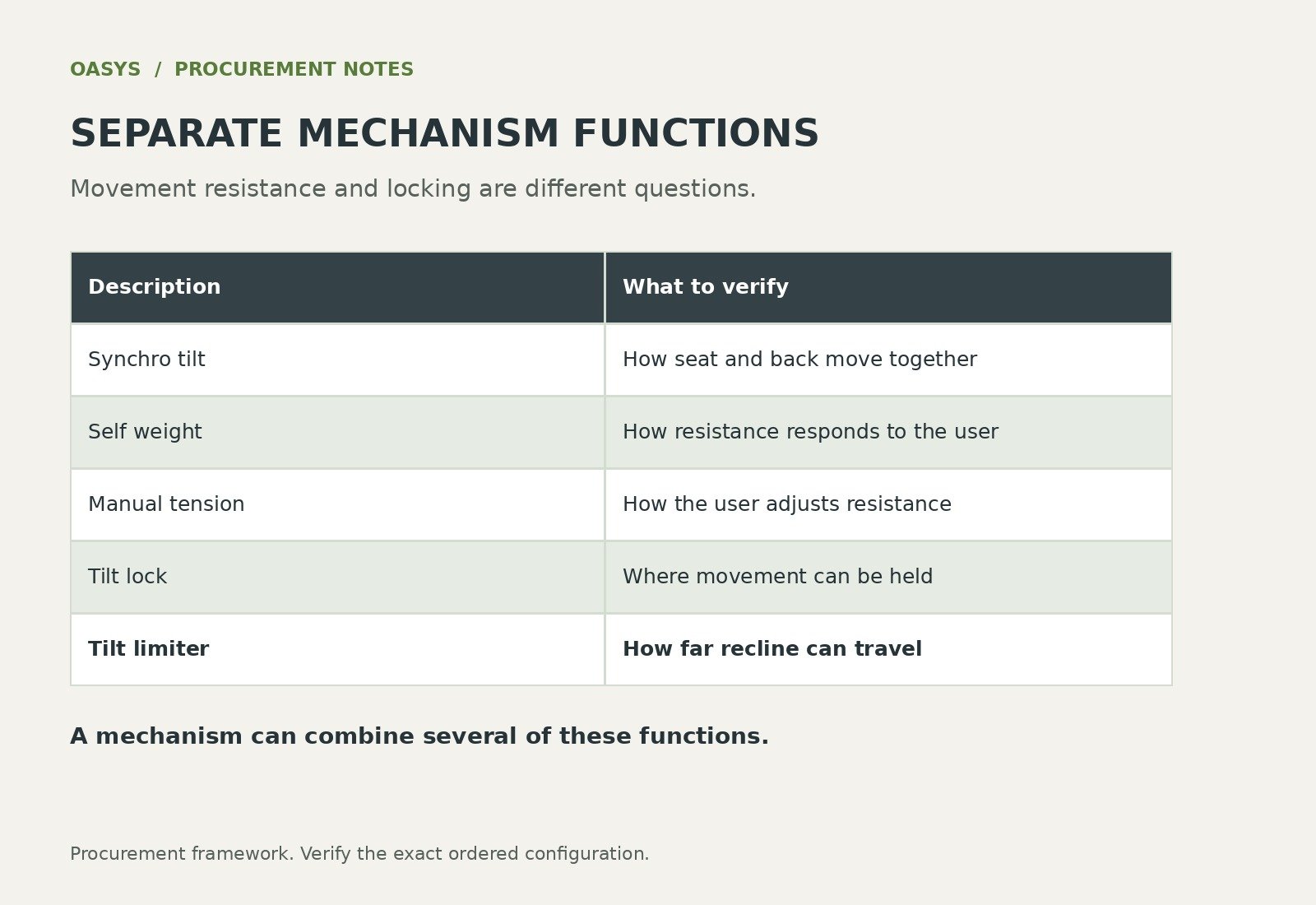
Office chair mechanism comparison at a glance
| Description | What it describes | What the buyer must verify |
|---|---|---|
| Synchro tilt | Coordinated seat and back movement | Actual movement reference frame and ratio |
| Self weight | Resistance response to the occupant | Usable range extra adjustments and instructions |
| Manual tension | User changes movement resistance | Control effort setup sequence and trial |
| Tilt lock | Holding at specified positions | Positions release method and approved use |
| Tilt limiter | Restricting recline travel | Limit settings and whether it also locks |
Compare movement resistance and locking
- What moves: seat back or the complete assembly?
- What is the movement reference frame?
- How does resistance change and who adjusts it?
- Does the control lock a position limit travel or do both?
Start the comparison with a movement diagram or demonstration. Identify the seat, back, and mechanism interfaces. Ask how the angles and positions change through the usable travel. A broad statement that the chair reclines does not establish whether the seat moves with the back or how the user’s relationship with the desk changes.
Request the supplier’s technical description for the exact assembly. If a ratio is stated, ask what it measures and whether it remains constant through movement. Do not apply a presumed universal synchro ratio to every chair. Different mechanism designs and chair geometries may require different descriptions. The purchasing record should preserve the supplier’s actual definition.
Observe the complete chair instead of the mechanism alone. Seat contour, backrest mounting, arms, and lift configuration can affect the experience. A mechanism brochure is useful context, but the buyer orders an assembled configuration. Confirm that the sample, quoted assembly, and instructions refer to the same version.
Distinguish coordination from resistance
Movement coordination and resistance adjustment answer different questions. Coordination describes how parts move relative to one another. Resistance describes the effort or support experienced during movement and how it is changed. A chair can have coordinated seat and back movement while using manual tension adjustment or another resistance arrangement.
Build a comparison schedule with separate fields for movement, resistance, locks, limits, seat adjustment, and controls. This avoids treating a single marketing term as a complete description. It also helps the supplier identify an alternative assembly that meets the required behavior, even when its product terminology differs from another manufacturer’s label.
Examine manual tension adjustment
For a manually adjusted mechanism, ask how resistance is changed and what the user must do to reach a suitable setting. Review control location, direction, operating effort, and instructions. A knob may offer adjustment, but its usefulness depends on whether users understand the action and can operate it in the intended environment.
During a trial, ask users to establish a setting after instruction. Record how long the process takes, whether assistance is needed, and what the user reports during movement. These observations address usability. They do not establish structural durability, a universal suitable setting, or a health outcome. Keep the conclusion within the limits of the evaluation.
Consider the use pattern. An individually assigned chair may retain a setting for one user, while a shared chair may require repeated adjustment. Compare the operational burden with the organization’s setup support. A manual system can be suitable when its operation fits the program; the label alone does not establish a disadvantage.
Examine the self weight claim precisely
Ask what the supplier means by self weight. Request an explanation of the mechanism’s intended response and whether additional adjustment is available or required. Identify any operating conditions or stated user range provided by the manufacturer. Do not infer that automatic response guarantees a suitable experience for every occupant.
Test the explanation with representative users and tasks. Record initial movement, perceived resistance, return behavior, and any settings changed. If users experience different results, ask the supplier whether the observation is expected and whether another configuration is appropriate. The trial should reveal usable behavior without claiming to validate the mechanism’s internal engineering independently.
Keep weight response separate from load rating. A mechanism described as adapting to an occupant’s weight is not thereby proven structurally suitable for an unlimited range. Product performance evidence and the manufacturer’s intended use conditions need their own review. Combining the two claims can produce misleading purchasing and marketing language.
Understand tilt locks and limiters
Ask whether the mechanism locks at fixed positions, limits travel, or uses another arrangement. A tilt limiter may restrict recline without holding the chair at a selected angle. A lock may behave differently depending on the design. Demonstrate the actual function and preserve the supplier’s terminology in the operating instructions.
Record available positions and the release sequence. Some actions may require a change in occupant pressure before release. The user guide should explain the correct method for the supplied mechanism. A trial should identify confusion or unintended operation, especially when several controls are close together. Do not improvise a release method based on another chair.
Define what the application needs. A purchasing brief might require a particular upright working behavior or several usable positions. State the observable requirement and ask the supplier to propose an assembly. The number of lock positions is relevant only when those positions serve the task and can be understood by users.
Evaluate return movement and workstation fit
The transition back toward the working position deserves explicit evaluation. Observe how the chair responds when the user changes posture under the manufacturer’s instructions. Record whether the movement is understandable and controlled for the trial participants. If an unexpected condition occurs, stop that evaluation and request technical review rather than normalizing it through repeated experimentation.
Ask the supplier to explain any feature affecting return or lock release. The terminology may differ across assemblies, so the explanation should describe the behavior rather than rely on a feature name. The buyer needs enough information to prepare accurate instructions and evaluate whether the mechanism fits the intended users and environment.
Distinguish user observation from performance testing. A controlled short trial can identify operating questions, but it cannot establish how the mechanism behaves after extensive cycling. Relevant laboratory evidence and production controls support different conclusions. The selection record should state the evidence basis for each claim.
Check the working position at the desk
Mechanism selection should include desk compatibility. Observe how the seat and back relate to the working surface in the intended task position. Check equipment reach, armrest interference, and clearance. A mechanism that feels favorable away from the desk may create a different relationship when the user needs to operate a keyboard or handle documents.
Record the workstation and settings used. If the evaluation requires a particular lock state or tension adjustment, note that condition. The installation guidance should explain the relevant setup without implying that one state is appropriate for everyone. Individual needs should be addressed through the organization’s assessment process where necessary.
Review movement with the chair’s other adjustments. Seat depth and arm position may interact with recline. The purchasing team should assess the complete configuration rather than approving each feature independently and assuming the combined result will work. This is especially important where several mechanism options share a similar exterior appearance.
Consider shared use and rapid setup
Shared seating requires users to establish a workable configuration repeatedly. Ask whether the mechanism reduces or increases the setup work for the intended application. Evaluate the control sequence, available guidance, and the ability to identify the current state. An automatic resistance feature may be useful, but other settings can still require attention.
Use a changeover trial. One participant uses the chair, then another participant sets it up for a different task. Record the adjustments made and the questions asked. This reveals whether controls support the organization’s real use pattern. The trial is an original operational recommendation and should be adapted to the setting.
Consider how new users receive instruction. A shared room may need a visible guide, while an assigned workstation may support individual setup. The mechanism should be selected together with that support plan. A feature is commercially valuable when people can use it under the conditions the buyer can actually maintain.
Check controls adjustments and interfaces
Controls should be evaluated for location, labeling, differentiation, and operation. Ask the supplier for the current user guide and compare it with the sample. A guide showing a different lever arrangement can create confusion even if both assemblies perform similar functions. Documentation must match the version supplied.
Observe first time use separately from use after instruction. The first reveals discoverability; the second reveals whether the explanation works. Record persistent errors and the recovery process. A control that requires guidance is not automatically unsuitable, but the buyer should understand the instruction burden before selecting it for a dispersed or shared program.
Keep product content concrete. Explain how users adjust movement and what the controls do. Avoid claims that intuitive operation eliminates the need for setup support unless relevant evidence establishes that result. Clear descriptions help customers compare mechanisms and help service teams diagnose whether a reported problem concerns operation or a fault.
Check seat height and depth functions
A mechanism assembly may incorporate controls beyond recline. Identify seat height operation, seat sliding, and any seat angle adjustment. Record whether these functions are integral to the proposed assembly or separate options. A mechanism family name does not necessarily define every function available in the quoted version.
Ask how one adjustment affects another. The seat slider may change the user’s relationship with the back, while seat angle may alter the task position. Evaluate the relevant combinations using the supplier’s instructions. Procurement should know which settings were approved during the trial and which remain outside the evaluated scope.
Specify functions through an orderable configuration code. If the supplier proposes another assembly, require a clear difference schedule. A substitute that fits the mounting points may omit a control or change the movement. The buying record should preserve functional equivalence as an assessed decision rather than an assumption based on appearance.
Review the mechanism's interfaces
- Mounting geometry and fastening specification
- Seat and back interfaces in the complete chair
- Assembly and service clearance
- Approved part number revision and instructions
For OEM and ODM projects, mechanism selection should be integrated with engineering review. Ask for mounting geometry, applicable component information, and the interfaces with the seat and back structures. The manufacturer’s qualified team should determine what information is necessary to assess compatibility. The buyer should not assume that a visually similar assembly is interchangeable.
Review assembly access and service access. A mechanism may require a particular fastening sequence or clearance. Ask how the production team controls the relevant interfaces and how service staff will identify the installed version. These questions connect the component choice with repeatable manufacture and practical support.
Record approved changes. If the seat structure or back mounting is revised after mechanism selection, determine whether the change affects movement, assembly, or evidence. Update the controlled package and sample record. A mechanism should remain connected to the complete chair definition throughout development and subsequent supply.
Verify evidence manufacturing and service
Request product specific reports relevant to the proposed construction. Identify the test standard and edition, issuing laboratory, sample configuration, and results. Ask how optional mechanisms are represented in the evidence schedule. A qualified reviewer should resolve differences between the tested sample and ordered version before the buyer makes a performance claim.
BIFMA’s public standards overview provides scope information for furniture test standards (BIFMA, n.d.). It does not establish that a particular mechanism or chair option has passed. Use that overview to inform the evidence discussion, then obtain the actual applicable records. This paper does not reproduce full test procedures or determine applicability for a novel construction.
Keep component information distinct from complete chair evidence. A mechanism supplier’s data can be useful, but the assembled chair introduces interfaces and geometry. The buyer should understand what each document covers. A broad certification statement should not replace a traceable link between the evidence and the configuration being ordered.
Establish manufacturing and inspection controls
Ask how the mechanism is identified and checked during assembly. The production record should distinguish assemblies with different functions or revisions. Work instructions should show the appropriate mounting and control arrangement. A look alike component can create an error if identification relies only on a model family name.
Agree on relevant functional checks for the completed chair. The manufacturer’s technical team should determine suitable methods and acceptance criteria for the project. Procurement should ensure that required functions are represented and that the inspection reference matches the approved configuration. Do not invent a universal cycle count for a routine assembly check.
Define how a functional nonconformity is handled. Record affected units, proposed correction, verification, and release authority. A repair or adjustment should be performed under an approved method. If the observation indicates a broader issue, the team should investigate its scope rather than treating every occurrence as an isolated user setup problem.
Plan service and replacement
- Part identifier and compatible replacement
- Manufacturer-approved service procedure
- Parts availability and discontinuation notice
- Instructions updated when an approved replacement changes the controls
Ask for mechanism identifiers, compatible replacements, and current service instructions. Determine who is qualified to perform replacement and which operations are outside routine user maintenance. A general educational article should not provide an improvised disassembly procedure for a load bearing assembly. The buyer needs a practical route to appropriate support.
Review parts availability and discontinuation arrangements. A long term chair program may need replacement assemblies after the original version changes. Ask how the manufacturer will communicate compatibility and what records it will retain. The buyer should be able to identify the installed configuration through order or product information.
Update the service record after replacement. A new assembly may alter controls or movement even when it mounts successfully. Verify the approved alternative and revise instructions where needed. This prevents the chair program from accumulating unreviewed combinations that purchasing and support teams cannot explain.
Compare complete program cost
Mechanism price should be assessed alongside functions, implementation, evidence, and service. Ask which features the quoted assembly includes and whether other components change with the option. A lower component price may not represent a lower program cost if it requires additional instruction, a different seat structure, or more service stock.
Use explicit assumptions for a total cost comparison. Include development work, testing needs, purchasing quantities, and replacement arrangements where relevant. Do not claim that one mechanism type universally saves money or lasts longer. The model should show which project conditions drive the result and which uncertainties remain.
Document why additional functions are selected. If a feature serves a clear task or user requirement, its cost can be evaluated against that purpose. If its value is unclear, test it or remove it from the mandatory brief. This approach preserves useful capability without turning a purchasing decision into a competition for the longest feature list.
Use hypothetical scenarios to compare behavior
Consider a hypothetical shared meeting area. Users need quick setup and a straightforward movement experience. The buyer compares a manual resistance configuration with a self weight configuration using the same tasks and instructions. The result should show operating differences and support needs, not a universal verdict about the two technologies.
Now consider an individually assigned workstation with detailed setup support. The manual configuration may allow a user to retain a preferred setting, while the alternative may reduce one adjustment step. Evaluate the complete chair and the user’s task requirements. A mechanism that suits one scenario can remain unsuitable for another application.
Finally, consider a branded chair offered with two mechanism options. The sales page should explain the actual differences and identify the version shown. Service teams need codes and instructions for both. The hypothetical example highlights an assortment obligation: offering more choice requires accurate configuration communication through quotation, delivery, and aftersales support.
Prepare an answer oriented mechanism page
Useful content should answer what moves, how resistance is set, what locks or limits do, and how the mechanism is operated. Use diagrams or demonstrations tied to the current product. Avoid presenting a general movement description as proof of an outcome for every user. The page should help a buyer identify the next information needed for selection.
Separate educational explanations from model specifications. A general article can define evaluation questions, while the product page provides verified ranges, controls, and configuration codes. Link to current instructions and the route for requesting evidence. If a detail is not publicly confirmed, ask the reader to request it rather than supplying an estimate.
Review wording when options change. A familiar mechanism term can remain on the page while the supplied assembly changes. The editorial process should therefore connect product claims with the controlled configuration record. This protects the usefulness of the content and improves the consistency of customer support.
Keep the supplied version identifiable
The mechanism should remain identifiable throughout the selling process. If a photograph or demonstration shows one option, label it and explain any difference in the base offer.
Confirm that order codes, carton information, user guides, and service records all refer to the same assembly. This is particularly useful when two versions share the same chair shell.
Customers may recognize the chair’s appearance while expecting the controls shown in a video. A configuration specific description gives the distributor a reliable basis for answering that question and prevents a generic mechanism label from obscuring the actual product supplied.
Use the trial to prioritize information gaps
A mechanism trial can reveal where another explanation is needed. If users cannot identify a lock state, request clearer instructions or labeling.
If movement differs from the supplier’s description, obtain technical clarification for the exact assembly. If the chair works away from the desk but creates interference at the workstation, review the complete system.
These findings lead to different actions and should not be combined into one negative score. Record the gap, responsible owner, and closure method.
The trial then becomes a useful decision process rather than a collection of preferences disconnected from engineering and implementation.
Choose through behavior and support
Synchro, self weight, and tilt terminology helps begin a discussion. The final decision should rest on verified movement, resistance, controls, workstation compatibility, evidence, and service. A strong specification describes the behavior required for the application and identifies the assembly that provides it.
For an OASYS inquiry, explain assigned or shared use, workstation conditions, and the functions being considered. Request the current mechanism option schedule, instructions, and relevant configuration specific evidence. Use a structured trial to assess usability and task compatibility. Keep the trial’s conclusions separate from claims supported by laboratory reports.
Preserve the approved version for production and repeat orders. Review changes through the same requirements that justified selection. A mechanism becomes a useful commercial feature when the buyer can specify it accurately, explain its operation, verify relevant claims, and support the installed chair over time.
Describe mechanism behavior with measurable observations
A mechanism comparison should describe which bodies move, their reference points and the control state. Synchronized movement, resistance adjustment, tilt limiting and position locking answer different questions. A marketing name does not establish an angle relationship or usable resistance range. Film or observe the sample under defined conditions, then connect the record to the mechanism part number and chair configuration.
Suppose a hypothetical sample evaluation records a 16 degree change in back angle and an 8 degree change in seat angle over a selected part of the movement. The observed ratio for that interval is two to one.
It should not be applied to the entire motion, another reference frame or every mechanism called synchro tilt. Compare upright work, recline and return separately.
Ask whether a lock holds a position or whether a limiter only defines a movement boundary.
When evaluating a price premium, identify the function it adds and the interface consequences. A more complex mechanism may require another seat mounting arrangement, control access, instruction set or packing method.
Include these costs in the quote comparison. A simpler mechanism may be appropriate when it meets the recorded task; a mechanism with more settings should justify them through usable behavior and the service obligations of the program.
| Mechanism question | Evidence to request |
|---|---|
| Motion | Seat and back reference angle record |
| Resistance | Manual or weight responsive behavior |
| Control | Lock limiter and return instructions |
| Interface | Mounting drawing and fastener specification |
| Commercial scope | Mechanism option assembly and service price |
For the next procurement step, use the task chair specification guide and office chair RFQ checklist to connect these requirements with supplier selection and quotation review.
Discuss your office chair project with OASYS
Share your target market, application, proposed configuration, quantity and launch requirements with OASYS. A useful inquiry identifies which requirements are approved and which need engineering or commercial input.
Explore furniture resources · Explore workplace applications · Contact OASYS
References
BIFMA (n.d.). BIFMA standards overview. Retrieved October 11, 2026, from https://www.bifma.org/page/standardsoverview