
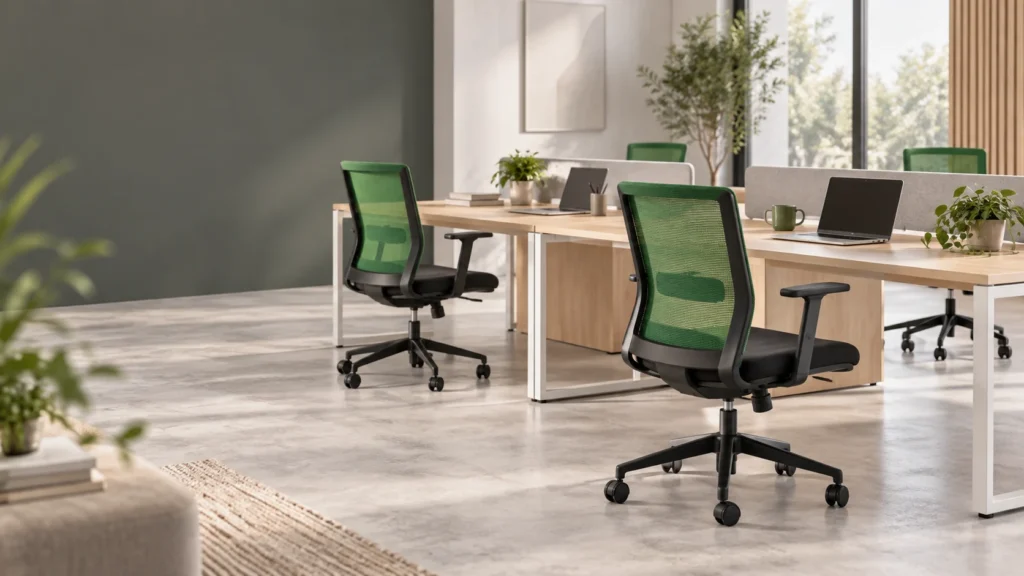
A chair specification should begin with the people, work and space it needs to support. Comparing a feature list is useful, but the important question is how those features work together in the configuration you will purchase.
Start with the Work, Not Just the Chair
Define whether the chair will support individual desk work, shared workstations, meeting rooms or occasional visitors. The length and type of use, the desk height and the available space help establish which adjustments and support features need attention.
For a shared workstation, straightforward adjustment and a usable height range may matter more than an option rarely used. For an individual work setting, seat depth, back support, arm clearance and recline behaviour deserve a closer comparison.
Compare Support and Adjustment Together
- Seat fit: review height adjustment and the seat dimensions. A slider, where offered, provides a different fitting option from a fixed-depth seat.
- Back support: compare the back shape, material and available lumbar support. A breathable mesh back and an upholstered back offer different material experiences.
- Arms: identify the adjustments required and check whether the selected arms clear the desk or table. An arm option shown in a photograph may not be included in every configuration.
- Recline: understand how the mechanism responds, which locking positions are available and whether tension needs adjustment. Confirm the mechanism for the actual model.
Use the Series to Narrow the Choice
Aria combines a mesh back and upholstered seat with adjustable support and a synchro mechanism. SIM provides weight-responsive recline within a seating family whose task and guest versions serve different uses. These examples help frame a comparison; their specifications should not be treated as interchangeable.
Use the product sheets in Resources to identify dimensions and options, then ask for confirmation of the selected mechanism, base, arms and finishes.
Evaluate the Complete Configuration
When assessing a sample, check how the chair fits the intended workstation, how adjustments are reached and how the material feels under the expected use. Include the selected base and castors or glides, especially when the floor surface or movement requirements affect the decision.
For a volume purchase, record the model and options you evaluated. Align that record with the quotation, approved finishes and any testing documentation needed for the destination market. A product-family name alone is not a complete purchasing specification.
A Practical Enquiry Checklist
Provide the intended application, series of interest, quantity, destination and required timing. Add desk or table constraints, the adjustments you need, material preferences and any evaluation requirements. This gives the discussion a technical starting point and reduces assumptions.
Explore space applications for room-specific considerations, or send a task chair enquiry with your project details.
Common Questions
Does a longer feature list make a chair more suitable?
Suitability depends on the user, task and selected configuration. Prioritise adjustments and support that address the brief, then evaluate how they work together. Additional options should solve a defined need rather than substitute for a fit assessment.
Can we use one specification across every workstation?
Begin by comparing user needs and workstation dimensions. A consistent series can simplify a project, but different settings may require different arms, support features or bases. Confirm the specification and evaluation requirements for each planned configuration.