

Cover image source: AI-generated editorial illustration. The chair, studio and material samples are conceptual and do not identify a tested product.
Start with the chair the report actually covers
To verify a BIFMA office chair test report, connect the claim to the standard, issuing laboratory, tested configuration, recorded results and current order. A genuine report can still leave a coverage question when the supplied chair uses another mechanism, base or arm assembly.
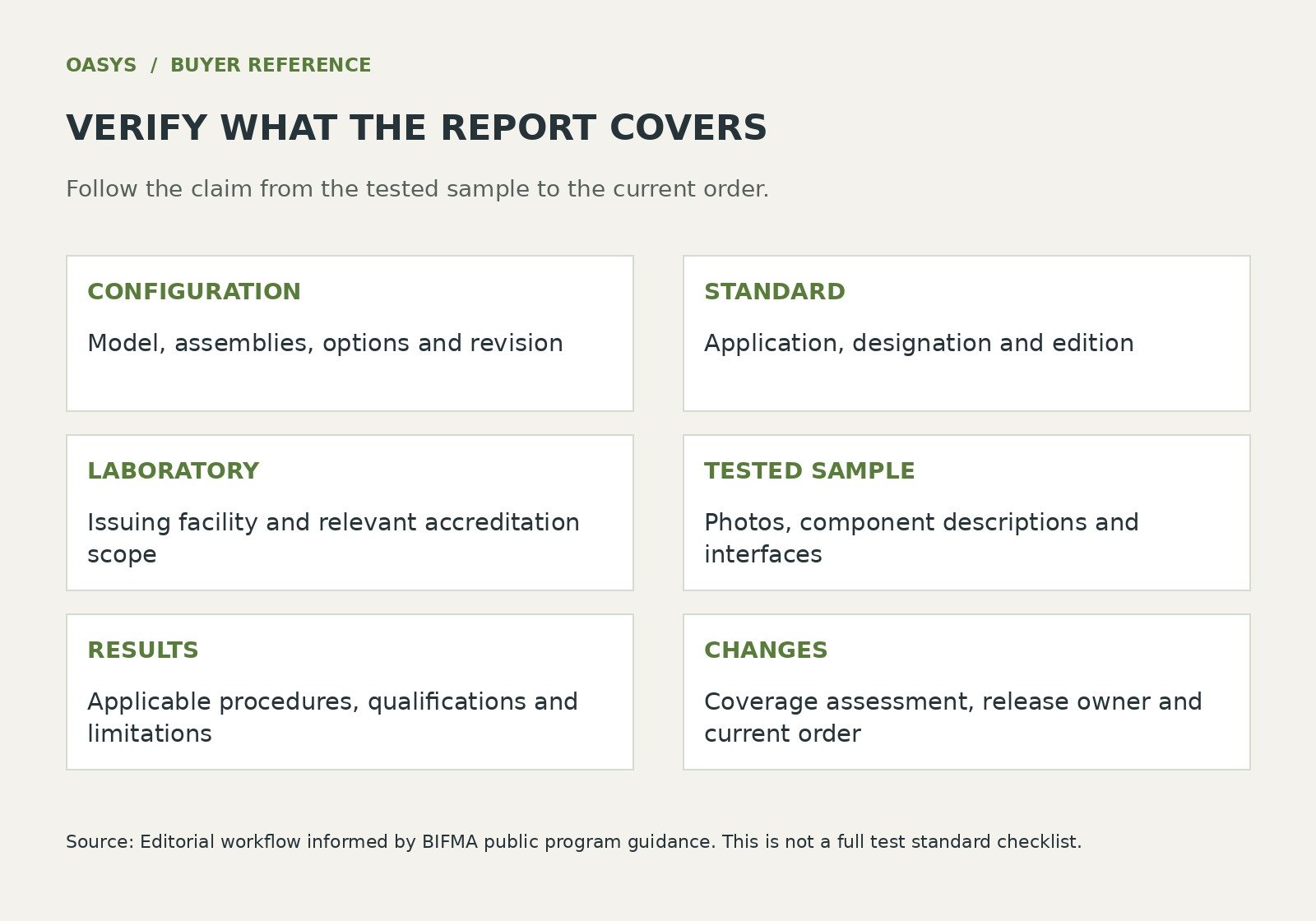
| Record | Verify | Leave open until resolved |
|---|---|---|
| Claim | Tested, conforming or registry-listed wording | Unspecified broad certification language |
| Configuration | Model, assemblies, options and revision | Differences from report photographs |
| Standard | Designation, edition and applicability | Missing or conflicting scope |
| Laboratory | Issuing facility and relevant credentials | Accreditation scope uncertainty |
| Results | Applicable procedures and stated limitations | Partial testing or omitted sections |
| Changes | Coverage assessment and accepted revision | Unreviewed substitutions |
Define the claim and chair configuration
- Record the exact wording of the claim.
- Identify the ordered model, assemblies and options.
- Assign a technical reviewer and an acceptance owner.
Ask the supplier to state the claim precisely. A chair may be described as tested to a standard, conforming to a standard, or listed in a verification program. Those statements need different supporting records. Record the wording before collecting documents so the review has a defined purpose.
BIFMA describes Compliant as a verification program involving applicable testing in an appropriately accredited laboratory (BIFMA, n.d.-a). That is a specific program description. It should not be reduced to the broad phrase BIFMA certified or extended automatically to every product made by a participating company.
Create a claim register for the proposed chair. Identify each structural, material, environmental, or other statement separately. The buyer can then connect each claim with its supporting record and reviewer. This prevents one valid document from being used to imply several unrelated conclusions.
Identify the ordered chair completely
Prepare a configuration record before reviewing the report. Include model, version, seat, back, mechanism, lift, base, casters or glides, arms, headrest, and relevant materials. Use component codes and revision information where available. The record should describe the chair the buyer intends to receive.
Compare the configuration with the quotation and sample. A trial chair may include options absent from the base offer. A catalog photograph may show another mechanism or arm assembly. Resolve those differences before deciding whether a report is relevant. The evidence review should follow the actual order rather than the most favorable image.
Record intended use and destination. Qualified personnel need this context to assess the selected standard and other requirements. Do not assume that a familiar standard covers every novel chair construction or every market obligation. The procurement team should identify who is responsible for determining applicability.
Confirm standard scope and report identity
Request the full standard designation and edition stated in the report. Compare it with the purchasing requirement. BIFMA’s public standards overview identifies different furniture applications and test standards (BIFMA, n.d.-b). Use that information as context, then have the technical reviewer confirm the appropriate scope for the product.
Do not erase the edition when summarizing a result. A report to an earlier edition should be reviewed against the buyer’s requirement and any relevant transition or interpretation guidance. This paper does not declare every earlier report acceptable or obsolete. The decision needs a documented technical and contractual basis.
If the specification is unclear, resolve it before order approval. A request for BIFMA compliance without a standard or application can produce ambiguous proposals. Ask the supplier and reviewer to identify the intended requirement and the evidence needed. Record the agreed wording so future reorders use the same basis.
Request a complete usable record
Ask for the complete relevant report, including identification, methods, results, photographs or descriptions, qualifications, and attachments that define scope. If commercial confidentiality limits disclosure, discuss an appropriate verification route that still answers the buyer’s requirements. A cropped pass page often omits the information needed to connect the result with the chair.
Check document continuity. Review page numbers, report identifiers, dates, issuing organization, and referenced appendices. Identify whether the file is a full report, summary, declaration, or certificate. The buyer should not label all these records as test reports because their evidentiary roles differ.
Keep the received version unchanged in the purchasing file. Record the source, receipt date, and any later replacement or clarification. If the supplier provides a revised report, preserve the reason and supersession relationship. This supports traceability without implying that ordinary document review is a forensic authentication exercise.
Verify laboratory sample and results
- Verify the issuing facility and relevant accreditation scope.
- Match photographs and component descriptions to the ordered chair.
- Review omitted procedures, limitations and qualifications.
Identify the laboratory and the facility that performed the work. Ask for accreditation information where required by the purchasing or program conditions. Review the relevant scope and dates with appropriate expertise. A laboratory name alone does not establish that the particular test work falls within the claimed accreditation.
BIFMA’s laboratory database advises users to check credentials, scope, and qualifications (BIFMA, n.d.-d). Its presence in a directory is a starting point, not a substitute for that review. Where uncertainty remains, use an independently obtained official contact route to ask the laboratory or accreditation body for confirmation.
Record the verification result and limitations. If the reviewer confirms the scope, retain the basis. If a credential is unclear, identify the action required before acceptance. Avoid making unsupported allegations about a laboratory or supplier based on a missing document; resolve the factual question through the relevant issuing organization.
Match the report to the tested sample
Review model names, photographs, drawings, component descriptions, and sample identifiers. Determine whether the report describes the same construction as the proposed chair. A similar silhouette does not establish equivalence. Differences in mechanism, base, arms, or interfaces can require technical assessment even when the retail name is unchanged.
Prepare a comparison record listing tested and ordered versions side by side. Identify matching details, differences, and information not disclosed. Ask the supplier to explain each consequential difference. Qualified personnel should decide whether the existing evidence applies or whether another review or test is necessary.
Keep the conclusion narrow. If the evidence supports one configuration, record that configuration. Do not extend it automatically to every option in the model family. The supplier may have a legitimate coverage strategy, but the buyer needs a reviewable explanation rather than an assumption based on shared branding.
Review the actual results and scope
The technical reviewer should examine which procedures were performed, the stated results, and any qualifications. A report summary saying pass may not establish that every applicable requirement was addressed. Identify omitted, not applicable, modified, or separately reported items and obtain an explanation of their relevance.
For BIFMA Compliant, the public program description refers to all applicable tests and relevant standards within laboratory scope (BIFMA, n.d.-a). Use that requirement when reviewing a claim about that program. This paper does not provide a substitute checklist for the full standard or determine applicability of individual clauses.
Record the reviewer’s decision for unresolved items. If an interpretation is needed, consult the appropriate official route or qualified laboratory. Do not reconstruct a full test procedure from a marketing brochure. The purchasing decision should rely on actual evidence and competent interpretation.
Distinguish partial testing from complete conformance
A report may cover one component or selected procedures. Such evidence can be useful for development or a defined claim, but it should not be presented as proof of complete chair conformance without an appropriate basis. Ask the supplier to state exactly what the record supports.
Separate component and assembly evidence in the file. A mechanism or caster report does not identify every interface in the final chair. The technical reviewer should determine how component data contribute to the complete evidence strategy. Procurement should retain that reasoning and avoid combining several unrelated pass statements into an unsupported overall claim.
If additional testing is required, define the plan and release condition. Identify the representative sample, standard, laboratory, and decision owner. The buyer should know what remains to be completed before production or public claims are approved. A preliminary quotation can acknowledge that work without pretending it is already closed.
Review options registry claims and changes
Ask how optional arms, bases, upholstery, or mechanisms are covered. The supplier may use several reports or a documented assessment strategy. Request enough information to connect the ordered option with relevant evidence. The technical reviewer should assess the approach and identify any gaps.
Avoid an unqualified worst case assumption. A configuration that is demanding for one procedure may not represent every other procedure. This article does not identify a universal worst case chair. Qualified personnel should determine the relevant selection and document the basis, using applicable standards and interpretations.
Maintain the coverage record when the assortment changes. Adding an option can create a new evidence question even if it requires little commercial development. The buyer should trigger review before the new version is offered or ordered. This keeps the product range connected to the evidence supporting its claims.
Verify registry claims separately
If the supplier claims BIFMA Compliant listing, request the current product entry and verify the relevant brand and product. Compare the listing with the proposed configuration and ask about any uncertainty. The buyer should distinguish a company participation statement from a product specific registry claim.
BIFMA’s participant resources limit product mark use to the relevant listed products and distinguish it from participant communication (BIFMA, n.d.-c). Use that distinction when preparing marketing content. Do not imply that a participant mark establishes compliance of the manufacturer’s entire range.
Record the entry reviewed and the date. A registry is a useful verification resource, but the buyer should still preserve the configuration and claim basis in its purchasing file. Where a product is not listed, evaluate the actual evidence route required by the specification rather than assume that absence alone proves failure.
Treat report age and product change separately
A report date is important, but product history also matters. Ask whether the chair has changed since the test and what records support the current construction. A recent report for another version may be less relevant than an older report for an unchanged configuration, subject to applicable requirements and competent review.
Identify product changes and assess their effect on previous evidence. For a program-specific claim, request the current rules and the supplier’s documented change assessment. Qualified reviewers should decide what further evaluation is required; appearance alone does not establish equivalent coverage.
Maintain a change log linked to the evidence schedule. Record the affected component, reason, review decision, implementation boundary, and updated documents. This gives future buyers and service teams a way to understand which evidence applies to each version. A model name should not be the only link between product and report.
Keep evidence types and acceptance decisions separate
A quality management system certificate concerns a defined organizational system and scope. It does not replace the chair’s product test evidence. ISO explains that certification is performed by external bodies rather than ISO itself (International Organization for Standardization, n.d.). The purchasing file should identify the certificate and issuing body separately from product reports.
Likewise, a material certificate addresses its stated material or property. Keep upholstery, foam, emissions, and structural evidence distinct. Each record should have a defined requirement and reviewer. This prevents a broad certification folder from creating the impression that every product claim has been verified.
Use a simple evidence matrix. List the claim, record, scope, product or organization identity, review status, and open action. The matrix reveals gaps more effectively than a collection of logos. It also provides a practical editorial reference when product pages or quotations need accurate wording.
Handle unavailable information transparently
If a supplier cannot disclose a full report immediately, ask why and what verification route is available. Confidentiality, ownership, or administrative issues may require a different process. The buyer should still obtain enough information to satisfy its requirements. Do not treat an unexplained summary as equivalent to a complete reviewed record.
Record the open issue and deadline linked to order approval. If the requirement is mandatory, it should remain a release condition. If the buyer considers another evidence route, have the responsible reviewer assess it. Commercial pressure should not silently remove an evidence requirement from the purchasing decision.
Avoid public accusations based on incomplete information. The appropriate action is to clarify scope, contact the relevant issuing organization where necessary, and document the result. The buyer can decline an unresolved proposal without claiming that the supplier’s evidence is fraudulent. Precision protects both the review and the working relationship.
Use a hypothetical report mismatch
Consider a hypothetical quotation for a chair with adjustable arms and a particular base. The supplied report photographs show fixed arms and another base. The buyer records those differences and asks the supplier for the relevant coverage explanation. A shared model name does not close the question.
The technical reviewer evaluates whether existing records support the ordered construction or whether additional evidence is required. The decision should identify its basis and limits. This example does not assert that every component difference invalidates a report; it illustrates why differences need competent review instead of automatic acceptance.
Once resolved, update the configuration and evidence schedule. If another version is selected, revise the quotation and instructions accordingly. If testing is planned, identify the approval condition. The purchasing record should show the chair ultimately ordered and the evidence that supports its claims.
| Hypothetical component | Tested version | Ordered version | Review action |
|---|---|---|---|
| Arms | Fixed arms | Adjustable arms | Identify relevant coverage or evaluation |
| Base | Base A | Base B | Check construction and supporting evidence |
| Mechanism | Mechanism revision 1 | Revision 2 | Review interfaces and change assessment |
Define acceptance authority
Assign responsibility for technical evidence review, commercial approval, and final release. The roles may be held by the same person in a small organization, but the decisions should remain distinguishable. A purchasing signature should not imply that an unqualified reviewer has resolved a technical interpretation.
Use a review record stating accepted, pending clarification, or not accepted, with reasons. Identify conditions and affected configurations. This makes the result understandable to people who did not participate in the original discussion. It also prevents a conditional decision from becoming an unqualified approval through later summary language.
Retain the record with the order. If the configuration changes, trigger the relevant review again. A clear authority structure helps the team handle late substitutions and prevents a supplier or sales contact from assuming that an informal conversation authorized a change to the evidence basis.
Maintain evidence through repeat orders
The register should identify product configurations, report versions, laboratory information, standards, registry claims, reviewer decisions, and changes. It should also show which records are superseded. A practical register allows purchasing and content teams to use current evidence without rereading every report for routine work.
Review the register when standards, products, or claims change. Qualified personnel should determine what action is required. This paper does not prescribe a universal calendar for retesting every chair. The review should follow applicable requirements, program conditions, and the actual product history.
Connect service replacements where they affect configuration. A replacement assembly can introduce an evidence question if it changes the approved construction. The service process should use approved compatible parts and retain relevant records. Evidence control continues after the first shipment because the installed product may change over time.
Complete a report review worksheet
- Product and quoted configuration
- Report identifier, version, date, standard and edition
- Tested sample and every unresolved difference
- Decision, release conditions, owner and closure date
A review worksheet can organize the evidence without pretending to replace technical judgment. Its first section identifies the claimed product and proposed configuration. Its second identifies the received document, issuing organization, report number, date, standard, and edition. Its third records the tested sample and differences. Its final section records the review decision, conditions, owner, and closure date.
Use separate fields for information present, information unclear, and information absent. This prevents an empty field from being interpreted as confirmation. For example, if the report photographs do not identify a mechanism, record that uncertainty and ask for clarification. Do not fill the gap by assuming the mechanism shown on the current product page was used in the test.
Link observations to the actual report location where practical. A page or appendix reference helps a later reviewer retrieve the relevant evidence. Preserve the original document and place the worksheet beside it. The worksheet summarizes the review; it should not become a substitute report that silently omits qualifications or changes wording.
After clarification, update the decision and retain the supporting response. If the laboratory issues another version, record which file controls. A clean worksheet makes the purchasing record easier to use while preserving the full evidence needed for consequential questions.
Translate evidence into claim wording
Before publication, compare the proposed sentence with the review decision. Ask what product it identifies, which result it states, and whether the wording implies broader coverage. A statement about a tested configuration should not silently become a statement about an entire range. A statement about one property should not imply unrelated environmental or ergonomic outcomes.
Use the exact scope that has been accepted by the responsible reviewer. If options are excluded, make the distinction visible where it affects the customer’s decision. If a claim depends on current registry status, establish a process for checking it when the page is reviewed. The editorial team should know where the supporting record is held and who resolves questions.
Review photographs and labels as well as text. An image of another configuration can create a broader impression than the accompanying sentence supports. Confirm that captions, downloadable sheets, quotations, and sales presentations are consistent. Evidence discipline should cover the complete customer communication rather than only one paragraph on the website.
This proposed editorial workflow connects technical review with practical content management. It does not authorize use of a program mark or determine compliance independently. Its purpose is to preserve the meaning of an approved claim as it moves from the purchasing file into public communication.
Verify the chain from claim to supply
A reliable review follows the chain from intended application to configuration, standard, laboratory, sample, results, and current supply. Each link should be identifiable and any uncertainty should have an accountable action. The objective is a defensible purchasing decision, not simply a folder containing impressive documents.
For an OASYS inquiry, request the proposed configuration and relevant reports together. Ask how options and changes are covered, which registry claims apply, and who can support technical clarification. Use qualified review to resolve applicability and preserve the decision with the order.
After approval, maintain the link through change control and repeat orders. The same evidence discipline should guide quotations, product pages, service, and future assortment development. A verified claim remains useful when the buyer can explain exactly which chair it describes and why the supporting record is relevant.
Build an option coverage map before pricing validation
Represent the chair configuration as a list of assemblies and permitted alternatives. Connect each test report to the actual tested mechanism, seat support, back structure, arms, base and castors where these are identified.
A report number should be a reference into that map rather than a label applied automatically to every version in the catalog. Have the responsible technical reviewer decide which changes require additional evaluation.
If a hypothetical project allocates USD 2,200 to a defined validation program across 500 chairs, the simple allocation is USD 4.40 per chair. Across 2,000 chairs it is USD 1.10.
This is not a laboratory price estimate and does not predict the scope of testing required. Use an actual laboratory proposal before approval and retain its exclusions.
A material or component change after that approval can alter the work needed even if the model name is unchanged.
Give each unresolved difference a disposition and owner. It may be accepted within documented coverage, evaluated through further technical review or tested under a revised program. The purchasing record should distinguish those outcomes. This avoids both unnecessary repeat work and unsupported product claims, and makes the cost of customization visible before a quotation becomes an order.
| Configuration field | Coverage decision |
|---|---|
| Mechanism and mounting | Match tested assembly or review change |
| Base and castors | Identify approved alternative scope |
| Seat and back structure | Confirm version and materials |
| Report edition | Verify purchasing requirement |
| Validation cost | Use actual defined laboratory scope |
Discuss your office chair project with OASYS
Share your target market, application, proposed configuration, quantity and launch requirements with OASYS. A useful inquiry identifies which requirements are approved and which need engineering or commercial input.
Review quality and testing · Explore furniture resources · Contact OASYS
Connect verification with supplier selection
Use the broader furniture test document guide, the manufacturer selection framework and the RFQ checklist to carry the evidence decision into the order.
References
BIFMA (n.d.-a). BIFMA Compliant. Retrieved October 11, 2026, from https://www.bifma.org/page/bifma-compliant
BIFMA (n.d.-b). BIFMA standards overview. Retrieved October 11, 2026, from https://www.bifma.org/page/standardsoverview
BIFMA (n.d.-c). Participant resources. Retrieved October 11, 2026, from https://www.bifma.org/page/participant-resources
BIFMA (n.d.-d). Test lab database. Retrieved October 11, 2026, from https://www.bifma.org/search/custom.asp?id=801
International Organization for Standardization (n.d.). Certification. Retrieved October 11, 2026, from https://www.iso.org/certification.html