
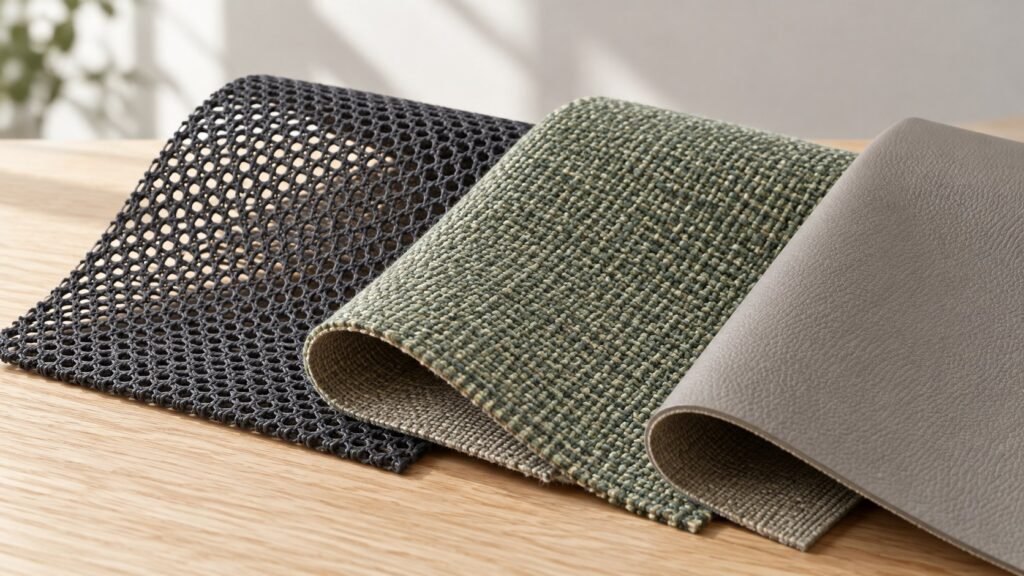
Cover image source: AI-generated editorial illustration. The chair, studio and material samples are conceptual and do not identify a tested product.
Mesh vs fabric vs PU at a glance
Compare upholstery by its construction, the chair assembly, relevant evidence and the care your operation can support. Mesh, woven fabric and polyurethane-coated upholstery are categories. None is a performance grade or a universal lifespan promise.
| Material | Inspect the complete construction | Ask for |
|---|---|---|
| Mesh | Frame, tension, attachment and edge support | Exact material code and assembly trial |
| Woven fabric | Cushion, contour, seams and direction | Technical sheet and approved cleaning |
| PU-coated fabric | Coating, substrate, edges and seam behavior | Adhesion, flex, hydrolysis and care evidence |
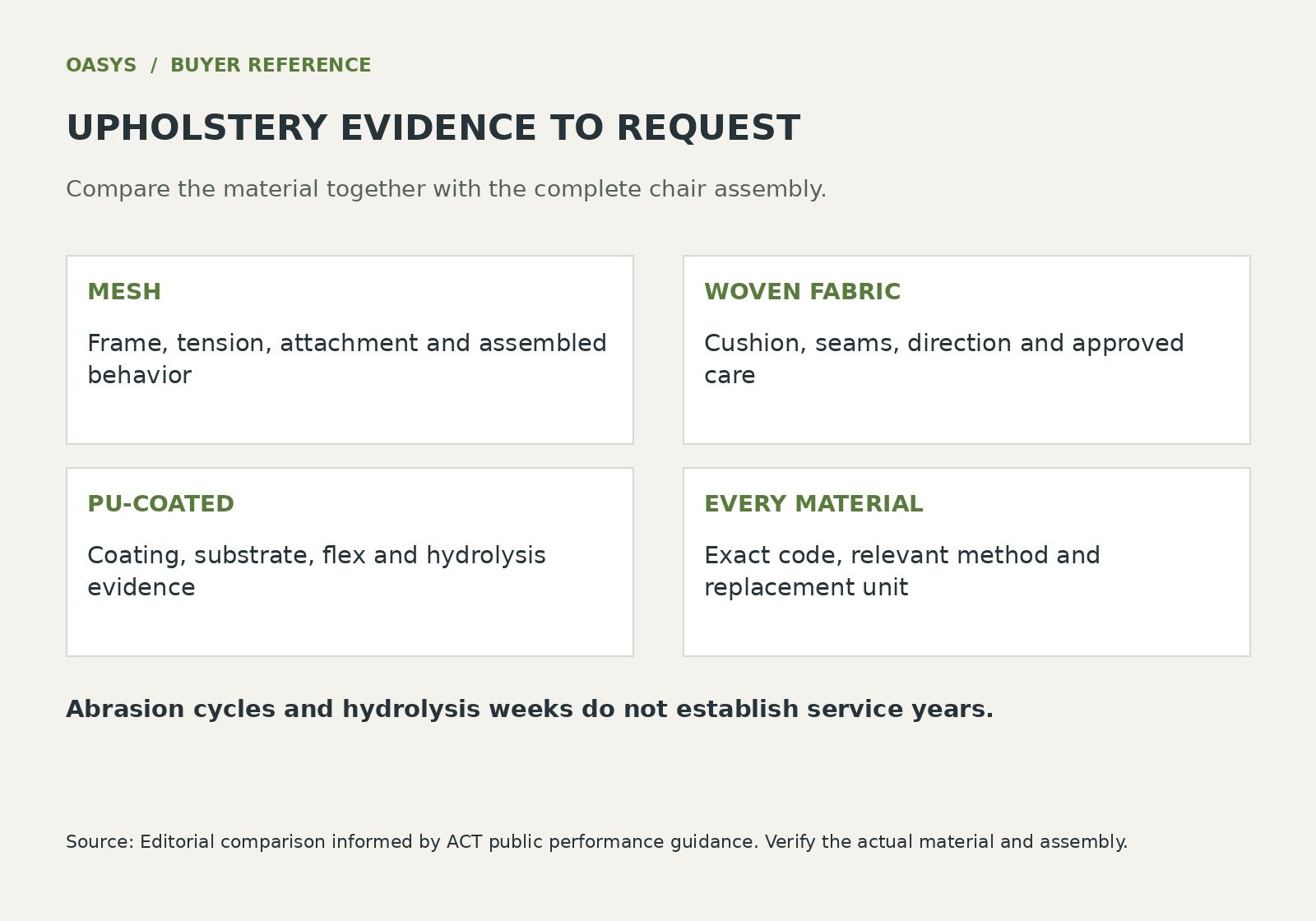
Compare the material and complete assembly
- Material code, supplier and exact construction
- Color, backing, substrate and finish
- Complete seat or back assembly used in the trial
- Relevant reports and manufacturer-approved care guide
Ask the supplier what the material is, how it is constructed, and what role it performs on the chair. A stretched suspension surface and a decorative cover over a cushion should not be treated as equivalent merely because both are called mesh. The relationship with the seat or back structure determines which questions need evaluation.
ACT distinguishes textile and coated fabric constructions in its performance guidance (Association for Contract Textiles, n.d.-b). Use that distinction to request relevant data rather than one generic upholstery report. Identify the material code, supplier, color, backing or substrate, and any finish that affects the proposed application. The record should distinguish the approved material from similar looking alternatives.
Request an assembled sample as well as a swatch when construction matters. A small sample can communicate color and texture, but it does not demonstrate tension, seams, contour, or attachment behavior. The buyer should state what each sample review is intended to approve and keep material approval separate from complete chair acceptance.
Evaluate mesh as part of its support system
For a mesh back or seat, ask how the surface is supported and attached. Identify the frame, edge treatment, and replacement arrangement. The procurement question is not simply whether mesh is breathable; it is whether the complete assembly provides the required behavior and can be maintained. Avoid making a universal comfort claim from the presence of visible openings.
Review the assembled surface under the intended use and through relevant chair movement. Observe appearance, perceived support, contact with surrounding structures, and any areas requiring explanation. Record the sample configuration and material identity. A favorable trial of one mesh should not be transferred automatically to another mesh or frame.
Ask how the manufacturer controls the approved construction. Relevant questions may concern material identification, attachment checks, and visual references. Qualified technical staff should determine appropriate inspection criteria. Procurement should ensure that the criteria describe the agreed product rather than rely on a general request for premium mesh quality.
Evaluate woven fabric through the upholstered assembly
For a woven cover, identify the exact textile and how it is applied to the cushion and structure. Review texture, pattern scale, direction, seams, and the effect of shaping. A fabric that looks attractive as a flat swatch may produce a different appearance around a curved seat or back. Approval should include the form in which customers will see it.
Ask how pattern direction and matching are controlled where relevant. A plain material may have less obvious directional requirements than a patterned one, but texture and light can still make orientation visible. Define the intended result with samples or annotated images. This creates a usable reference for the upholstery team and final inspector.
Evaluate the complete cushioning system during user trials. Fabric is only one contributor to the perceived seat. Foam, support structure, contour, and cover tension can change the result. The buyer should not attribute every comfort observation to the textile or assume that changing the cover will resolve an unidentified seat construction issue.
Evaluate coated upholstery through coating and substrate
Request the coating type, substrate construction, material code, and relevant technical data. Coated upholstery is a category containing different systems, so a general label such as synthetic leather provides limited purchasing information. The buyer needs enough detail to distinguish proposed materials and understand which evidence applies.
ACT’s coated fabric guidance includes adhesion, tear, breaking, seam, and flex related evaluation (Association for Contract Textiles, n.d.-c). That public framework supports asking for more than an abrasion value. Obtain the relevant reports or technical sheet and have project criteria established through appropriate review. This paper does not apply every published guideline as a mandatory requirement for every chair.
Review the assembled material around edges, seams, and contours. Ask whether the construction requires a particular treatment to achieve the approved appearance. Record any differences between the development sample and intended production route. Appearance approval should not be treated as evidence of every physical property or specialized cleaning claim.
Read abrasion and hydrolysis data correctly
Ask which abrasion method produced the reported value and how the result is expressed. ACT cautions that abrasion results do not directly predict service life and that different methods should not be treated as interchangeable (Association for Contract Textiles, n.d.-a). The purchasing comparison should preserve the method and context rather than rank materials by the largest number alone.
Use abrasion data alongside the application’s actual exposure. Consider the chair’s use pattern, surface construction, cleaning, and likely contact points. These are project evaluation questions, not a formula converting a laboratory value into years. If the buyer needs a particular requirement, define it with qualified technical input and record why it applies.
Avoid misleading product language. A high reported abrasion value should not become a promise that the upholstery will last a stated number of years. Explain the tested property and the relevant method. A precise claim is more useful to procurement readers and easier to maintain when the material or evidence changes.
| ACT application grouping | Wyzenbeek double rubs | Martindale cycles |
|---|---|---|
| Woven or knit in less-used commercial areas | 15,000 | 20,000 |
| Woven or knit in busy shared commercial areas | 30,000 | 40,000 |
| Coated upholstery in busy shared commercial areas | 50,000 | Not stated in this ACT guideline |
Examine other relevant textile properties
Review the technical sheet for properties relevant to the application, such as color transfer, light exposure, and physical integrity. Ask which methods were used and whether the data refer to the exact material and finish proposed. A report for a related product may not establish the same result for the selected version.
Prioritize requirements rather than collecting documents without a decision purpose. A chair near substantial daylight may create different questions from one in an internal room. A dark textile used beside pale clothing may prompt a particular review. The buyer should explain the application so the supplier can identify appropriate evidence and limitations.
Separate mandatory destination requirements from voluntary purchasing preferences. Regulatory interpretation should be handled through appropriate specialists and current official information. The procurement framework can organize those decisions, but it should not imply that one textile test sheet proves compliance for every market or every upholstered construction.
Review polyurethane hydrolysis claims carefully
Where a proposed material uses a polyurethane coating, ask whether hydrolysis related evidence is relevant to the application. ACT describes this evaluation in relation to heat and humidity and warns against converting test weeks directly into service years (Association for Contract Textiles, n.d.-c). Preserve that distinction when reviewing supplier claims.
Request the report, method, material identity, and stated result. Ask the supplier to explain any limitations and the relationship with the proposed chair construction and care regime. Do not conclude that every polyurethane material is unsuitable, or that a favorable report guarantees performance under every environment. The specific system and use conditions need review.
Keep accelerated testing language out of unsupported lifespan promises. A product page can state the tested property accurately, with appropriate context. If a warranty is offered, describe its actual terms separately. Test evidence and warranty obligations are different records, and neither should be used to imply the other without a clear basis.
ACT’s coated-fabric guidance identifies a five-week ISO 1419 tropical hydrolysis evaluation for polyurethane coatings and expressly separates laboratory weeks from service years. Confirm the exact report and material identity; a five-week result does not mean a five-year lifetime.
Source: ACT hydrolysis guidance, reviewed 13 October 2026.
Match cleaning and appearance with operations
- Compare permitted products with the actual facility cleaning process.
- Check restrictions affecting seams, coatings, foam and frames.
- Record who resolves conflicting material and chair instructions.
Ask for current care instructions before approving upholstery. Identify permitted products, methods, restrictions, and any special conditions. If the customer’s facility has an established cleaning regime, compare it with the material instructions. A material that conflicts with routine operations may create an avoidable burden even when its laboratory data are favorable.
Do not assume that a smooth surface is compatible with every disinfectant or that a textile tolerates any steam process. Obtain a specific written response for the proposed product and method. Where hygiene requirements are important, involve the relevant facility and infection control professionals. A general furniture article should not prescribe a specialized cleaning protocol.
Review the entire chair, including seams, pads, frames, and cushion layers. The upholstery supplier’s instruction may not cover every assembly component. The manufacturer should provide a coherent product care guide. The buyer should know who resolves a conflict between material and chair instructions before the furniture enters use.
Review color and finish approval
Use a controlled approval method for color, texture, and finish. Digital images are useful for discussion, but the buyer should determine whether physical references are needed for acceptance. Identify the lighting or viewing conditions relevant to the project. The supplier should understand which materials must coordinate and which differences are intentional.
Review the assembled chair where adjacent materials influence perception. A mesh, frame, arm pad, and seat fabric may each be individually acceptable while producing an unintended combination. Record the approved configuration with material codes and photographs. These records help the buyer reproduce the assortment and explain changes in later orders.
Ask how production variation is assessed. The technical team should propose suitable criteria and reference methods for the material. Avoid defining zero variation as a purchasing condition without understanding what can be measured and controlled. A clear approval standard is more useful than a subjective demand for a perfect match under every lighting condition.
Specify seams and directional appearance
Where upholstery includes seams, describe the intended location and appearance. Identify pattern direction, visible alignment, and interfaces with the chair structure. Use approved samples or drawings to communicate the result. This is particularly important when a new material is introduced to an existing pattern, because its behavior during fabrication may differ.
Ask the manufacturer to evaluate feasibility and relevant seam evidence. Do not prescribe a universal stitch count or thread specification without project specific expertise. The fabric and construction should be reviewed together. Procurement’s role is to ensure that the agreed appearance and performance requirements are converted into an executable production definition.
Record any approved deviations. If a seam must move to support fabrication or assembly, assess the effect on appearance, function, and evidence. Update the reference before production. A late verbal approval can otherwise leave the inspector comparing the finished chair with an obsolete image.
Assess supply continuity and replacement
Ask which materials are standard stock and which require special purchasing. Identify minimum quantities, expected availability, and the treatment of discontinued colors. A broad color range can support sales, but it may create material commitments and service complications. The buyer should understand those obligations before publishing options.
Distinguish a forecast from a confirmed order. A hypothetical annual demand of several hundred chairs in one fabric does not necessarily support the same purchasing conditions as one consolidated release. Provide quantities by material and production release. The supplier can then explain the assumptions behind price and lead time.
Establish a substitution process. An unavailable textile should not be replaced solely because another option has a similar color or abrasion number. Review construction, relevant properties, care, appearance, and the effect on the complete chair. Record the approved alternative and the implementation boundary so future service and reorders remain identifiable.
Compare repair and replacement options
Ask whether upholstery is replaceable as a cover, cushion assembly, back assembly, or another service unit. The practical repair route can differ across constructions. Request part identifiers, compatible versions, and instructions describing who should perform the work. Do not assume that a removable appearance means user replacement is approved.
Review how a replacement will match older chairs. A current material may differ in color, texture, or construction from a discontinued version. Discuss whether service stock or an approved alternative is appropriate for the program. The decision should reflect commercial needs and evidence rather than a promise of indefinite exact matching.
Include repair access in total cost analysis. A low initial material price may be less attractive if a minor upholstery issue requires replacing a large assembly. Conversely, a replaceable design can still be costly if parts are difficult to source. Use actual proposed arrangements and explicit assumptions to compare the options.
Build a material evidence file
- Identify the property and exact test method.
- Match the tested sample to the offered material version.
- Separate measured results from trial observations.
- Update records when materials, finishes or care conditions change.
Create an upholstery evidence schedule with material code, supplier, construction, color or finish, report identifiers, and the properties reviewed. Record which data are current and which need clarification. The schedule should support a decision, not merely accumulate certificates. Each document should answer a defined requirement.
Confirm the relationship between a report and the proposed version. A material family name may cover several finishes or constructions. Ask the supplier to explain applicability where the tested sample differs. Qualified reviewers should determine whether the evidence is sufficient for the project. Do not infer equivalence from a shared marketing name.
Retain evidence with the approved chair configuration. If the upholstery changes, review the affected documents and update the care guide. This keeps material claims connected to actual supply. It also helps the content team maintain accurate product pages instead of repeating old technical values after a substitution.
Use hypothetical application comparisons
Consider a hypothetical shared office with ordinary facility cleaning and varied users. The buyer compares a mesh back with two upholstered alternatives. The trial examines the assembled feel and operation, while technical review examines relevant properties and care. No material wins simply because it belongs to a preferred category.
Now consider a hypothetical training facility that moves and stores chairs frequently. The buyer reviews visible surfaces, handling exposure, storage contact, and repair arrangements. A material with favorable laboratory data may still require a construction change to suit the handling pattern. The comparison should include the entire chair and its storage method.
Finally, consider a branded retail collection emphasizing coordinated colors. Supply continuity and exact option identification may become important alongside other requirements. The buyer should decide how many material choices it can support consistently. These scenarios illustrate a purchasing method rather than a claim that one upholstery type performs best in a particular market.
Approve the material and control repeat orders
Separate mandatory requirements from weighted preferences. Mandatory conditions may involve destination requirements, cleaning compatibility, or a defined technical property. Preferences may involve texture, appearance, assortment flexibility, or cost. Confirm mandatory conditions before comparing preference scores. A visually popular material should not conceal an unresolved essential requirement.
Record the evidence basis for each assessment. Identify whether a conclusion comes from a technical sheet, a report, an assembled sample, a user trial, or a commercial proposal. This prevents subjective impressions from being presented as measured performance. It also reveals where the decision depends on an assumption that needs resolution.
Use the matrix to explain tradeoffs. A material may offer a desirable appearance while requiring more careful maintenance. Another may simplify care while limiting the desired texture. The buyer should select the combination it can support operationally, with clear instructions and service arrangements, rather than claim that one material is best in every respect.
Convert approval into a repeatable specification
The released specification should identify the exact material and its approved application. Include color references, directional requirements, seam or attachment references, and the care guide. Connect the specification with the chair configuration and relevant evidence. A generic request for black fabric is not sufficient for a repeatable branded program.
Ask how production identifies and segregates material versions. Similar colors or constructions can be confused if the process relies only on appearance. Relevant controls should be established by the manufacturer and reviewed through the project’s quality plan. Procurement should understand how the approved material reaches the correct chair variant.
Define the response to a proposed material change. Require a description of the difference, reason, evidence implications, and sample review where appropriate. Update commercial and editorial records when the change is approved. The specification should remain a living controlled document rather than an attachment that becomes outdated after the first order.
Use a material approval record
The approval record should identify the material, chair application, samples, evidence reviewed, care guide, decision, and limitations. Include any condition that must close before production. If the buyer approves color on a swatch but postpones assembled review, state that distinction. A partial approval should not become a complete release through a later summary email.
For a hypothetical patterned textile, the record may identify direction on the seat, alignment at a visible seam, and the approved adjacent frame finish. The technical sheet remains linked for the properties it supports. The assembled sample remains linked for appearance and trial observations. Each record serves a defined purpose.
Review the record when a supplier proposes another version. The buyer should know which decisions remain valid and which require reconsideration. This practical structure helps preserve the approved material across production releases and gives the content team a reliable basis for describing the option customers will receive.
Select the material the program can support
Mesh, woven fabric, and coated upholstery should be compared through actual construction and application. The final decision should integrate technical evidence, assembled evaluation, cleaning, availability, repair, and cost. A category label or a single abrasion value cannot perform that work for the buyer.
For an OASYS inquiry, provide the intended environment, cleaning regime, visual requirements, and quantities by material. Request exact identifiers, relevant data, assembled samples, and service arrangements. Ask how substitutes will be reviewed and how the approved version will be preserved for repeat orders.
The strongest upholstery specification is one the manufacturer can reproduce and the customer can maintain. Preserve the evidence and approval record, communicate care accurately, and review changes before they enter supply. That discipline gives material selection practical value beyond the first sample and the initial sales presentation.
Translate an upholstery saving into a service sensitivity
Material selection needs both a technical and a commercial boundary. Mesh construction, woven upholstery and a polyurethane coated material have different support, attachment and care arrangements. ACT guidance cautions against treating higher abrasion results as a direct prediction of longer life. For purchasing, retain material identity, relevant test methods, approved cleaning instructions and the finished seat construction.
In a hypothetical 500 chair program, an upholstery alternative saves USD 2 per chair, or USD 1,000 initially. If a complete service event costs USD 80 for the approved replacement unit, labor and handling, approximately 13 extra events would consume that saving.
The calculation is 1,000 divided by 80, rounded up for whole events. This does not predict that one material will fail more often; it identifies the service assumption that matters to the commercial decision.
Use that threshold to guide evidence collection. Review actual maintenance conditions, replacement scope and supplier support instead of inventing failure rates. If the material is used in a humid or frequently cleaned space, ask the relevant technical questions before approving it. A seat cover alone may be cheaper than a complete upholstered assembly, but only the approved service route should enter the cost model.
| Material comparison field | Decision value |
|---|---|
| Construction identity | Comparable test and care evidence |
| Abrasion method | Context rather than lifespan prediction |
| Cleaning compatibility | Facility procedure review |
| Replacement unit | Cover seat or complete assembly |
| Cost threshold | Initial saving divided by service event cost |
Discuss your office chair project with OASYS
Share your target market, application, proposed configuration, quantity and launch requirements with OASYS. A useful inquiry identifies which requirements are approved and which need engineering or commercial input.
Review manufacturing capabilities · Explore furniture resources · Contact OASYS
Connect material approval with the purchasing brief
Add material codes and care requirements to the office chair RFQ checklist. Review the task chair specification guide for workstation fit, and compare relevant cost assumptions in the office chair price comparison.
References
Association for Contract Textiles (n.d.-a). Abrasion disclaimer. https://contracttextiles.org/learn/abrasion-disclaimer/
Association for Contract Textiles (n.d.-b). Performance guidelines. https://contracttextiles.org/performance-guidelines/
Association for Contract Textiles (n.d.-c). Physical properties coated fabrics indoor use. https://contracttextiles.org/performance-guidelines/physical-properties-coated-fabrics/