

Cover image source: AI-generated conceptual editorial illustration; not a verified OASYS model, facility or test. Technical figures are separately attributed.
Oem or odm?
Choose the development model through responsibility, design control, evidence and the volume at which the commercial assumptions work. The label on a quotation is only the start of that review.
- Identify the supplier-owned platform and the buyer-controlled changes.
- Assign drawing, tooling, testing and change approval responsibilities.
- Model fixed development and recurring cost at realistic releases.
- Record access to assets and service information before funding development.
| Decision | Define before quotation | Record to retain |
|---|---|---|
| Design definition | Which platform parts and new geometry are included | Released drawings and configuration |
| Development assets | Ownership, access and permitted reuse | Agreed asset and permission schedule |
| Validation | Who plans, funds and approves each activity | Evidence and release responsibilities |
| Unit economics | Recurring scope and fixed development allocation | Comparable quantity scenarios |
Describe the product before naming the business model
An office chair is a system of interacting components. A buyer may specify the visible design while relying on a supplier’s mechanism, base, gas lift, and upholstery process. Another buyer may provide complete drawings but still need manufacturing changes to achieve consistent assembly. Calling either arrangement OEM provides little information about who will resolve those technical decisions.
Begin with a definition map. List the components already determined, the characteristics still open, and the party expected to make each decision. Include seat geometry, backrest construction, armrest movement, materials, mechanism functions, finish, packaging, and instructions. Distinguish a drawing that communicates appearance from one that defines production requirements. This prevents an attractive rendering from being mistaken for a complete manufacturing specification.
For this paper, OEM means manufacturing against substantial buyer supplied product definition. ODM means using a manufacturer supplied design or substantial manufacturer led development. These definitions help organize a discussion; the signed scope remains authoritative for the commercial relationship. Hybrid arrangements are common enough that buyers should evaluate responsibility at the component and deliverable level.
Understand what an OEM program requires from the buyer
An OEM program suits a buyer that has a clear product concept and a reason to retain control of its definition. The buyer may have its own designers, technical consultants, or an established engineering package. Its responsibility is to make decisions quickly enough that the manufacturer can translate the package into production without repeatedly guessing the intended outcome.
Review the maturity of the supplied information. Are dimensions and interfaces defined? Are materials identified beyond general names? Are structural and cosmetic requirements distinguishable? Does the package include acceptable tolerances and inspection references? If these elements remain incomplete, budget for engineering clarification even when the project is described as build to print.
Buyer control creates an approval obligation. When a manufacturer proposes a change to a molded part, weld location, seam, or purchased component, someone on the buyer’s side must assess the impact. A sourcing manager should not be expected to make an unsupported structural judgment because a launch date is approaching. Assign engineering authority before requests begin to accumulate.
OEM also requires a plan for maintaining the product definition. The approved drawings, component list, test evidence, and marketing claims should remain aligned after the first order. A buyer that owns the design but cannot identify the current revision has limited practical control. Ownership becomes commercially useful when it is accompanied by accessible records and a functioning approval process.
Understand the advantages and limits of an ODM platform
An ODM platform can offer an existing structure around which the buyer develops its commercial offer. The manufacturer may already understand how the platform is assembled and which options are technically compatible. The buyer can focus its development resources on the features that matter to its audience instead of creating every component from the beginning.
An existing platform should still be qualified for the intended market and ordered configuration. A demonstration sample may use a mechanism or upholstery option that differs from the quoted version. Request a configuration schedule that identifies the alternatives and any restrictions on combining them. This is particularly useful when a product page lists features across several versions.
The platform’s availability to other customers affects differentiation. Ask whether the base design is shared, whether particular finishes or components can be reserved, and what commercial conditions support exclusivity. A color exclusive arrangement creates a different competitive position from ownership of a new backrest design. Evaluate the arrangement against the brand’s actual marketing strategy.
An ODM relationship can also create dependence on a manufacturer’s design knowledge and component network. Establish what documentation the buyer will receive and how service will continue if an option is discontinued. Familiarity with a platform should not replace a written definition of the delivered product. The buyer needs enough information to manage its assortment and support its customers.
Separate customization from new product development
- Customization varies widely in its engineering significance.
- Organize changes by the decisions they require.
- For each modification, request a description of the development work, necessary samples, evidence review, cost, and schedule.
Changing a label or carton artwork is different from changing a seat support, back frame, or mechanism attachment. Even an apparently visual change can affect other requirements if it alters material behavior, assembly, or the relevant evidence. Ask the manufacturer to explain the consequences of each requested modification.
Commercial presentation changes concern branding and instructions. Material changes concern the selected upholstery, finish, or component grade. Geometric changes affect shape, dimensions, and interfaces. Functional changes concern movement, adjustment, and intended use. These categories are a discussion aid rather than a substitute for technical review.
Identify whether the change creates a new production part or remains within an established option. A supplier should explain why a request is routine or why it requires further validation. This makes the quotation more informative than a simple customization surcharge.
Consider the hypothetical example of a distributor adding a new fabric to an existing chair. The fabric’s appearance is only one consideration. The upholstery team may need to review stretch, seam behavior, cutting orientation, and compatibility with the cushion. The buyer should also confirm the relevant material evidence and cleaning instructions. The request remains commercially modest only if those checks support that conclusion.
Allocate engineering and validation responsibility
A responsibility matrix should identify who prepares a document, who reviews it, and who releases it. Cover product requirements, drawings, prototypes, component approval, packaging, testing, and production instructions. Use named roles rather than departments alone. A project can stall when both parties believe the other party is responsible for approving the same sample.
Define the purpose of each review. An appearance review assesses whether the product matches the intended design. A functional review assesses whether adjustments and interfaces work as specified. A validation review assesses the evidence required for release. These reviews may involve the same physical chair, but they answer different questions and should produce distinct decisions.
Product evidence also needs a responsible owner. BIFMA describes different furniture standards and multiple procedures within its office chair standard (BIFMA, n.d.). For a development program, identify the applicable evaluation with qualified technical input. Do not assume that an existing report covers the buyer’s modifications merely because the product retains the original model name.
Record the conditions under which further assessment is required. A component substitution, change of structural material, or new production route should enter the agreed review process. The buyer and manufacturer should decide who funds additional work and who updates affected records. Clear responsibility reduces the chance that technical questions will be deferred until shipment.
Establish ownership and permitted use of development assets
Treat intellectual property and physical assets as separate discussion topics. A buyer may fund a mold while the underlying design remains subject to a supplier’s rights. A supplier may develop drawings that the buyer is permitted to use only within a defined production relationship. Payment alone does not communicate the full ownership arrangement.
Create an asset schedule covering drawings, design files, molds, fixtures, software or data needed for production, approved samples, and relevant documentation. Identify existing assets and newly created assets. State who holds each asset, who can use it, and what happens if the relationship ends. Have appropriate legal advisers resolve the contractual language for the relevant jurisdictions.
Confidentiality should reflect the information actually exchanged. WIPO identifies reasonable measures to preserve secrecy as an element of trade secret protection (World Intellectual Property Organization, n.d.). In a manufacturing discussion, this supports careful access to commercially sensitive drawings and process information. It does not mean that every shared document automatically receives the same legal protection.
Practical controls can accompany the agreement. Limit circulation of sensitive files, identify current revisions, and separate information needed by subcontractors from information they do not need. Agree on how confidential material can be shared for testing or production. The objective is to support necessary collaboration while maintaining the protections that the parties have deliberately chosen.
Compare development economics on an equivalent basis
Development quotations should separate nonrecurring investment from recurring chair cost. Request line items for design work, prototype rounds, tooling, fixtures, validation, packaging development, and production preparation. Identify assumptions about the number of revisions and the point at which further requests become chargeable. This allows the buyer to see how uncertainty could affect the budget.
For an ODM platform, determine whether adaptation fees include ownership rights or simply cover work performed. For an OEM program, determine whether the quoted manufacturing price assumes finished buyer drawings and approved components. A quotation that excludes unresolved engineering can appear attractive while leaving a substantial part of the project unpriced.
Evaluate the cost of variant complexity. Each additional material, mechanism, or armrest option can create separate records, stock, inspection references, and service needs. The commercial benefit of a wider assortment should justify those obligations. A launch with a small number of controlled configurations may be easier to support than an assortment whose options have not been qualified together.
Use scenarios instead of a single optimistic forecast. Model a conservative order quantity, a delayed launch, and additional development work. The scenario values should come from the buyer’s assumptions or supplier quotations and remain clearly identified. This provides a more useful comparison than claiming that ODM is always cheaper or that OEM automatically generates a higher margin.
Ask for an asset schedule before paying a tooling invoice
Separate physical tooling from digital development records. A paid mold, an editable drawing, a manufacturing fixture and a supplier-owned mechanism can have different access and reuse arrangements. Put identifiers, storage location, maintenance responsibility, permitted use and transfer conditions into the commercial review. Payment alone should not be used to infer rights that the agreement has not defined. WIPO public guidance provides context for confidential business information; the specific rights and obligations belong in the project agreement.
Ask how the buyer will continue supply if a part changes or a relationship ends. The answer needs the current bill of materials, revision history and access to the records required for an approved alternative. A broad promise of design ownership is less useful than a precise list of deliverables. Technical feasibility and commercial permission both need to be resolved before another factory can reproduce the chair.
Build a schedule around approval dependencies
Development lead time is the result of dependent activities. Specification approval precedes some engineering work; tooling depends on the released geometry; certain tests depend on representative samples. Materials may have their own purchasing times. Map these dependencies with the manufacturer so the schedule describes what must happen rather than presenting only a final delivery date.
Define the starting point for every quoted duration. A tooling period measured from payment and approved drawings is different from a period measured from the first design discussion. Identify the buyer decisions that could delay the next activity. Include a reasonable review process for sample shipment, evaluation, and written feedback without inventing a universal development timeline.
ODM may remove some activities when an established configuration meets the brief. It may also add work when requested customization affects the platform’s construction. OEM may proceed efficiently when the buyer’s package is mature, or require substantial iteration when it is incomplete. The schedule should reflect the project evidence, not a general assumption attached to the business model.
Maintain a decision log throughout development. Record the issue, options, agreed action, accountable role, and required date. This helps distinguish a genuine production delay from a pending design decision. It also creates a usable record when the commercial team asks why a revised launch date differs from an earlier estimate.
Plan commercial terms and the first production order
The development agreement and the production order should align. State which approved specification becomes the basis of supply, which configuration the price covers, and what information the buyer must provide before production begins. Include the treatment of buyer supplied materials and any limits on changes after procurement or manufacturing starts.
Define delivery terms precisely. ICC describes Incoterms 2020 as allocating obligations, costs, and risks between the contracting parties (International Chamber of Commerce, n.d.). Use the agreed rule with a named place and edition, then document the remaining commercial terms separately. The chair configuration, acceptance arrangements, and payment schedule should not be left implicit in a shipping abbreviation.
The first production order deserves particular attention because it tests the operating relationship. Agree on inspection references, batch identification, assembly instructions, packaging, and the treatment of exceptions. Establish who may authorize release if a nonconformity is found. A conditional release should describe the actual deviation and affected quantity instead of using an informal approval message.
Discuss spare parts and future availability at this stage. The buyer should understand how the approved configuration can be serviced and reordered. If the program depends on a unique component, ask how its supply will be maintained and how discontinuation will be communicated. These arrangements can materially influence the long term value of either development model.
Use a hypothetical project to test the proposed arrangement
Consider a hypothetical furniture brand seeking a chair for a compact home office assortment. The brand has a visual concept but no completed structural drawings. Its commercial team wants a distinctive backrest, two fabric choices, and packaging suited to parcel delivery. Describing the project as OEM would leave substantial engineering responsibility unresolved.
A useful supplier proposal might begin with an existing seat and mechanism platform while developing the backrest and presentation elements. That hybrid approach could reduce some development work while preserving selected differentiation. The proposal should identify the supplier’s existing design assets, the new work, and the rights attached to each. It should also explain how the new backrest affects validation.
The buyer can compare that proposal with a fully new design by examining the same requirements. Compare development deliverables, required approvals, tooling access, evidence coverage, production cost, and service support. Evaluate whether the distinctive feature is visible and valuable enough to justify its additional obligations. Do not assume that a larger amount of custom tooling necessarily produces a stronger market position.
Before selecting a route, ask both proposals to address a future change: one fabric becomes unavailable after launch. Who identifies an alternative, qualifies it, updates the specification, and supports existing service stock? This practical question reveals whether the arrangement can sustain the assortment beyond the opening order. A development model should be evaluated through future operations as well as launch readiness.
Questions to ask the proposed manufacturing partner
Ask which elements of the proposed chair already exist and which must be developed. Request a written explanation of what the supplier means by OEM and ODM for this engagement. Ask who owns each design asset and what documentation the buyer receives. These questions turn a broad service claim into an assessable commercial scope.
Ask how a requested change will be evaluated. The answer should identify technical review, sample requirements, evidence implications, and commercial approval. Ask what happens if the prototype meets appearance expectations but requires a structural revision. This separates willingness to customize from the ability to manage a controlled development process.
Ask which costs and activities are excluded. Request the assumptions supporting the timeline and unit price. Ask how the first production batch will be compared with the approved sample and specification. A detailed response is more valuable than a general promise to provide a complete solution, because it gives both parties a basis for resolving exceptions.
Finally, ask how the relationship will function after launch. Reorders, service parts, confidential information, and production changes need workable procedures. Buyers should leave the discussion knowing who makes decisions, what evidence is retained, and how a future issue will be escalated. Those capabilities make the development model useful in practice.
Record the decision before approving development
A development decision should be recorded in a short project charter. Identify the chair configuration, intended users, target channel, and features that must distinguish the product. Assign a named owner to the technical specification, a separate owner to commercial approval, and a contact for supplier coordination. These roles may belong to the same person in a small organization, but the responsibilities should remain visible.
Include a list of assumptions that could change the decision. For example, an ODM proposal may depend on retaining a particular mechanism or accepting a shared shell design. An OEM proposal may depend on receiving complete drawings from the buyer. Record what happens if those assumptions prove incorrect. The team can then reconsider the route promptly instead of continuing under an outdated label.
Set approval conditions for the first investment. A buyer might require an agreed engineering scope, a tooling quotation, an ownership schedule, and a sample evaluation plan before authorizing tool manufacture.
These are proposed project controls rather than a universal contractual checklist. Adapt them to the degree of novelty and the buyer’s internal approval requirements.
Their purpose is to make the investment decision understandable to people who were not present in the initial discussions.
Finally, establish an exit review. Before launching the chair, compare the actual deliverables with the project charter.
Confirm that the approved version is identifiable, the promised documents have been received, service arrangements are usable, and unresolved conditions have an accountable owner. This review tests whether the chosen model delivered a manageable product program.
It also provides a stronger starting point for the next OEM or ODM engagement because the buyer can distinguish assumptions from demonstrated capability.
Make the choice through control and commercial fit
OEM and ODM are useful starting labels when they help the buyer describe its needs. The final decision should be based on the division of work, the desired differentiation, available engineering resources, and the economics of maintaining the product. An existing design can be a sound commercial choice. A new design can also be justified when its value and responsibilities are clearly understood.
For an OASYS sourcing discussion, bring the product brief and the list of unresolved decisions. Request a proposal that connects development scope with the ordered configuration. Compare alternatives through deliverables and evidence rather than through the label attached to the quotation. A well defined arrangement allows the brand and manufacturer to collaborate without leaving critical approvals unassigned.
The preferred route is the one the buyer can manage confidently from design through service. It should provide enough control to support the commercial strategy and enough documentation to sustain repeat orders. Once those conditions are established, the business can proceed with a development program whose obligations are visible and whose approval process is practical.
Calculate the volume at which development economics change
Separate the initial development charge from recurring manufacturing cost. Tool ownership, sample stages, validation, maintenance and design changes should each have a named responsibility, because a single tooling total can conceal different commercial obligations. The selected arrangement should also describe what happens if the program never reaches its intended volume.
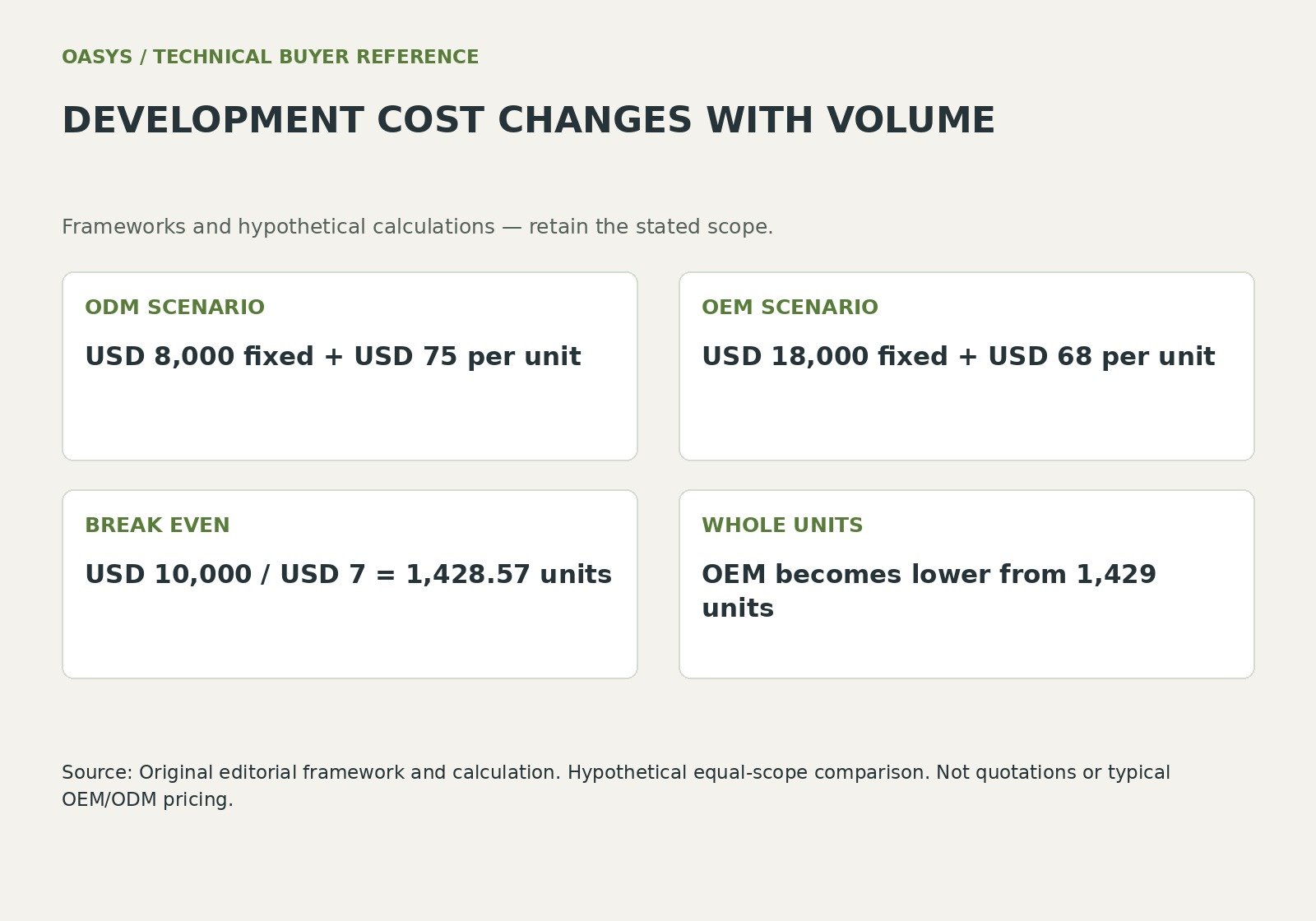
In a hypothetical comparison, an existing ODM platform requires USD 8,000 in development and costs USD 75 per chair. A more customized OEM route requires USD 18,000 and costs USD 68 per chair under the same approved scope.
The extra USD 10,000 is recovered through a USD 7 unit difference after approximately 1,429 chairs: 10,000 divided by 7. At 500 chairs, the allocated totals are USD 91 and USD 104 per chair respectively.
At 3,000 chairs they are about USD 77.67 and USD 74.00. These are scenario inputs rather than estimates of either manufacturing model’s typical prices.
The crossover is useful only if the two programs satisfy the same requirements and if the volume can actually be ordered. Apply downside quantities and project cancellation conditions before approving development. A lower recurring cost does not resolve a tooling access restriction, an unclosed test obligation or the cost of inventory that the buyer does not need.
| Hypothetical program | ODM platform | Customized OEM |
|---|---|---|
| Initial development USD | 8000 | 18000 |
| Recurring unit USD | 75 | 68 |
| Allocated unit at 500 chairs USD | 91 | 104 |
| Allocated unit at 3000 chairs USD | 77.67 | 74.00 |
Discuss your office chair project with OASYS
Share your target market, application, proposed configuration, quantity and launch requirements with OASYS. A useful inquiry identifies which requirements are approved and which need engineering or commercial input.
Explore OEM and ODM services · Review manufacturing capabilities · Contact OASYS
| Approval field | Record before release |
|---|---|
| ODM SCENARIO | USD 8,000 fixed + USD 75 per unit |
| OEM SCENARIO | USD 18,000 fixed + USD 68 per unit |
| BREAK EVEN | USD 10,000 / USD 7 = 1,428.57 units |
| WHOLE UNITS | OEM becomes lower from 1,429 units |
Questions buyers ask
Does ODM remove all development cost?
An established platform may reduce the amount of new work, but customization, samples, evidence review, packing and instructions can still create costs. Compare the quoted scope and exclusions rather than assume that an existing design needs no development.
Is the lowest unit price the best development route?
Compare fixed and recurring costs at the quantity the business can actually release. Also review control, product suitability, launch dependencies and service access. A hypothetical break-even volume is useful only while the compared scopes and other assumptions stay equivalent.
Connect the review with your purchasing brief
Use How to Choose an Office Chair OEM and ODM Manufacturer in Taiwan; Office Chair RFQ Checklist for Accurate OEM and ODM Quotations; Office Chair Price Comparison Retail Benchmarks and OEM Cost Drivers to connect this decision with the configuration and supplier review.
References
BIFMA (n.d.). BIFMA standards overview. Retrieved October 11, 2026, from https://www.bifma.org/page/standardsoverview
International Chamber of Commerce (n.d.). Incoterms 2020. https://iccwbo.org/business-solutions/incoterms-rules/incoterms-2020/
World Intellectual Property Organization (n.d.). Trade secrets. https://www.wipo.int/en/web/trade-secrets/