
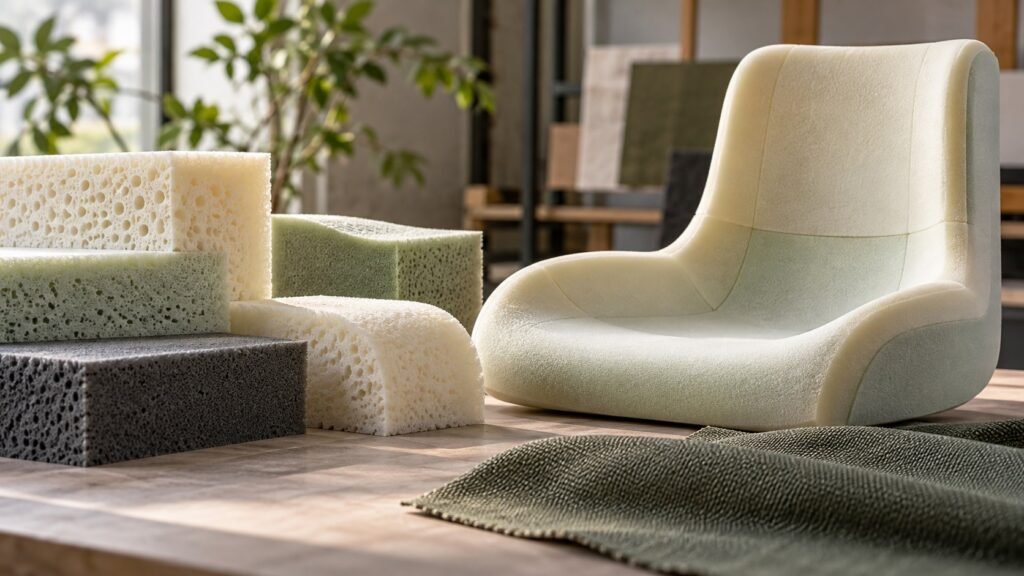
Cover image source: AI-generated conceptual editorial illustration; not a verified OASYS model, facility or test. Technical figures are separately attributed.
Foam: more than density
Density, firmness, shape and the surrounding seat construction answer different questions. A buying specification should preserve all four before comparing a foam grade or a molded cushion proposal.
| Property | Question answered | Approval record |
|---|---|---|
| Density | How much mass per unit volume? | Value, units and material identity |
| Firmness | What indentation response under the method? | Method, conditions, units and result |
| Geometry | What thickness and contour are supplied? | Drawing and assembled reference |
| Fatigue and recovery | What changes under the evaluated exposure? | Relevant report and retained scope |
- Keep density and firmness in separate specification fields.
- Identify thickness, contour, support structure and cover tension.
- Ask which evidence applies to the exact proposed grade.
- Approve a material substitution through the complete assembled seat.
Separate the four purchasing questions
Ask four questions at the beginning of foam selection. What material is proposed? How does it respond under relevant evaluation? What shape and thickness are required? How will it be manufactured and assembled? These questions prevent a single descriptor from carrying meanings it cannot support. A supplier response should identify which decisions are already defined and which require development.
Use a property schedule with separate fields. Record density with units, firmness with method and conditions, geometry with drawings, and manufacturing route with the supplier’s description. Include the seat support and cover construction. The schedule should be specific enough that another technical reviewer can understand what was approved.
Classify requirements by purpose. Some describe the desired user experience, some support material control, and some concern production feasibility. Keep those purposes visible. A preference for a soft initial feel should not automatically become a low density requirement, and an appearance requirement should not silently determine a material property without review.
Understand what density states
The Polyurethane Foam Association defines density as mass per unit volume and distinguishes polymer density from density affected by fillers (Polyurethane Foam Association, n.d.). For procurement, request the value, units, material identity, and relevant measurement basis. Ask the supplier to clarify what its quoted number represents when the formulation or construction includes other materials.
Do not compare values without consistent units and context. A hypothetical schedule using kilograms per cubic meter cannot be compared directly with another using pounds per cubic foot without a correct conversion. The buyer should also confirm that the figures describe comparable samples and methods. A converted number does not resolve a difference in material definition.
Use density as one specified property rather than a complete quality grade. Ask how the proposed grade relates to the application and which additional evidence supports the selection. If the supplier recommends a higher value, request the reason and the relevant performance information. The commercial decision should not rest on the assumption that the largest number always represents the best seat.
Understand what firmness states
PFA explains that firmness and density are distinct and that indentation force deflection is used to describe firmness (Polyurethane Foam Association, n.d.). A buyer should therefore request firmness information separately. Identify the method, sample conditions, units, and any tolerance proposed for production control. A phrase such as medium firm provides insufficient detail for a repeatable material specification.
Compare data only after the technical team confirms that the methods and conditions are compatible. Different sample geometry or conditioning can limit a direct comparison. This paper does not supply a universal conversion among firmness methods. Where a supplier uses another designation, ask for an explanation and supporting documentation.
Relate the property to an assembled evaluation. Users experience the seat structure, cushion, and cover together. A material test supports a defined property; it does not establish that every person will prefer the complete chair. Keep measured data and user observations in separate fields so the final decision can use both without confusing their meanings.
Review support response beyond initial feel
- Ask the supplier how the foam responds as compression increases and which relevant data describe that behavior.
- Avoid specifying a universal support factor through a general article.
- During an assembled trial, record the user's task, setup, and observations about the cushion.
PFA discusses support factor as a relationship between indentation measurements (Polyurethane Foam Association, n.d.). Use the public explanation to frame the question, then obtain project specific information from the technical team and supplier.
The appropriate choice depends on the seat system and application. Ask why a proposed material suits the required cushion geometry and user range. If the supplier provides only an initial firmness value, determine whether that information is sufficient for the project’s decision.
If an evaluator reports contact with a hard underlying structure, describe the circumstances and request review. Do not assign the cause automatically to density or thickness. Several parts of the assembly may need investigation.
Specify thickness through geometry
Thickness should be defined on a drawing at relevant locations. A contoured cushion may not have one uniform dimension. Identify the reference surfaces and whether the value describes the unloaded component or another condition. A catalog statement that the cushion is thick does not establish a useful acceptance criterion.
Review how thickness affects the complete chair. A cushion change can alter seat height, usable depth, visual proportions, upholstery pattern, or the relationship with arms and back support. The technical team should evaluate these interactions before approving another foam construction. A local material substitution can have system level consequences.
Avoid treating thickness as a direct comfort ranking. A thicker cushion may serve a design requirement, but its value should be evaluated with the material and support structure. The purchasing record should explain why the selected geometry is appropriate and how it will be checked, rather than assuming more material always improves the result.
Evaluate contour and edge design
Contour should be reviewed through the user’s relationship with the seat and the intended visual form. Ask for drawings and representative samples showing the final geometry. Evaluate the front edge, transitions, and interfaces with the back and arms. Record whether the prototype uses the intended production route or a temporary fabrication method.
Review the cover pattern together with the contour. Upholstery can affect the assembled appearance and feel, while its tension and seam placement may depend on the cushion shape. The supplier should explain how the approved result will be achieved in production. A foam component approval should not automatically authorize a different cover construction.
Use specific feedback. An instruction to make the seat more comfortable is difficult to execute. A record identifying the location, task, setting, and observed concern gives the technical team a clearer starting point. Qualified assessment should guide individual requirements that cannot be resolved through general product development.
Compare molded and fabricated routes through scope
Ask the supplier to describe the proposed route. A molded component is formed through its relevant molding process, while a fabricated cushion is shaped or assembled from foam stock through the manufacturer’s stated methods. The exact production approach should be confirmed for the project rather than inferred from a finished photograph.
Compare the routes using the required geometry, development effort, tooling, quantity, and control plan. A molded route may be proposed for a particular contour; a fabricated route may be proposed for another commercial situation. This paper does not claim a universal durability or cost advantage for either. Ask the manufacturer to explain the tradeoff with evidence and a project specific quotation.
Record which route produced the approved sample. If the production route differs, determine what review is needed before release. A hand prepared prototype can communicate form, but it may not represent the variation or assembly behavior of commercial production. Approval should identify those limits explicitly.
Keep material quantity separate from manufacturing cost
The 0.10125 kg mass difference in the simplified example is a material-quantity difference. It is not the finished-cushion price difference. Fabrication waste, molding route, setup, tooling, finishing and assembly can change the commercial result. Ask the supplier to identify those cost drivers separately when a denser or thicker grade is proposed.
For firmness data, preserve the method and sample conditions rather than copying an isolated number into an RFQ. PFA explains the distinction between density and indentation response. The seat trial then evaluates the cushion together with its support and cover. If two samples with the same density feel different, investigate their complete constructions and response data. Changing density first can obscure the actual reason for the observation.
Review tooling and development implications
If new tooling is required, request a separate scope describing geometry, trial stages, charges, and approval conditions. Ask which changes can be accommodated and which would require further investment. The buyer should understand the relationship between the tool and the released cushion specification before authorizing work.
Discuss ownership, maintenance, storage, and future access through the appropriate commercial agreement. Paying a charge should not be assumed to settle every right or obligation. These questions need a project specific decision and suitable advice. Keep the agreement connected to the tool identity and the product version it supports.
Plan the sample sequence. An initial shape sample, tool trial, and production representative cushion may serve different purposes. Record what each review closes and what remains provisional. This prevents an early approval of appearance from being interpreted as approval of the final material, process, and assembly.
Ask for fatigue and recovery evidence appropriately
PFA describes fatigue evaluation through changes in properties after repeated compression or flexing (Polyurethane Foam Association, n.d.). Buyers should ask which relevant tests or supplier evaluations support the proposed foam. Identify the method, sample, conditions, and reported result. Do not convert a cycle count directly into years of chair use.
Review the evidence through the application’s needs. A laboratory report answers a defined question under stated conditions. It should be assessed alongside the complete seat construction and service requirements. If the buyer needs a particular durability criterion, qualified personnel should establish it and explain why it is appropriate.
Keep warranty language separate. A warranty is a commercial commitment with terms and exclusions; a material test is evidence about a defined evaluation. Neither record should be used to imply the other without a clear basis. The product description should state each claim precisely and preserve its supporting documentation.
Identify relevant test methods without copying procedures
Ask the laboratory or qualified technical reviewer to identify the applicable method, edition, specimen preparation, and reporting needs. The purchasing team should specify the information required for acceptance and retain the resulting report. Avoid inventing test instructions from a short public summary or combining parts of unrelated methods.
Check the report’s material identity and relationship with the proposed cushion. If the tested stock differs from the final molded or assembled component, ask how the evidence is being used. The answer should explain the scope of the conclusion. A shared supplier name does not establish that every foam grade has the same result.
Review the seat support structure
The foam sits within a wider seat system. Identify the supporting shell, board, suspension, or other structure used in the proposed design. Review interfaces, fastening, contour, and any layers between the support and cover. These details can affect the assembled result and should be included in the controlled configuration.
During development, evaluate whether a cushion change requires a structural or pattern change. Ask the manufacturer to identify dependencies. A new foam shape may alter assembly access or attachment position. The approval process should address the complete system rather than accepting the foam as a standalone improvement.
Preserve the support version in sample records. If the trial chair uses a different support structure from production, record that limitation and resolve relevant questions on a representative sample. User feedback is most useful when the team knows exactly which assembly produced the observation.
Review upholstery and adhesive interfaces
Ask how the cover, foam, and support are combined. Identify relevant attachment methods and materials through the supplier’s specification. If adhesives are used, obtain the information needed for application and destination review from appropriate technical personnel. Do not assume that a foam data sheet covers every material in the upholstered seat.
Evaluate appearance and assembly consistency. Wrinkles, uneven contour, or displacement may involve several parts of the construction. Record the observed condition and request investigation rather than immediately changing density. The technical team should determine the cause and whether the correction affects evidence, geometry, or other approved characteristics.
Define the production reference for the assembled seat. Material identity, drawings, approved samples, and relevant inspection criteria should work together. A buyer should be able to explain both the foam specification and the resulting seat assembly. This supports repeatability and makes service discussions more accurate.
Account for destination and facility requirements
Identify the intended markets and environments before approving the seat construction. Flammability, chemical, or other requirements may apply depending on the product and destination. Have the responsible specialists determine current applicability and the evidence needed. A general foam grade description should not be treated as proof of complete chair compliance.
Provide the supplier with the actual requirement rather than a vague request for certified foam. Ask which component or assembly the evidence covers and whether the proposed cover or adhesive changes the conclusion. Retain the review decision with the configuration record. This makes the approval traceable when materials or markets change.
Review facility care and maintenance requirements as well. A cleaning method can affect more than the visible cover. Request product specific instructions and clarify restrictions before installation. The procurement team should know how the upholstered assembly can be maintained and which actions require professional service.
Design an assembled seat trial
Use the intended chair and workstation, with the final or clearly identified provisional seat assembly. Explain the evaluation purpose and provide setup support. Record tasks, settings, observations, and limitations. The trial should help compare perceived fit and usability rather than claim to prove long term performance or a medical outcome.
Ask focused questions. What changed after adjustment? Where was support insufficient or excessive for the task? Did the user move away from the back? Was a workstation issue present? These observations give the technical team more useful information than a simple soft or hard rating.
Compare alternatives under reasonably consistent conditions. If one sample uses another fabric or support structure, record the difference and avoid attributing the entire result to foam. A controlled comparison helps the buyer decide what further development or evidence is needed before selecting a material and geometry.
Use a hypothetical specification comparison
Consider two hypothetical seats with the same stated density. One uses a thinner contoured cushion over one support structure; the other uses a thicker cushion and different cover tension. Their assembled feel can differ, so density alone cannot establish equivalence. The buyer should compare the complete specification and trial observations.
Now consider a supplier proposing a new foam grade while preserving the drawing. Ask for separate density and firmness data, relevant evidence, and an assembled sample review. Determine whether other components or instructions change. The substitution should be approved through documented requirements rather than accepted because the density number matches.
Finally, consider a new molded contour requested for a branded collection. Compare development scope, tooling, sample stages, production control, and service support with an existing construction. The hypothetical example highlights the need to evaluate commercial and engineering obligations together, without assuming that a more specialized process automatically creates a better product.
Establish production acceptance criteria
The released seat specification should identify foam grade, relevant properties, geometry, cover, support, and assembly references. Qualified technical staff should propose suitable checks and limits. Procurement should ensure those controls address the characteristics that justified approval. A generic high density requirement is inadequate for a repeatable program.
Ask how incoming material and finished assemblies are identified. A production system should distinguish similar grades and versions. Review the records relevant to the project and how deviations are escalated. The buyer needs to understand how the approved specification is preserved without dictating an unsupported universal inspection plan.
Define change approval. A different foam supplier, formulation, thickness, or manufacturing route should prompt review of affected requirements. Record the change and implementation boundary. Update technical and editorial claims where necessary. This protects the link between the approved sample, supplied chair, and published description.
Plan service and replacement
Ask how a worn or damaged seat is serviced. The approved replacement unit may be a cushion, upholstered seat, or larger assembly. Request part codes, compatibility information, and current instructions. Determine which work belongs to trained personnel. A general white paper should not supply an improvised repair procedure.
Discuss future material availability. A replacement should be assessed for geometry, appearance, function, and evidence rather than accepted solely because it fits. Record any approved alternative so service teams can explain the difference to customers. Long term support depends on configuration information as well as a promise that parts will be available.
Include the service route in cost comparison. A lower initial cushion price may be less attractive if replacement requires a large assembly or difficult sourcing. Use actual proposed arrangements and explicit assumptions. The buyer should understand which factors drive the cost rather than rely on a broad claim about one foam type.
Separate material quantity from material quality
For a simple rectangular hypothetical foam blank, volume can be calculated from length, width, and thickness, using consistent units. Multiplying volume by density estimates mass under the stated assumptions. That calculation is useful for checking whether quotation inputs are internally consistent. It does not measure firmness, support, or durability, and it does not describe a contoured cushion accurately unless its actual volume is known.
For example, increasing nominal thickness while retaining the same footprint and density increases the calculated material mass for that simplified blank. The commercial effect still depends on fabrication, waste, tooling, handling, and assembly. A buyer should therefore ask the supplier to distinguish material consumption from the other cost drivers. A calculation showing more foam does not establish a better chair.
Where a supplier offers a cost reduction, ask which input changes. A revised contour, another grade, a different process, or a purchasing adjustment can have different implications. Record the proposal through those actual differences. This makes value engineering assessable and prevents a lower cushion cost from concealing an unreviewed change to the approved seat.
Specify the seat through evidence and assembly
Density, firmness, thickness, contour, and manufacturing route each answer a different question. The best purchasing decision connects them with the support structure, cover, relevant evidence, user evaluation, and service plan. No single descriptor can establish the complete quality or suitability of an office chair seat.
For an OASYS inquiry, provide the intended application and the aspects of the seat requiring development. Request separate material properties, drawings, relevant data, and representative samples. Ask how the approved construction will be identified and controlled in production, and how future substitutions will be reviewed.
Preserve the final assembly record for repeat orders and maintenance. Product content should describe verified properties accurately while keeping user preference and laboratory evidence distinct. A clear seat specification gives manufacturers, buyers, and service teams a common reference for maintaining the intended product over time.
Calculate foam mass without confusing it with support
Density and firmness should remain separate specifications. PFA explains the distinction and identifies relevant foam evaluation methods. An engineering discussion should also connect cushion geometry with the supporting seat structure and cover. Mass calculations can help check material quantity, but they do not establish comfort, fatigue performance or a suitable firmness for an individual user.
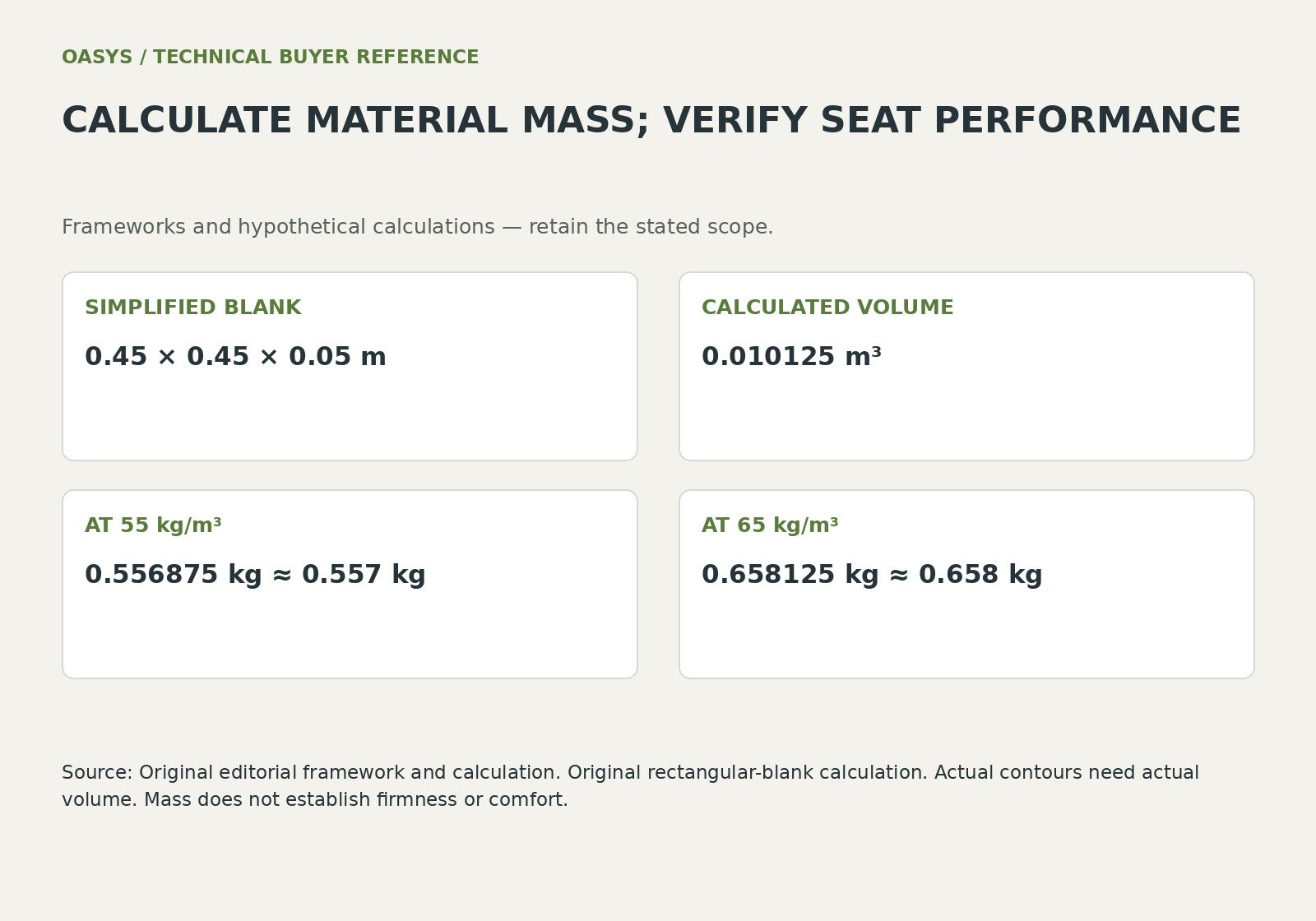
For a deliberately simplified rectangular cushion 450 mm by 450 mm by 50 mm, volume is 0.45 multiplied by 0.45 multiplied by 0.05, or 0.010125 cubic metres. At an assumed density of 55 kilograms per cubic metre, mass is approximately 0.557 kg.
At 65 kilograms per cubic metre it is approximately 0.658 kg, a difference of about 0.101 kg. A molded contour needs its actual volume, and this illustration excludes cover, adhesive and support.
Neither density is a recommended grade.
Tooling allocation is another distinct calculation. A hypothetical USD 6,000 cushion tool allocated over 300 seats adds USD 20 per seat; over 3,000 seats it adds USD 2. Confirm which development services the tool price includes, and compare recurring component prices separately. This explains how volume can change the commercial value of a manufacturing route while leaving the material performance decision to representative evidence.
| Illustrative input or output | Value |
|---|---|
| Rectangular cushion volume m3 | 0.010125 |
| Mass at 55 kg per m3 kg | 0.557 |
| Mass at 65 kg per m3 kg | 0.658 |
| Tool allocation at 300 seats USD | 20 |
| Tool allocation at 3000 seats USD | 2 |
Discuss your office chair project with OASYS
Share your target market, application, proposed configuration, quantity and launch requirements with OASYS. A useful inquiry identifies which requirements are approved and which need engineering or commercial input.
Review manufacturing capabilities · Explore OEM and ODM services · Contact OASYS
| Approval field | Record before release |
|---|---|
| SIMPLIFIED BLANK | 0.45 × 0.45 × 0.05 m |
| CALCULATED VOLUME | 0.010125 m³ |
| AT 55 kg/m³ | 0.556875 kg ≈ 0.557 kg |
| AT 65 kg/m³ | 0.658125 kg ≈ 0.658 kg |
Questions buyers ask
Does higher density always mean a firmer seat?
PFA distinguishes density from firmness. A procurement record needs separate properties and the relevant method. Review the complete cushion and chair assembly rather than infer surface feel from mass per volume alone.
Can a rectangular mass calculation price a molded cushion?
It can check a simplified material quantity under stated assumptions. A contoured part needs its actual volume, and the quote also reflects the manufacturing route and other costs. The example provides neither a finished price nor performance evidence.
Connect the review with your purchasing brief
Use Mesh vs Fabric vs PU Office Chairs Material Performance and Lifecycle Cost; Office Chair RFQ Checklist for Accurate OEM and ODM Quotations; Office Chair Price Comparison Retail Benchmarks and OEM Cost Drivers to connect this decision with the configuration and supplier review.
References
Polyurethane Foam Association (n.d.). Foam performance. https://pfa.org/foam-performance/