

Cover image source: AI-generated conceptual editorial illustration; not a verified OASYS model, facility or test. Technical figures are separately attributed.
Environmental claims with a boundary
A sustainable-furniture proposal needs specific attributes and inspectable evidence. Recycled content, repair arrangements and an EPD answer different questions and should retain their respective scopes.
- Define the product version and precise attribute.
- Keep material and declaration evidence tied to its scope.
- Verify repair as parts, instructions and practical access.
- Review comparative wording against a supported baseline.
| Claim topic | Evidence to request | Boundary to preserve |
|---|---|---|
| Recycled content | Component identity, mass and supplier records | Component versus complete product |
| Repairability | Approved parts, access and replacement instructions | Feature versus actual service arrangement |
| EPD | Declaration, product coverage, PCR and verification | Assessment assumptions and comparable scope |
| Impact reduction | Qualified comparison and baseline | Do not infer from one material attribute |
Replace broad labels with a defined attribute
Start by asking what the sustainability statement means. It may concern a material input, repair feature, verified declaration, manufacturing practice, packaging change, or another attribute. Identify the product and the actual benefit being claimed. A broad green label leaves the buyer unable to assess scope or relevance.
The FTC’s published Green Guides summary cautions against broad unqualified environmental benefit claims and emphasizes specific substantiated statements (Federal Trade Commission, 2012). This is a public U.S. guidance reference, not a complete legal analysis for every market. The buyer should obtain appropriate current destination review for consequential claims.
Write a claim record before collecting evidence. State the proposed sentence, subject, boundary, measurement, source, reviewer, and limitation. The record helps distinguish a useful specific claim from language that implies more than the evidence establishes. It also gives the content team an identifiable basis for future updates.
Separate product facts from ambitions. A company may intend to improve materials or service access, but the achieved condition needs its own record. The website should make that distinction clear. Readers can value a direction of work without being told that an unverified result has already occurred.
Identify the exact chair and material scope
Prepare the configuration schedule, including relevant components, materials, options, and revisions. An environmental statement may apply to one version and not another. The buyer should know which product is being assessed. A family name or photograph is insufficient when materials differ across options.
Request the material information needed for the claim and assessment. The supplier may provide declarations, composition records, or another suitable evidence route. Qualified personnel should determine what is necessary and reliable. The buyer need not collect unrelated proprietary information without a decision purpose.
Record which parts are included and excluded. A recycled content statement about one base should not become a percentage for the whole chair. A packaging claim should identify packaging rather than imply product composition. These distinctions make the evidence usable and prevent the editorial process from broadening scope unintentionally.
Maintain identity through changes. Another upholstery, base, or supplier can affect the statement. Trigger review before the new version enters supply or public content. A verified attribute remains meaningful when its supporting record continues to describe the actual chair.
Review recycled content with a clear denominator
Ask whether the statement concerns a component, material, package, or complete product. Request the quantity basis, calculation method, supporting records, and relevant definitions used. Qualified reviewers should determine the appropriate method and claim wording. Do not infer a whole chair value from one component’s supplier statement.
Use a hypothetical example to show the distinction. Suppose an invented chair has a total mass of ten kilograms and one two kilogram component is stated, with supporting evidence, to contain fifty percent recycled material by mass. That component contributes one kilogram to the calculation under those simplified assumptions. It does not establish that the chair is fifty percent recycled.
If no other recycled contribution is included, the simplified whole product calculation would be ten percent by mass. The example is arithmetic using invented inputs, not OASYS data or a complete approved claim method. A real calculation must use the applicable definitions, evidence, and product boundary reviewed by qualified personnel.
Keep component and product statements separate in content. A precise description of the documented component can be useful without claiming an overall value. If the buyer publishes a whole product percentage, retain the calculation and supporting identities. The denominator is part of the claim, not a detail to omit.
Evaluate repairability as a working system
- Request replaceable assemblies, part codes, compatibility records, instructions, service access, and availability arrangements.
- Ask who can perform the work and what service unit is supplied.
- Review availability and discontinuation.
A removable component creates potential, while an operating service system makes that potential useful. The buyer should assess both before making a repairability statement.
A cover may be replaced only as a larger assembly. A component may require trained personnel. The published description should reflect the actual approved route instead of imply that every user can repair every part with ordinary tools.
An indefinitely repairable promise needs a supported arrangement, not only a visible fastener. Describe the actual service features and terms accurately. If environmental benefit is claimed from repair, use an appropriate defined comparison rather than assume it follows automatically.
Review durability through relevant evidence
Durability statements should identify the property and supporting evaluation. Request configuration specific product reports, material data, and intended use conditions. Keep those records separate. A material abrasion value, a structural report, and a warranty answer different questions.
Do not convert a laboratory cycle count into years of service without an appropriate basis. The buyer should describe the tested property accurately. If a service life assumption is used in an environmental assessment, qualified personnel should establish and document it through the relevant method.
Review the complete product and maintenance system. A durable component can still be difficult to service, while an accessible repair may preserve use under suitable conditions. The purchasing decision should connect performance, care, parts, and actual application. No one attribute establishes the entire sustainability profile.
Use operational records responsibly. Historical service information can inform questions, but it should not be generalized across another configuration or environment without assessment. Keep observed findings and forecasts distinguishable. A claim of longer life needs a defined comparison and supporting evidence.
Distinguish an EPD from superiority
EPD International describes an environmental product declaration as verified life cycle environmental information and states that having one does not imply superiority over alternatives (EPD International, n.d.). That distinction matters in procurement. A declaration is a source of defined information, not an automatic award of best environmental performance.
Request the actual declaration and review product identity, validity, relevant rules, declared basis, boundaries, verification, and results through qualified personnel. This paper does not reproduce the full program instructions or determine comparability independently. The buyer should understand what the document includes and what it excludes.
If several declarations are compared, have a competent reviewer assess whether the methods and boundaries support that comparison. A lower visible carbon number may not be meaningful if the declared bases or stages differ. The purchasing summary should preserve the comparison conditions instead of extract isolated figures.
Keep product and company data separate. A company wide emissions statement is not necessarily the chair’s footprint. An EPD for another model is not automatically evidence for the proposed chair. The claim record should identify the actual subject and relevant document.
Build a life cycle question set
An original procurement question set can organize raw materials, manufacture, distribution, use, maintenance, and end of use. Ask which stages the proposed assessment covers and which assumptions are used. Qualified environmental practitioners should choose the method, data, and interpretation. The buyer’s role is to make the decision purpose clear.
Define what service is being compared. A chair comparison may need to account for quantity, use period, performance requirements, and support arrangements. This article does not prescribe a universal functional unit for every assessment. The reviewer should establish a suitable basis and explain why it fits the question.
Identify uncertain assumptions, including service life, replacements, transport, and end of use routes. A result can depend strongly on them. Request appropriate sensitivity review where consequential. The summary should explain the drivers and limits rather than present one precise value as independent of assumptions.
Keep the assessment connected to purchasing. If the configuration or route changes, review the affected conclusion. A footprint for another packaging or shipment arrangement may not describe the actual program. Environmental evidence needs configuration control just as product performance evidence does.
Check comparability before using an EPD as a ranking
The International EPD System describes an EPD development process that includes selecting a product category rule, conducting an LCA, compiling the declaration, verification and registration. An EPD’s presence establishes a document to inspect; it does not by itself identify the chair with the lowest impact. Compare the product coverage, declared or functional unit, assessment boundary, included modules, assumptions and applicable rules before drawing a comparative conclusion.
A component recycled-content record cannot substitute for that assessment. Likewise, a replaceable seat establishes a design and service question, while a claim of lower life-cycle impact needs an appropriate comparison. Keep the buying record specific enough that marketing can explain the evidenced attribute without broadening it. FTC’s published Green Guides summary provides U.S. claim context; the actual destination wording needs current appropriate review.
Review transport and packaging claims through baselines
Ask what changed and what comparison supports the claim. A lighter package, smaller carton, or different delivery state can affect a project, but the benefit should be measured within a defined boundary. The FTC summary emphasizes identifying the basis of source reduction comparisons (Federal Trade Commission, 2012). Use appropriate current review for the actual wording.
Request packaging identity, dimensions, mass, shipment assumptions, and relevant records. A catalog loading quantity is not a complete environmental assessment. The buyer should know whether the statement is a verified package fact, a logistics scenario, or a calculated impact result.
Use hypothetical comparisons transparently. A smaller carton may allow another planning arrangement under stated conditions, but that does not establish lower impact across every route. The assessment should account for protection, damage, handling, and other relevant factors through a qualified method. Do not invent a universal carbon saving percentage.
Keep protection requirements mandatory. Reducing packaging should not create an unresolved delivery problem. The buyer should review the complete package and evidence for the actual route. Commercial and environmental decisions should use the same product and shipment scope.
Evaluate dismantling through actual access and routes
Ask how the product can be separated under the approved method and which operations require trained personnel. Request material identification and relevant instructions. A theoretical ability to remove components should not become a claim that users can easily separate the chair into recyclable streams.
Review the customer’s practical end of use arrangement. Local collection, reuse, refurbishment, and recycling routes can differ. The buyer should confirm what is available for the actual location and product. This article does not establish recyclability from material names alone or provide a universal disposal method.
Keep technical potential and operational access distinct. A material may have a known recycling process while the customer’s route does not accept the assembled component. Qualified reviewers should determine appropriate claim wording. The content should explain limitations that matter to the reader’s decision.
Include dismantling in service planning where relevant. Instructions, compatible parts, and trained support can influence reuse or refurbishment options. The buyer should assess the complete arrangement. A sustainable design statement becomes more useful when it describes what the customer can actually do.
Review ecolabel and certification claims precisely
Request the current certificate or public entry, product scope, issuing organization, validity, and relevant version. Verify the claim through the appropriate official route. A company commitment or another model’s award should not be presented as certification of the proposed chair.
Have qualified personnel assess relevance to the tender or purchasing requirement. Different programs evaluate different criteria. The buyer should not combine several labels into an unsupported overall superiority statement. Each record should identify the attribute or scope it establishes.
Keep marks and text within authorized use. The editorial team should obtain the relevant program guidance and confirmed product identity. This paper does not authorize any mark or independently certify conformance. Public content should follow the actual verification and approval process.
Review status when products or claims change. Another material or configuration may need an update under the program’s conditions. The supplier should explain how it manages that obligation. Procurement should preserve current records and avoid using an obsolete certificate because the model name remains familiar.
Distinguish emissions chemical and structural evidence
An emissions report, chemical declaration, and structural performance report answer different questions. Request evidence for the actual requirement and configuration. Do not infer one result from another. A quality management certificate also has another subject and scope.
Qualified specialists should determine current destination and application requirements. This paper does not reproduce chemical restrictions or advise that one material automatically complies in every market. The buyer should provide the intended use and obtain the appropriate review.
Record the evidence matrix with separate rows. Identify subject, record, method or program, reviewer, status, and open action. The matrix makes gaps visible and prevents a large folder of certificates from creating an unsupported impression that all environmental questions are closed.
Use precise product language. A verified emissions result should not become a broad non toxic or healthy claim without the required basis. Readers need to know what was evaluated. The editorial process should preserve the scope accepted by the qualified reviewer.
Use a hypothetical sustainability proposal
Consider a hypothetical supplier proposing a recycled base, a replaceable seat assembly, and smaller packaging. Each attribute needs its own record. The base statement needs material and calculation support. The service statement needs parts and instructions. The packaging statement needs a baseline and actual configuration.
The buyer should not combine the three facts automatically into a claim that the chair has the lowest environmental impact. That conclusion requires an appropriate comparative assessment. The example is original procurement analysis and does not describe an OASYS product or measured outcome.
The evidence review may support precise statements about the verified features. The buyer can then assess relevance to its program, including care, service, transport, and end of use. A clear attribute can have practical value without being presented as an overall environmental verdict.
If a component changes after approval, revisit the affected records and wording. The recycled calculation, service compatibility, or packaging baseline may change. The claim register should identify the implementation boundary and current version. This keeps educational and sales content connected to actual supply.
Create an environmental claim register
For each statement, record wording, product identity, attribute, boundary, method, supporting record, reviewer, conditions, and review trigger. Keep company ambitions separate from achieved results. The register should help purchasing and content teams use the same approved information.
Distinguish verified, pending, and unsupported statements. A pending assessment should not be published as a completed result. An unsupported broad label should be replaced with a narrower factual statement or removed. The process should make the next evidence action clear.
Retain the source files and calculations. A summary should not omit qualifications or change the claim’s scope. If a third party document is updated, record the supersession and affected products. The current register should point to the records that control public wording.
Review images and captions as well as text. Visual elements can imply a broader claim than the sentence supports. A green symbol, recycled graphic, or certification mark should receive the relevant review. Evidence discipline applies to the complete customer communication.
Ask suppliers for a structured evidence package
Provide the purchasing objectives and intended claims. Ask for product specific materials, service, declarations, certifications, packaging data, and end of use information relevant to those objectives. Do not collect every available document without a defined role. The supplier should understand what the buyer needs to decide.
For an OASYS inquiry, identify the exact configuration and attributes requiring verification. Request current data and distinguish public company statements from product evidence. Do not assume that a sustainability aspiration establishes a completed result. The response should make known facts and open questions visible.
Agree on change notification and review. Another material, component, route, or packaging can affect claims. The supplier and buyer should know who updates records and public content. Environmental evidence should be part of the continuing product program rather than a one time marketing exercise.
Use qualified reviewers for technical assessment and destination claim requirements. Their decisions should be understandable to commercial and editorial teams. The final wording should identify the actual feature and supported scope. This preserves usefulness without overstating certainty.
Compare proposals through an evidence ladder
An evidence ladder can help a buyer organize statements without treating every document as equal. Begin with a clearly described design intention, then distinguish a documented product feature, a measured attribute, a verified declaration or certification, and an assessed comparative conclusion. These are proposed review categories rather than a formal standard. Their purpose is to show what additional work is needed before the wording becomes broader.
For example, a proposal to make a seat replaceable is an intention. A released design and approved service route can support a feature statement. Records of actual service can support defined operational observations. A claim that the design reduces environmental impact compared with another system requires an appropriate comparison. The earlier evidence does not automatically establish the later conclusion.
Use the ladder in the editorial review. Ask where the current statement sits and what evidence supports that level. If the wording exceeds the record, narrow it or obtain the missing assessment. This practical method keeps useful facts publishable while preventing ambitions and partial evidence from becoming unsupported superiority claims.
Keep an explicit comparison record
For any comparative environmental statement, record the alternatives, product requirements, quantity or service basis, boundaries, data, assumptions, method, result, reviewer, and limitations. Qualified practitioners should determine whether the comparison is appropriate. The summary should preserve important conditions rather than publish only the most favorable number.
If a comparison uses a hypothetical scenario for education, label it and retain the invented inputs. Do not present it as a measured OASYS outcome.
If it uses actual product data, connect the record with the configuration and review triggers. A change in materials, service life assumptions, transport, or end of use can require another assessment.
This record makes the claim maintainable and gives procurement readers a practical basis for understanding what the result means.
Calculate recycled content within a defined product boundary
A recycled content claim should identify the component, mass basis, supplier evidence and treatment of relevant preconsumer or postconsumer material. FTC guidance calls for claims to be qualified where their scope requires it. A statement about one plastic part should not be presented as a percentage of the whole chair unless the full product calculation supports that interpretation.
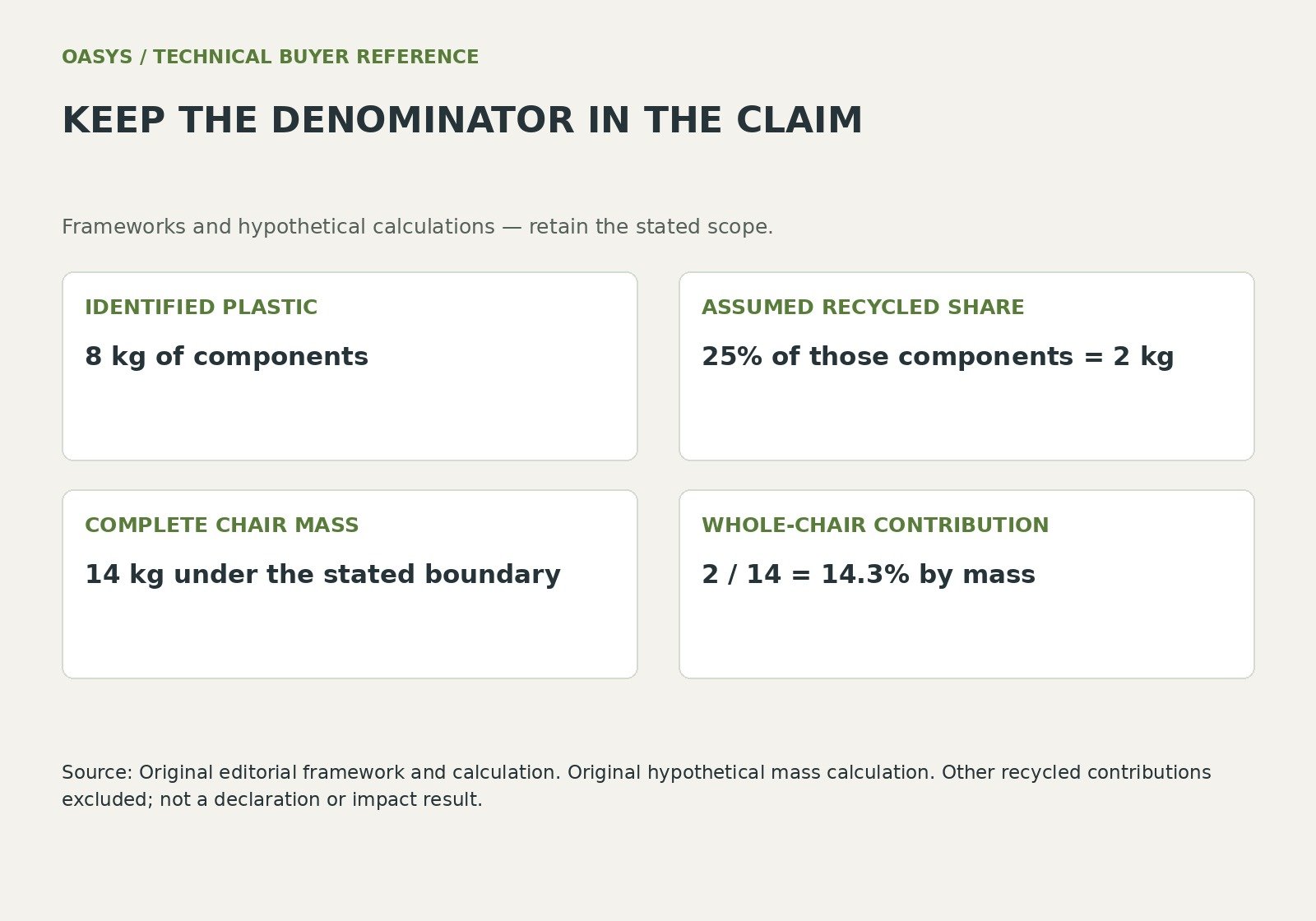
In a hypothetical chair with 8 kg of identified plastic components and an evidenced 25 percent recycled content for those components, recycled plastic mass is 2 kg. If the complete chair weighs 14 kg, that contribution represents approximately 14.3 percent of total chair mass, not 25 percent of the whole product.
This illustration assumes consistent boundaries and excludes any recycled content in other components. It is not an OASYS material declaration or environmental impact result.
Repairability needs a similarly practical boundary. Identify replaceable assemblies, access method, parts availability and the documentation that supports service. Then compare repair cost with the complete replacement route using project specific inputs. An EPD can supply verified environmental information under its stated rules, but its existence alone does not establish that the chair is environmentally superior to another product.
| Hypothetical content input | Value |
|---|---|
| Identified plastic mass kg | 8 |
| Recycled share of those plastics | 25 percent |
| Calculated recycled mass kg | 2 |
| Complete chair mass kg | 14 |
| Contribution to whole chair mass | 14.3 percent |
Discuss your office chair project with OASYS
Share your target market, application, proposed configuration, quantity and launch requirements with OASYS. A useful inquiry identifies which requirements are approved and which need engineering or commercial input.
Review quality and testing · Review manufacturing capabilities · Contact OASYS
| Approval field | Record before release |
|---|---|
| IDENTIFIED PLASTIC | 8 kg of components |
| ASSUMED RECYCLED SHARE | 25% of those components = 2 kg |
| COMPLETE CHAIR MASS | 14 kg under the stated boundary |
| WHOLE-CHAIR CONTRIBUTION | 2 / 14 = 14.3% by mass |
Questions buyers ask
Does 25% recycled plastic mean a chair is 25% recycled?
Only if the relevant complete-product calculation supports that denominator. The example’s 2 kg contribution divided by 14 kg total is about 14.3% by mass. Preserve component scope and any excluded contributions.
Does an EPD certify that a product is greener than another?
Inspect the declaration and comparison conditions. Verified environmental information and a comparative superiority claim are different conclusions. Matching product scope, assessment rules and assumptions is necessary before an appropriate comparison.
Connect the review with your purchasing brief
Use Mesh vs Fabric vs PU Office Chairs Material Performance and Lifecycle Cost; Office Chair Price Comparison Retail Benchmarks and OEM Cost Drivers; How to Choose an Office Chair OEM and ODM Manufacturer in Taiwan to connect this decision with the configuration and supplier review.
References
EPD International (n.d.). What is an EPD?. Retrieved October 11, 2026, from https://www.environdec.com/getting-started/what-is-epd
Federal Trade Commission (2012, October). Environmental claims summary of the Green Guides. https://www.ftc.gov/business-guidance/resources/environmental-claims-summary-green-guides
EPD International (n.d.). International EPD System development process. Retrieved October 13, 2026, from https://www.environdec.com/getting-started/epd-development