

Cover image source: AI-generated conceptual editorial illustration; not a verified OASYS model, facility or test. Technical figures are separately attributed.
Certificate or product evidence?
An ISO 9001 certificate concerns an identified management system and scope. Chair product evidence concerns a defined configuration and applicable requirements. Keep both records precise and connect them through the supplier’s production controls.
| Evidence | Subject | Check |
|---|---|---|
| QMS certificate | Entity, site and certified activities | Issuer, status, scope and edition |
| Chair report | Identified sample and requirements | Configuration, standard, results and limits |
| Production records | Approved design reaching supply | Materials, revisions and deviations |
| Change assessment | Current configuration versus prior evidence | Affected claims and acceptance decision |
- Verify the entity, site, scope and issuing body.
- Confirm certificate status through the appropriate official route.
- Review product evidence against the actual order configuration.
- Keep transition questions and change triggers in the evidence register.
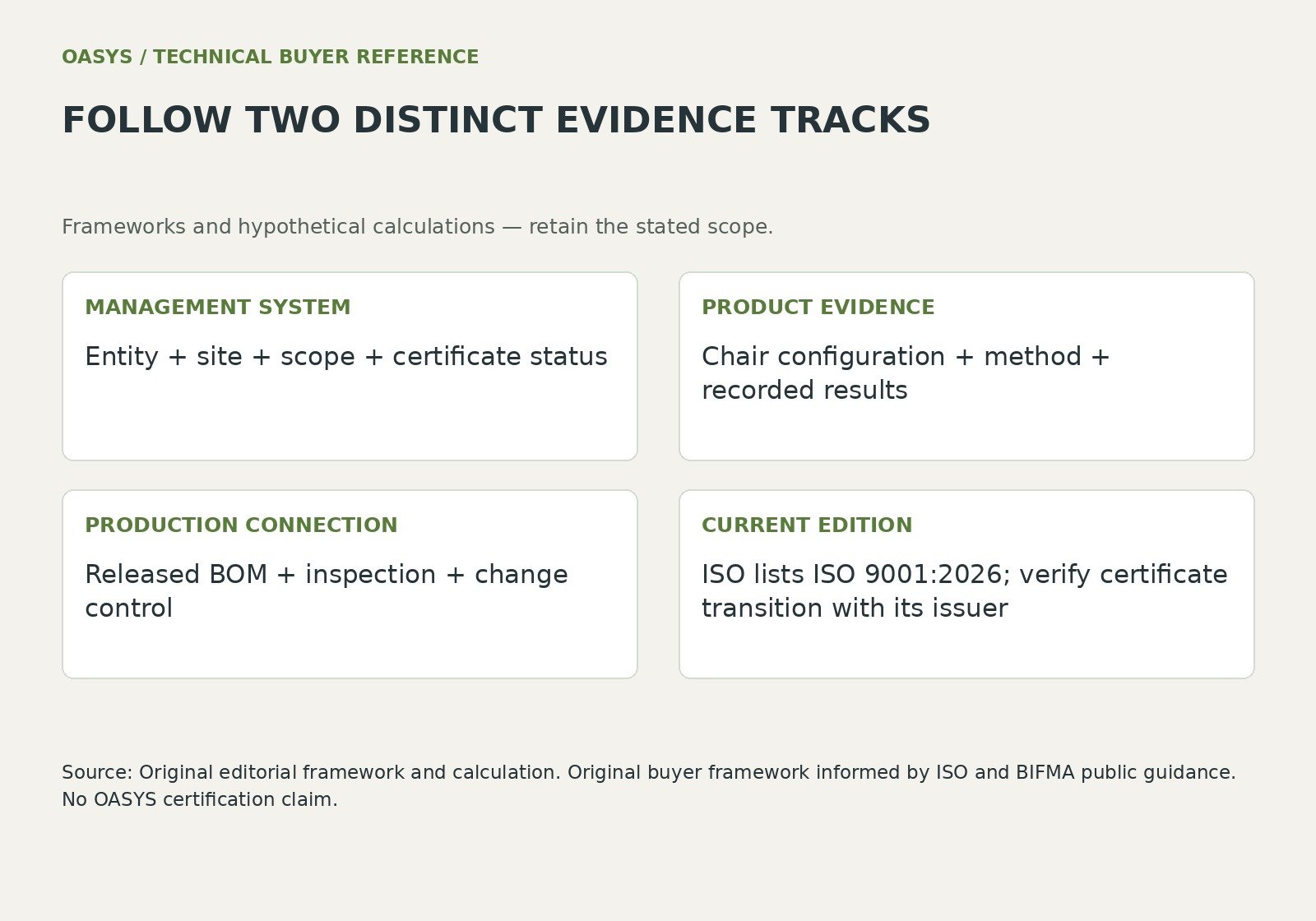
Define the two evidence tracks
Create one track for the supplier’s organizational system and another for the proposed product. The system track asks how work is managed within the stated scope. The product track asks what evidence supports the chair’s defined requirements. Keeping the tracks separate makes missing information easier to identify.
For the system track, collect the relevant certificate and verification information. For the product track, collect configuration specific reports and records. Assign reviewers with appropriate competence for each task. A purchasing team can coordinate the process without assuming that one reviewer can interpret every organizational and technical question.
Connect the tracks through operational evidence. Ask how the supplier releases specifications, identifies materials, approves changes, controls production, and handles deviations. These original review questions help the buyer understand how a tested design becomes repeatable supply. They are not a clause by clause ISO audit checklist.
Understand the certificate's subject
ISO’s public overview describes ISO 9001 as requirements for a quality management system (International Organization for Standardization, 2026). That subject differs from a chair’s structural performance. The buyer should therefore read the certificate for the organization and activities it identifies, not treat the document as a product approval covering every model.
Ask the supplier to explain how the certified scope relates to the proposed work. Design, manufacture, assembly, distribution, and service may be represented differently. The reviewer should determine what the scope actually states and whether it is relevant to the purchasing decision. Do not fill gaps by assuming every company activity is included.
Record the conclusion narrowly. A relevant certificate can support supplier qualification, while product requirements remain subject to their own evidence. This distinction should appear in the internal review and public content. A broad statement that every chair is ISO certified can create a misleading impression if the evidence concerns the management system.
Verify the legal entity and site
Compare the certificate’s organization name with the proposed contracting and manufacturing entities. Related companies may have similar names, but the buyer should understand which entity holds the certificate and which will supply the goods. Ask for clarification where a trading company, group company, or manufacturing facility has another legal identity.
Review site information. If the certificate includes several locations or references an appendix, obtain the relevant complete record. Determine whether the proposed manufacturing activities occur at a covered site. The buyer should not assume that a group headquarters certificate automatically includes every factory or subcontractor.
Keep the organizational relationship in the supplier file. Record who is responsible for the proposal, production, quality communication, and service. This information is useful beyond certification because it clarifies accountability. A certificate review should improve understanding of the supply arrangement rather than remain an isolated administrative exercise.
Read the scope as written
- Scope describes the activities covered by the certificate.
- Identify any exclusions, limitations, or referenced records where present.
- Use scope information to guide additional qualification.
Read the actual wording and ask how it relates to the proposed office chair program. A broad furniture description may still require clarification about design or other activities important to the buyer. The responsible reviewer should assess relevance rather than infer scope from the company website.
This paper does not interpret every possible certificate format. The buyer should obtain a usable document and consult the issuing body when the meaning is unclear. Keep the clarification in the file so later teams do not repeat the same assumption.
If an important activity is outside the stated scope, determine what other evidence or review is appropriate. The decision need not be an automatic rejection, but it should be explicit. Procurement should know which conclusion the certificate supports and which questions remain open.
Verify the issuing body and status
ISO states that it develops standards but does not issue certificates; external certification bodies perform certification (International Organization for Standardization, n.d.). Identify the issuing body on the certificate and use its official verification route or an appropriate accreditation resource where relevant. Avoid relying only on a copied image supplied in a sales presentation.
Review dates and status through the relevant source. Record what was checked and when. If a certificate’s status is unclear, ask the supplier and issuing body to resolve the question. A missing online entry should not be treated automatically as proof of misconduct; the reviewer should establish the facts through the appropriate organization.
Distinguish certification and accreditation. They concern different parts of the conformity assessment system. The buyer should record the specific information needed for its requirements and avoid combining all credentials under one generic approved label. Where competence or scope questions are consequential, involve an appropriately qualified reviewer.
Handle the 2026 edition carefully
ISO’s public page lists ISO 9001:2026 as the sixth edition, published in September 2026 (International Organization for Standardization, 2026). That current fact should be reflected in new educational content. It does not justify an unsupported statement that every certificate to an earlier edition immediately became invalid on publication.
Ask the supplier which edition its certificate states and how the issuing body is handling transition. Obtain the current status and relevant conditions from that body. ISO’s public transition guidance directs certified organizations to their certification body for further information (International Organization for Standardization, 2026). Preserve the answer in the supplier qualification record.
Review content when facts change. A page written during an earlier transition stage may become outdated. The editorial team should use a research date and a review owner for standards related claims. This is a practical content control recommendation, not a promise that the article will remain current without maintenance.
Review the chair's product requirements separately
Identify the exact chair configuration and intended application. Determine applicable requirements through qualified review. Request reports that identify the standard, edition, laboratory, sample, results, and limitations. A management certificate does not remove the need for that product evidence.
BIFMA’s public Compliant description concerns product verification through applicable testing (BIFMA, n.d.). That is a different evidence route from organizational quality management certification. Use precise terminology in the purchasing file and avoid presenting the two records as interchangeable certificates.
Record the product review decision by configuration. Options and changes may require additional assessment. A chair family name should not automatically extend one result across every version. The evidence schedule should identify what is covered, what is uncertain, and who closes the remaining actions before approval.
Use a change trigger rather than an unexamined expiry reminder
A certificate expiry date is one review trigger. A new manufacturing site, altered certified scope, new issuer or changed product configuration can create another question before that date. Record what changed and which review it affects. A product-component change usually belongs in the chair evidence track even where the organization’s management system certificate remains unchanged.
ISO’s public overview identifies ISO 9001:2026 as the sixth edition, published on 16 September 2026. That fact does not independently determine the transition status of a supplier’s existing certificate. Retain the edition shown on the document and obtain the issuing body’s applicable guidance. The purchasing record should distinguish a confirmed certificate status, a pending transition question and a separate product evaluation requirement.
Ask how the approved specification reaches production
The buyer should understand how the supplier converts an approved design into work instructions and purchasing information. Ask how drawings, component schedules, materials, and samples are released. Identify who approves updates and how obsolete versions are prevented from entering current work.
Review a project relevant example where appropriate. The supplier may demonstrate its method through records it can disclose without revealing unrelated customer information. The purpose is to assess the operating process, not collect confidential files unnecessarily. A controlled example is more useful than a general statement that the company follows documented procedures.
Connect the specification with the order. Quantities, variants, finishes, and accessories should match the approved record. A commercial option added late can introduce a version not covered by development or product review. The supplier and buyer should have a practical route for identifying and resolving that difference.
Ask how materials and components are controlled
Request an explanation of identification, approved sources, substitutions, and relevant incoming checks. The level of detail should match the product and project. A certificate does not tell the buyer which material is installed in a particular chair, so configuration and material records remain important.
Ask how a proposed alternative is reviewed. The change should identify the affected component, reason, properties, interfaces, and evidence implications. Qualified personnel should determine what evaluation is needed. Procurement should retain the approval and implementation boundary rather than accept an informal assurance that the part is equivalent.
Review traceability where needed. The supplier should explain how an affected batch can be identified if a material or component issue arises. The buyer does not need to impose one universal coding system, but it should understand the investigation route. Accountability depends on usable records as well as a management certificate.
Review production checks through the product
Ask how relevant characteristics are checked during and after manufacturing. Identify the references, methods, records, and response to deviations. The manufacturer’s qualified team should define the control plan. Procurement should ensure it addresses the agreed requirements and connects with the released configuration.
Distinguish routine checks from product qualification testing. An assembly function check answers a different question from a laboratory performance test. Both can be useful, but the buyer should understand the conclusion supported by each. Do not treat a final inspection record as a substitute for every required product report.
Review the first commercial batch carefully where development is new. Pilot findings should have closure actions, and remaining concerns should receive targeted attention. A certificate should not make unresolved project issues disappear. The readiness decision should be based on the actual product and the conditions under which it will be supplied.
Examine the nonconformity process
Ask how the supplier identifies, records, and handles a deviation. The process should show affected goods, proposed disposition, verification, and release authority. The buyer should know when it is consulted and who can approve a concession. These are original procurement questions, not a reproduction of ISO requirements.
Review a relevant example or proposed workflow. Determine whether corrective action addresses a cause or merely repairs one unit. Qualified staff should establish the investigation method and scope. Procurement should retain enough information to understand whether the action restores the existing requirement or changes it.
Keep concessions separate from specification revisions. Accepting one defined deviation should not silently alter future acceptance criteria. If the buyer chooses to change the requirement, update the controlled documents deliberately. This clarity helps both organizations manage repeat orders and avoids conflicting interpretations in later inspections.
Evaluate subcontractor control
Ask which activities are outsourced and how responsibility is maintained. A certified supplier may use external operations, but the buyer should understand the actual arrangement. Identify specification transfer, approval expectations, relevant checks, and issue escalation. Outsourcing should be evaluated through control and accountability rather than treated as automatically acceptable or unacceptable.
Review changes in outsourced routes where they matter to the project. Another facility or process may affect product requirements. Establish how the buyer will be informed and which changes require approval. The certificate’s scope and the supplier’s operational process should be assessed without assuming they answer every subcontractor question.
Include external stages in traceability and corrective action. If a concern arises after final assembly, the relevant records should help identify affected production and responsibilities. The buying arrangement should provide one practical coordination route so the customer is not left to resolve disputes between manufacturing parties.
Review change management after testing
A tested chair can change during commercial supply. Ask how the supplier evaluates design, material, component, process, and packaging changes. The review should identify affected requirements and evidence. Qualified personnel should determine whether additional testing or assessment is needed.
Record the implementation boundary and compatibility implications. Purchasing and service teams should know which version uses which components. Update drawings, instructions, reports, and published claims where appropriate. A familiar model name should not conceal a construction change that affects the evidence basis.
Ask how the buyer participates. Some changes may require advance approval, while others may follow an agreed notification process. Define those expectations in the project arrangement. A management certificate may support confidence in a system, but the buyer still needs an explicit commercial and technical change procedure for its program.
Use a hypothetical certification scenario
Consider a hypothetical supplier with a valid certificate covering furniture manufacturing at the proposed site. The buyer also requests a chair with a new mechanism and backrest. The certificate supports one organizational review, but it does not establish that the new configuration has completed the required product evaluation.
The buyer prepares separate actions. One confirms entity, site, scope, edition, and status. Another defines the configuration and evidence plan. A third reviews how development and production changes are controlled. The example illustrates a combined qualification process without treating one document as proof of every requirement.
Now consider an existing chair report from the same supplier. If the proposed configuration differs, qualified review should determine applicability. A valid management certificate does not resolve that mismatch automatically. The purchasing record should show the specific decisions reached and the conditions required before order release.
Create an evidence matrix for procurement
Use separate rows for management certification, chair performance, material properties, environmental claims, packaging, and inspection. Identify the record, scope, reviewer, status, and open action. The matrix helps the team see what each document establishes and where another decision is needed.
Keep the matrix concise enough to use. Link to complete records rather than paste every page into the summary. Record dates and supersession where relevant. The matrix should guide work and preserve accountability, not become an impressive looking file that nobody maintains after the first order.
Use it during commercial approval. Mandatory conditions should be closed or receive an explicit authorized disposition. Preferences can be evaluated through the buying comparison. This structure prevents a favorable price or certificate image from obscuring a missing product requirement.
Explain certification accurately in public content
State the certificate’s subject and scope precisely after verification. Avoid language implying that ISO issued the certificate or approved every chair. Where the company wishes to publish the certificate, ensure the current document and permitted presentation are used. The editorial team should know who owns verification and review.
Describe product testing separately. Identify the relevant standard and configuration where the evidence supports the statement. Avoid combining several credentials into a broad fully certified claim. Readers benefit from understanding which record concerns the organization and which concerns the product.
Review the supplier relationship over time
Supplier qualification should remain connected to actual performance and changes. Review relevant certificate status, product evidence, recurring issues, and configuration updates through the organization’s purchasing process. Qualified personnel should determine review timing and actions. This paper does not prescribe one universal renewal schedule.
Use service and inspection feedback to identify questions. A recurring condition may justify additional process review even when documents remain valid. Conversely, favorable delivery history should not remove a mandatory evidence requirement. The buyer should combine operational information with the defined qualification criteria.
Maintain clear records for future teams. When contacts or responsibilities change, the supplier file should still explain why approval was granted and which conditions apply. Certification and testing have lasting commercial value when their scope and relevance remain understandable beyond the original sourcing discussion.
Prepare a qualification meeting agenda
A qualification meeting can organize the two evidence tracks without conflating them. Begin with the contracting entity and proposed production site. Review the certificate and open status questions. Then review the chair configuration, product requirements, and evidence schedule. Finish with the operational controls that connect the approved version with repeat supply.
Give each item an intended decision. For the certificate, the decision may be whether the scope is relevant and status is confirmed. For the product, it may be whether the evidence supports the ordered configuration. For operations, it may be whether the proposed change and nonconformity processes meet the buyer’s requirements. An agenda built around decisions is more useful than one built around a presentation of company credentials.
Record unresolved actions with owners. A certification body may need to confirm transition status, a laboratory may need to clarify report scope, and the manufacturer may need to provide a component schedule. Keep those actions separate so one answer does not appear to close all of them. The commercial team should know which conditions prevent order approval and which can be completed later under an agreed arrangement.
Use the meeting record as the basis for a consolidated supplier approval. State what has been reviewed, what conclusion was reached, and what limitations apply. People who join the program later should be able to understand the decision without reconstructing the meeting from email fragments.
Keep certificate verification proportionate
The purpose of verification is to establish the facts required for the purchasing decision. A clear valid record may require only the appropriate status check and scope review. An unclear entity, site, or edition may require further clarification. The buyer should scale the work to the uncertainty and consequence instead of creating an unnecessary administrative burden for every proposal.
Avoid collecting credentials that have no defined role in approval. Additional documents can make the file larger without making the decision stronger. Ask what each record establishes and whether the project needs that conclusion. Where the answer is unclear, revise the requirement rather than accepting a growing list of logos as evidence of quality.
At the same time, preserve mandatory conditions. Proportionate review does not mean waiving a requirement because clarification is inconvenient. The responsible decision maker should either close the condition or document an authorized change to the purchasing requirement. This keeps the supplier relationship practical while maintaining an understandable basis for approval.
Build confidence through distinct evidence
ISO 9001 and product testing can contribute to a strong purchasing decision when each is used for its proper purpose. Verify the organizational certificate, verify the chair evidence, and examine the process connecting approved design with ongoing supply. The records should support specific conclusions rather than a general impression of quality.
For an OASYS inquiry, request current entity and site specific certification information alongside configuration specific product evidence. Ask how edition transition, changes, production control, and service are managed. Use qualified reviewers to resolve technical or certificate questions and retain the decisions with the order.
The final objective is repeatable supply of the approved chair, with accurate claims and an accountable response to change. A clear evidence structure gives buyers, manufacturers, and content teams a common basis for that work. It makes certification meaningful without asking it to prove a product result outside its scope.
Budget supplier evidence review as a repeatable task
Supplier qualification can use two parallel registers. One records the legal entity, site, scope, edition, issuer and status of management system certification. The other records the model, configuration, standard, report and relevant product results. Keeping those records distinct prevents a certificate from becoming shorthand for a product evaluation it did not perform.
In a hypothetical review budget, two hours of internal work at USD 45 per hour cost USD 90 per supplier. Rechecking the same documents for twenty otherwise identical order releases would allocate USD 1,800 of internal effort.
A maintained register can reduce duplicated review, but that does not establish a measured saving without workflow data. Preserve a review date and change trigger so reused evidence remains tied to the current supplier and product.
ISO’s publication of a revised edition should trigger a status question to the certification body, not an assumption that every earlier certificate immediately lost validity. Record the body’s response and the certificate’s actual terms. A useful supplier review also asks how approved component revisions reach production and how deviations are closed. Those operating records provide a connection between the management system and the order without confusing their distinct evidentiary roles.
| Evidence track | Register fields |
|---|---|
| Management system | Entity site scope issuer edition status |
| Product evaluation | Model configuration method results |
| Review control | Owner date and change trigger |
| Commercial scope | Included review and additional work |
| Public wording | Only the verified claim |
Discuss your office chair project with OASYS
Share your target market, application, proposed configuration, quantity and launch requirements with OASYS. A useful inquiry identifies which requirements are approved and which need engineering or commercial input.
Review quality and testing · Review manufacturing capabilities · Contact OASYS
| Approval field | Record before release |
|---|---|
| MANAGEMENT SYSTEM | Entity + site + scope + certificate status |
| PRODUCT EVIDENCE | Chair configuration + method + recorded results |
| PRODUCTION CONNECTION | Released BOM + inspection + change control |
| CURRENT EDITION | ISO lists ISO 9001:2026; verify certificate transition with its issuer |
Questions buyers ask
Does ISO issue a supplier’s ISO 9001 certificate?
ISO explains that certification is performed by external certification bodies. Verify the issuer, scope and current status of the supplier’s document. The ISO standard itself is not a certificate for the offered chair.
Does a new standard edition invalidate every older certificate immediately?
Do not infer certificate status from publication alone. Check the actual document and the relevant certification body’s transition guidance. Continue reviewing the ordered product separately from management-system certification.
Connect the review with your purchasing brief
Use How to Choose an Office Chair OEM and ODM Manufacturer in Taiwan; Office Chair RFQ Checklist for Accurate OEM and ODM Quotations; Mesh vs Fabric vs PU Office Chairs Material Performance and Lifecycle Cost to connect this decision with the configuration and supplier review.
References
BIFMA (n.d.). BIFMA Compliant. Retrieved October 11, 2026, from https://www.bifma.org/page/bifma-compliant
International Organization for Standardization (n.d.). Certification. Retrieved October 11, 2026, from https://www.iso.org/certification.html
International Organization for Standardization (2026). ISO 9001:2026—Quality management systems—Requirements [Public overview]. https://www.iso.org/standard/9001
Source scope: Public standard overview and publication metadata; full standard not reproduced.