

Cover image source: AI-generated conceptual editorial illustration; not a verified OASYS model, facility or test. Technical figures are separately attributed.
Shipment release with evidence
Pre-shipment inspection needs a defined lot, current acceptance references, an approved plan and a release owner. Observations support a decision about identified goods; they do not substitute for product validation.
- Confirm available goods and the accepted configuration.
- Approve the inspection plan before the visit.
- Record deviations with identifiable units and references.
- Verify corrections and the quantity authorized for shipment.
| Record | Required content | Owner |
|---|---|---|
| Lot | Order, variant, quantity and available goods | Supplier and buyer |
| Plan | Selection, checks and decision criteria | Qualified quality team |
| Findings | Unit identity, observation and reference | Inspector |
| Disposition | Affected goods, correction and verification | Authorized release owner |
Define the decision inspection must support
State whether the inspection supports shipment release, a development review, or another decision. Identify the lot, order, configuration, and location. The inspector should know what goods are being assessed and which references control acceptance. A broad request to inspect chair quality leaves too much interpretation at the point of decision.
Identify the buyer’s mandatory conditions. Some relate to product conformity, others to packaging or documentation. Keep them visible in the scope. If a condition cannot be evaluated during inspection, assign it to another evidence review rather than omit it silently. The final release decision should show how all mandatory conditions are addressed.
Define who makes the commercial decision. An inspector reports observations under the agreed plan; the buyer or other authorized person may decide how an exception is handled. The arrangement should distinguish those roles. This prevents a report status from being interpreted as authority to accept an unapproved deviation.
Prepare the acceptance package
The package should include the purchase order, configuration schedule, drawings, approved samples, appearance criteria, relevant instructions, packaging requirements, and inspection plan. Identify revisions and dates. The inspector should not have to decide which of several conflicting attachments represents the current requirement.
Review the package before the inspection is booked. Check quantities by variant, material codes, accessories, labels, and destination. Resolve contradictions with the supplier. A clear package reduces avoidable delays and gives both parties a common basis for discussing an observed condition.
Keep physical references identifiable. If an approved sample is used, label its configuration and any limits. A sample with provisional upholstery or prototype components should not become a complete production standard by implication. Written references should address characteristics the sample cannot communicate, including hidden material identity and relevant tolerances.
Define the production lot
Ask what goods will be available and how they are grouped. Identify model, variant, production period, packaging status, and quantity. A mixed assortment should not be treated automatically as one homogeneous lot. Qualified personnel should determine how the inspection plan addresses meaningful differences.
Record the relationship between the available goods and the order. If only part of the order is complete, state that limitation. An inspection of one available subset should not be presented as approval of goods that were not present. The release decision should identify the affected quantity explicitly.
Ask how units remain traceable after inspection. If goods are moved, reworked, or repacked, the supplier should preserve the relationship with the report. The buyer needs a practical way to identify what was inspected and what ultimately enters the shipment. This becomes especially important when exceptions are limited to a particular batch or variant.
Establish sampling through qualified review
- If a formal acceptance sampling standard is required, use the actual applicable method and edition.
- Explain what the result means.
This article does not reproduce its tables or prescribe a universal acceptance quality limit. The plan should specify how the inspector selects units and handles variant coverage. Record assumptions and any limits on the conclusion.
Sampling supports a defined lot decision under its method; it does not establish that every unit is defect free. Keep that distinction in the report and customer communication. The buyer should also evaluate the supplier’s production controls rather than rely solely on final sampling.
Confirm product identity first
Check the model, version, components, upholstery, finish, and accessories against the configuration schedule. Similar looking chairs may use different mechanisms, bases, arms, or lifts. Identity checks should occur before detailed evaluation so the inspector does not spend time assessing the wrong product against the right criteria.
Use relevant codes and records as well as appearance. Ask how the supplier identifies components that are not visible after assembly. The technical team should determine suitable verification where hidden characteristics matter. An inspector should not claim to confirm an internal material solely from an external photograph.
Record discrepancies specifically. Identify the affected part, variant, and quantity information available. The supplier and buyer can then determine the scope and action. A general statement that the model is incorrect may be too vague to support sorting, rework, or replacement.
Review quantity and assortment
Compare available quantities with the order and packing schedule. Review variant counts, accessory packs, labels, and any split shipment arrangement. The buyer should know whether the inspection covers the full planned release or a defined partial shipment. Quantity review should be connected to actual goods and records.
Check how cartons identify contents. A correct chair in a mislabeled carton can create a delivery or installation problem. The inspector should review the agreed labeling requirement and note any inconsistency. If goods are repacked after inspection, determine what verification is needed to preserve the conclusion.
Keep loading supervision separate where it is required. Inspection confirms defined aspects of available goods; supervision can address what is actually loaded under its scope. The buyer should not assume that an inspection report proves the final container contents when loading occurs later without an agreed verification arrangement.
Measure dimensions consistently
Use the released drawings and measurement convention. Identify the chair setting, reference points, instruments, and acceptance limits. A catalog nominal dimension may not be a production tolerance. Qualified personnel should establish the relevant criteria before inspection rather than ask the inspector to invent them on site.
Prioritize dimensions that matter to fit, function, assembly, and project compatibility. The plan need not measure every possible feature without a decision purpose. It should cover the agreed requirements using suitable methods. Record results clearly enough that a later reviewer can understand what was measured.
If buyer and supplier measurements differ, compare conventions and methods. A disagreement may concern reference points rather than a manufacturing deviation. Resolve the issue through technical review and retain the decision. The inspection report should state the observed result and method instead of concealing uncertainty behind an unqualified pass or fail.
Keep inspection, disposition and product testing separate
NIST explains that acceptance sampling primarily supports a lot acceptability decision rather than estimating the lot’s quality. For a buying team, the important distinction is between the plan’s decision and an unsupported claim about every unit. Keep the approved sampling approach and its limits in the report. ISO’s public overview identifies ISO 2859-1:2026 as an attribute-sampling framework, but the project team must choose and apply the actual method.
If eight observed units need correction, identify and control those goods. Do not turn that observation into an assumed failure rate for the entire shipment without the appropriate statistical basis. The disposition may require a wider investigation under the quality team’s plan. Any concession should identify the requirement affected, the goods covered and the person authorized to accept it. Product validation and destination requirements remain separate release conditions where relevant.
Check functions under current instructions
Review seat height, recline, locks, sliders, arms, and other supplied functions as relevant. Use the current product instructions and the agreed inspection method. The manufacturer or qualified team should define suitable checks and limits. This article does not prescribe an arbitrary routine cycle count.
Confirm the control arrangement matches the ordered version. A chair may function but include another mechanism than the one approved. Identity and function should therefore remain separate checks. Record what the control does and any observed issue, including the setting and circumstances.
Avoid improvised destructive testing. Routine inspection and laboratory performance evaluation have different scopes. If a structural concern arises, hold the affected decision and request appropriate technical assessment. The inspector should not create a new load test on site from an unsupported numerical assumption.
Review appearance against common references
Use agreed viewing conditions, relevant surfaces, and approved examples where practical. Identify color, texture, seams, finish, scratches, and other characteristics included in the plan. Qualified personnel should define acceptance criteria appropriate to the product. A subjective request for flawless appearance creates uncertainty.
Record the location and condition with photographs where useful. Images should include context and detail, not only a close crop that cannot be located on the chair. The report should describe the observation in language the supplier can investigate. Avoid relying on photographs alone for color decisions where their limitations matter.
Distinguish a defined deviation from an optional preference. An inspector should assess the released requirement, not redesign the product during the visit. If the buyer identifies a new preference, manage it through a specification change for future production rather than treating conforming goods as defective retroactively.
Check assembly and hardware completeness
Review the relevant assembly interfaces, hardware, tools, and instructions under the agreed scope. If the chair is shipped partly assembled, evaluate a representative customer assembly process where required. The inspector should identify missing or mismatched parts and instructions that refer to another version.
Use approved methods and qualified personnel for operations outside routine assembly. Do not improvise a repair or disassembly procedure during inspection. A concern involving a load bearing assembly should receive appropriate technical review. The report should preserve the issue and the action required.
Check that hardware packs are identifiable and connected to the correct carton. A complete chair sample does not prove every packed unit contains the necessary kit. The sampling and quantity plan should address the relevant requirement. Record limitations so the buyer understands the scope of verification.
Inspect packaging for the delivery route
Compare carton construction, internal protection, packing sequence, labels, dimensions, and weights with the approved package. Identify whether the figures are confirmed or preliminary. The packaging should be assessed for the actual configuration and route, not copied from another model’s sample.
Routine packaging inspection does not replace a separate transport performance evaluation where required. The buyer should define that evidence route with qualified personnel. The final inspection can confirm that the approved packaging is being used and identify visible deviations. Keep those conclusions distinct.
Review contact points inside the carton. Parts may be protected individually but still interact during handling. If the inspection reveals an unexplained condition, request technical review rather than invent a packaging solution on site. An approved change should update the package reference and identify affected quantities.
Review instructions and labels
Check that instructions match the supplied controls, hardware, and assembly. Confirm the agreed language, version, warnings, and product identification through the scope established for the project. Specialist review should address regulatory content where needed. The inspector should not independently determine every destination obligation from a generic checklist.
Compare labels with the order and evidence basis. A product claim should not exceed the accepted scope. If a load statement, test mark, or material claim differs from the approved wording, record the issue and request review. Printed content is part of the delivered product and deserves configuration control.
Keep artwork revisions identifiable. A late packaging or label change can introduce an error even when the chair remains unchanged. The buyer should know which file was approved and how production uses it. This reduces disputes caused by competing versions of customer supplied artwork.
Keep laboratory evidence review separate
Pre shipment inspection can review whether required documents are available and identify the product configuration. It does not automatically verify every laboratory result or reproduce the applicable tests. Assign report review to appropriately qualified personnel and retain the decision with the order.
If the inspected configuration differs from the tested sample, record the difference and obtain technical assessment. The inspection should not silently accept equivalence because the chair looks similar. Identity findings can trigger evidence review, but the resulting interpretation belongs to the competent reviewer.
Use an evidence matrix alongside the inspection report. The matrix shows which product requirements are closed and which remain open. This prevents a favorable final inspection from being treated as approval of an unresolved testing condition. Shipment release should follow the complete set of mandatory requirements.
Classify findings before the visit
Agree on how findings are described and classified. Qualified quality personnel should define categories appropriate to consequence and requirements. This paper does not prescribe universal critical, major, and minor definitions for every chair program. The inspector needs a project specific basis rather than a vague instruction to use common sense.
Provide examples where they improve consistency. A boundary sample or annotated image can clarify a particular appearance condition. A functional requirement can identify the expected action. The examples should support the released criteria and avoid becoming an incomplete substitute for them.
Define escalation for an unclassified or unusual condition. The inspector should know whom to contact and whether the affected decision is held pending review. This prevents pressure to force every observation into a category that does not fit. A clear escalation route protects the usefulness of the report.
Handle nonconformity through documented disposition
Identify the affected characteristic, units or lot, and proposed action. Goods may be held, sorted, reworked, replaced, or considered for a concession under the agreed process. Record release authority and verification. An informal message saying proceed should be expanded into a clear decision tied to the actual deviation.
Keep corrective action distinct from a specification change. A repair should restore the approved requirement under an appropriate method. A revised requirement should receive its own approval and updated reference. Acceptance of one defined deviation should not automatically change the standard for later orders.
If reinspection is required, define its scope. It may need to verify the correction, affected quantity, and any other characteristics changed by the work. Qualified personnel should determine the plan. The original report should remain in the file with the new decision so the record shows how the issue was resolved.
Use a hypothetical mixed shipment
Consider a hypothetical order containing two upholstery colors and two mechanism options. Only one combination is ready when the inspector arrives. The report should identify that limitation. It should not be described as approval of the entire order simply because the ready combination belongs to the same model family.
The buyer and supplier can arrange a defined partial release or another inspection when the remaining goods are available. Record quantities and configurations. If the buyer changes shipment scope, update the commercial and packing records. The example demonstrates how lot definition and variant coverage affect the meaning of inspection.
Now consider repacking after a correction. The team should determine what verification is needed for the changed cartons and contents. The inspection conclusion remains useful when the goods it describes stay identifiable. Traceability connects the report with what the customer ultimately receives.
Align inspection with commercial terms
Agree on inspection timing, access, costs, reports, and the relationship with payment or release conditions. Delivery rules address specified obligations, costs, and risks, while product acceptance needs separate agreement (International Chamber of Commerce, n.d.). Do not assume that a shipping abbreviation establishes the entire inspection process.
Define the readiness notice and booking dependencies. The supplier should know what goods, documents, references, and personnel must be available. The buyer should allow the agreed review and response process before the planned shipment. A schedule that leaves no time to assess findings can undermine the inspection’s practical value.
Record any conditional release precisely. Identify the deviation, quantity, agreed action, and authority. The decision should be understandable to logistics and receiving teams. This connects quality review with the actual commercial operation without making the inspector responsible for decisions outside its scope.
Create an inspection briefing sheet
A briefing sheet should give the inspector enough context to execute the plan consistently. Identify the order, supplier contact, inspection location, readiness condition, available quantity, and configuration schedule. List the controlling attachments and their revisions. State where approved samples are available and any limitations on using them. This avoids requiring the inspector to reconstruct the project from an unorganized email archive.
Add a short list of consequential project concerns. For a new chair program, these might be issues identified during pilot review that require targeted verification. The list should refer to agreed requirements and closure actions rather than invite the inspector to apply personal design preferences. The qualified quality team should determine how the concerns affect the inspection scope.
Include communication and escalation instructions. The inspector should know whom to contact for technical clarification, who makes the release decision, and what to do when a condition cannot be classified. If an answer is unavailable during the visit, the report should preserve the uncertainty. It should not convert the absence of guidance into an unqualified acceptance.
Review the briefing with the supplier before the visit. Confirm access to goods, documents, equipment, and relevant personnel. If readiness differs from the plan, decide whether to revise scope or reschedule. A useful inspection begins with a shared understanding of what can actually be examined.
Use a hypothetical disposition record
Consider a hypothetical lot of two hundred chairs in which inspection identifies a labeling deviation affecting one defined variant. The buyer should record the observed condition and ask the supplier to establish the affected quantity. The sample finding does not automatically identify every affected unit, so the disposition may need sorting or another appropriate investigation under the quality team’s plan.
The record should state the requirement, observation, scope determination, proposed correction, verification, and release authority. If labels are replaced, define how the correct artwork and carton identity will be checked. If other goods are unaffected and a partial release is proposed, identify those goods precisely. The example uses an invented quantity only to illustrate documentation logic.
After the action, connect the verification with the original finding. The report file should show how the issue closed and which goods were released. Avoid deleting the original observation because the supplier corrected it. A complete record supports later receiving questions and helps the team distinguish a resolved deviation from an unresolved one.
Review whether the cause affects future orders. If the issue arose from obsolete artwork, the corrective action may need to address document control in addition to replacing labels. Qualified personnel should determine the appropriate action. This turns inspection feedback into an improvement in the supply process rather than a repeated shipment delay.
Preserve the report for receiving and service
The report should identify the inspected goods, methods, references, findings, limitations, and decision route. Receiving teams can use it alongside shipment records to understand the approved release. Service teams may need relevant configuration and traceability information later. Keep the report accessible within the product program.
Review recurring findings across orders. Patterns may justify a broader process or specification review. A final inspection should not become the only recurring response to a condition the supplier could address earlier. Qualified personnel should determine corrective action and relevant verification.
For an OASYS program, agree on configuration, references, inspection scope, and release responsibilities before production. Use final inspection as one element of a controlled supply process. The strongest result is a report whose meaning is clear and whose goods remain identifiable from factory readiness through delivery.
Connect inspection findings with a disposition cost
Inspection should identify the lot, variant distribution and acceptance criteria before the visit. A sampling plan is not a guarantee that every delivered unit is defect free.
The team’s briefing should define which issues require escalation and how the inspector records uncertainty. Where an AQL scheme is used, obtain a qualified plan with the applicable edition, inspection level, classification and switching rules; do not invent sample sizes from a general article.
For a hypothetical 500 chair shipment, a fixed USD 350 inspection allocation is USD 0.70 per chair. If the inspection identifies eight units that require an approved USD 30 rework each, the disposition cost is USD 240 before any extra inspection or delay.
Those observed eight units must not be converted into a batch wide failure rate without a valid statistical basis. The example demonstrates budgeting, not a proposed acceptance plan.
Record whether the rework changes the approved construction and whether another review is needed. An appearance correction and a structural substitution may require very different decisions. Assign release authority, retain evidence of closure and connect the result to destination receiving instructions. This converts a checklist into a usable shipment decision rather than a collection of photographs with no disposition.
| Inspection record | Required detail |
|---|---|
| Lot identity | Quantity variants and completion state |
| Finding | Location configuration and evidence |
| Disposition | Accept rework replace or hold |
| Closure | Owner reference and verification |
| Release | Named authority and remaining conditions |
Discuss your office chair project with OASYS
Share your target market, application, proposed configuration, quantity and launch requirements with OASYS. A useful inquiry identifies which requirements are approved and which need engineering or commercial input.
Review quality and testing · Review manufacturing capabilities · Contact OASYS
| Approval field | Record before release |
|---|---|
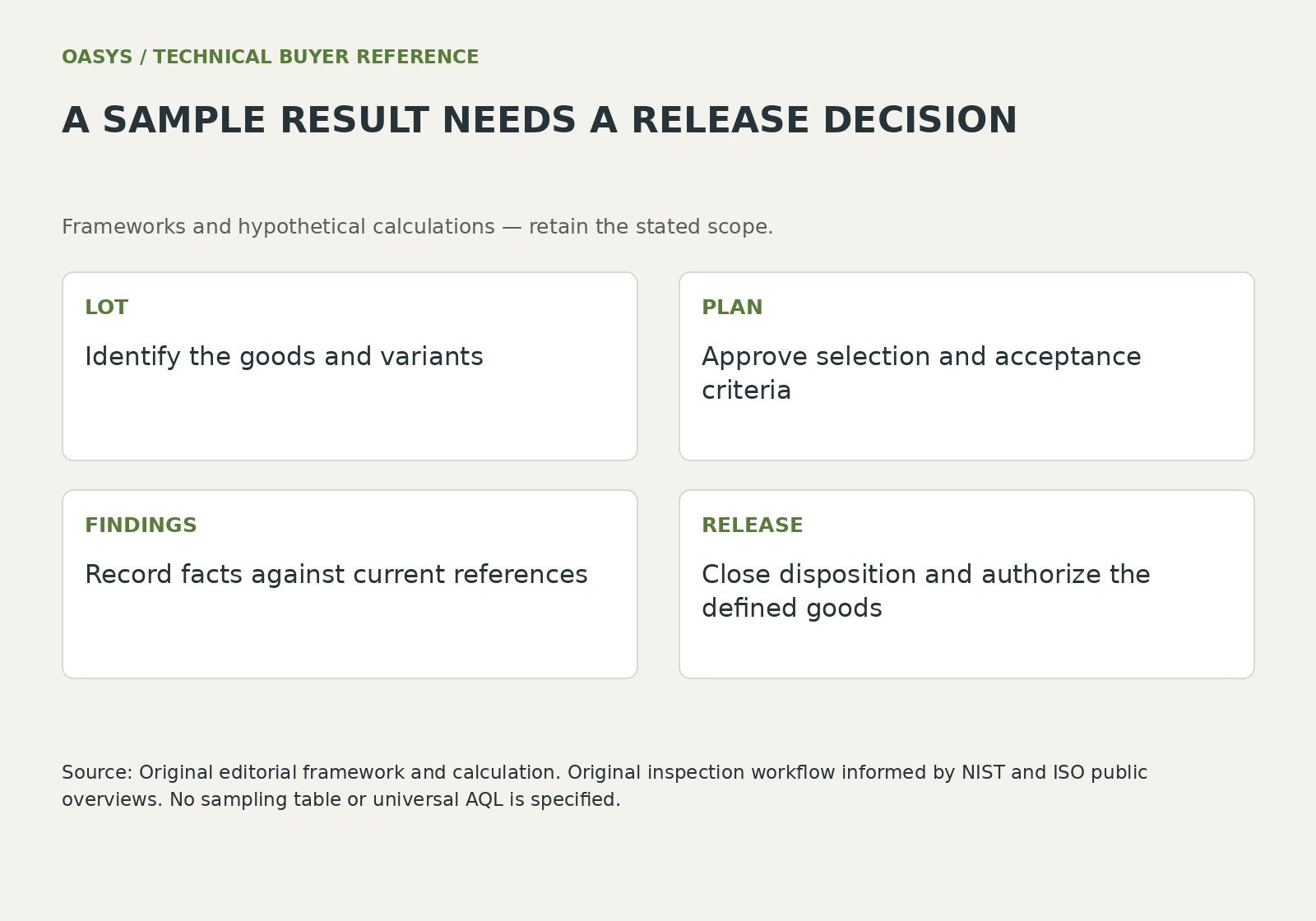
| LOT | Identify the goods and variants |
| PLAN | Approve selection and acceptance criteria |
| FINDINGS | Record facts against current references |
| RELEASE | Close disposition and authorize the defined goods |
Questions buyers ask
Does a passed sample mean every shipped chair is defect free?
A result supports the decision allowed by the agreed inspection plan. It does not establish that every unit was checked or that every possible defect is absent. Preserve lot scope, selection and limitations.
Can the inspector approve a changed product specification?
An inspector records observations under the agreed plan. A proposed concession or specification change needs the designated authority and any required technical review. Identify the affected goods and verify the accepted disposition before release.
Connect the review with your purchasing brief
Use Office Chair RFQ Checklist for Accurate OEM and ODM Quotations; How to Choose an Office Chair OEM and ODM Manufacturer in Taiwan; Mesh vs Fabric vs PU Office Chairs Material Performance and Lifecycle Cost to connect this decision with the configuration and supplier review.
References
International Chamber of Commerce (n.d.). Incoterms 2020. https://iccwbo.org/business-solutions/incoterms-rules/incoterms-2020/
National Institute of Standards and Technology (n.d.). NIST acceptance sampling guidance. Retrieved October 13, 2026, from https://www.itl.nist.gov/div898/handbook/pmc/section2/pmc21.htm
International Organization for Standardization (2026). ISO 2859-1 public overview. Retrieved October 13, 2026, from https://www.iso.org/standard/2859-1