
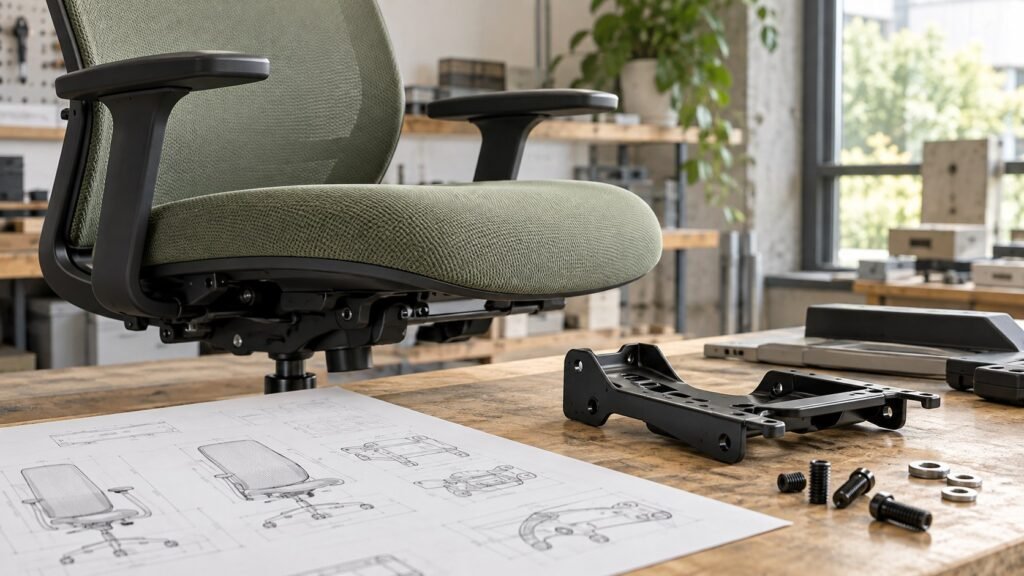
Cover image source: AI-generated conceptual editorial illustration; not a verified OASYS model, facility or test. Technical figures are separately attributed.
Prototype to production
A prototype becomes a supply program when interfaces, materials, tooling, evidence and production references agree. Design for manufacturing should expose the decisions that must close before each release.
| Release gate | Evidence to review | Decision |
|---|---|---|
| Concept | Application and interface map | Approve the design direction |
| Tooling | Released drawings and production-intent materials | Authorize only the defined tool scope |
| Pilot | Assembly, inspection, packaging and instructions | Close repeatability issues |
| Production | Accepted configuration and outstanding conditions | Record release authority |
Begin with a design brief that can guide decisions
A brief should define the chair’s intended application, users, commercial position, and principal functional requirements. Explain the surrounding workstation and selling channel. Identify which characteristics must distinguish the product and which can use an established platform. Without this hierarchy, design discussions can become a series of attractive ideas that have no consistent basis for selection.
Translate the commercial objective into evaluation questions. If compactness matters, define the relevant footprint or packaging constraint. If shared use matters, identify how adjustment controls will be evaluated. If a distinctive silhouette matters, state which views and surfaces express the intended design. The brief should help reviewers explain why a proposal succeeds or fails.
Assign ownership of the brief and record its revision. Marketing, engineering, purchasing, and service teams may contribute different requirements. Consolidate them before asking the manufacturer to begin detailed work. A change remains possible later, but its effect on cost, evidence, schedule, and existing approvals should be visible to the person authorizing it.
Establish the development responsibility map
List the decisions that belong to the buyer, the manufacturer, and any external specialist. Include styling, structural design, component selection, material approval, test applicability, labeling, packaging, and service documentation. A broad statement that one party manages development can hide important interfaces. The responsibility map should identify both the person preparing a recommendation and the person authorized to approve it.
Distinguish supplier owned platform elements from newly developed elements. A project may retain an existing seat and mechanism while creating a new backrest. That arrangement requires clear interfaces between the established platform and the new geometry. Ask which drawings are available, which details are controlled by component suppliers, and how proposed changes will be reviewed.
Set communication rules for technical questions. A consolidated issue log should describe the question, available options, decision owner, and dependency. Avoid allowing independent email conversations to create conflicting instructions. The map and log give the project a usable operating structure even when several organizations contribute to the final chair.
Review the concept before investing in detail
Concept review tests whether the proposed chair is a plausible response to the brief. Evaluate the overall geometry, adjustment concept, component architecture, visible design, and intended manufacturing route. Identify features that create uncertain interfaces or unusual maintenance needs. The purpose is to find consequential questions while alternatives remain relatively inexpensive to explore.
Ask for an explanation of the concept’s assumptions. A rendering may show a thin profile that depends on a material or internal support not yet selected. A moving component may require clearance unavailable in the proposed shell. Record these assumptions rather than treating the image as an engineering commitment. A concept can be approved conditionally while specific issues remain under review.
Evaluate the commercial implications alongside the design. New tooling, special upholstery, or unique hardware may be justified, but they should contribute to a defined customer benefit. Request an initial development and cost assessment with appropriate uncertainty. This helps the buyer decide which features deserve detailed engineering before the project accumulates avoidable commitments.
Develop the chair as a system of interfaces
- Detailed engineering should address the relationships between components.
- Identify the features critical to function and assembly.
- Create a controlled component schedule.
The seat, mechanism, lift, base, arms, and backrest must connect through defined interfaces. Review mounting geometry, clearance, assembly access, and movement. A component that performs well by itself may create a problem when installed in a particular chair configuration.
The drawings should distinguish them from purely cosmetic dimensions. Ask the engineering team to propose tolerances and inspection methods that support the intended result. Requiring identical precision everywhere can increase cost without improving the chair, while leaving an important interface undefined can undermine repeatability.
Record identifiers, revisions, material requirements, and approved suppliers where relevant to the agreement. The schedule should align with drawings and sample records. If a component remains provisional, label it clearly and assign a closure action. This prevents an early convenient part from becoming an unreviewed production default.
Evaluate manufacturing feasibility before tooling release
Manufacturing review should explain how the proposed geometry will be produced and assembled. Consider forming, molding, cutting, joining, finishing, upholstery, and final assembly as applicable. Ask where special fixtures or gauges are required and which characteristics depend on operator judgment. The review should make process assumptions visible before production tools are authorized.
Discuss access and sequence. A fastener may be easy to position in a drawing but difficult to reach after upholstery is installed. A finish may need protection during later operations. A decorative seam may require a particular assembly order. Reviewing these relationships early helps the team distinguish a feasible design from one requiring repeated workarounds.
Record accepted design changes with their reasons. A manufacturing recommendation should not automatically override the product brief. Evaluate the effect on appearance, function, evidence, cost, and service. When a compromise is approved, update the controlled definition. A verbal agreement about manufacturability should become part of the actual design package.
Select materials using application requirements
Material selection should connect the required behavior with an identifiable material and relevant evidence. Avoid selecting upholstery only from color photographs or foam only from a density description. Request technical information and samples appropriate to the intended construction. Identify which properties need independent evaluation and which can be accepted through supplier documentation.
Evaluate the assembled result as well as the material sample. A textile’s appearance can change when tensioned around a contour. Cushion feel depends on the complete seat construction. A finish may look different on an actual component than on a small reference panel. These observations support configuration review; they do not by themselves establish long term performance.
Document alternatives before approval. If a preferred material has uncertain availability, ask what substitution would require. The alternative should be evaluated through its own identity and relevant properties rather than accepted because it looks similar. Development is the right time to establish a practical material change process, especially for programs with several production releases.
Give every prototype a defined purpose
A prototype should answer identified questions. An appearance model may resolve proportions and styling. A functional prototype may resolve movement and control access. A production representative sample may support later acceptance. State the purpose on the sample record and describe any temporary materials, fabrication methods, or components. This keeps the evaluation aligned with what the sample can demonstrate.
Prepare the review protocol before the sample arrives. Identify the measurements, operating checks, comparison references, and evaluator roles. Ask reviewers to record specific observations and distinguish defects from preferences. A statement that the chair feels wrong is difficult to act on; a description of the control, setting, task, and observed problem is much more useful.
Retain sample identity throughout revision. Label samples, photograph important features, and record the corresponding design version. If parts are changed during evaluation, update the record. Otherwise, a later discussion may refer to a chair whose configuration no longer matches the drawing or the supplier’s original sample description.
A passing part can still produce a difficult assembly
The datum used for inspection must relate to the assembled interface. A hole location measured from a cut edge may be acceptable on a flat component, while the relevant locating surface appears only after forming. If the final bracket does not align, compare the measurement references and operation sequence before demanding a tighter laser specification. The problem may be an incompatible reference convention rather than insufficient machine precision.
Mark each consequential interface on the development review: what locates, what clears, what fastens and what moves. Ask the team to record which dimension or condition controls each function. A pilot should expose assembly effort and variation with the released parts, tools and instructions. Successful assembly by the designer after improvised adjustment is a useful observation, but it does not demonstrate the production process the buyer will receive.
Conduct user evaluation without overstating the evidence
A user trial can help assess adjustment access, perceived fit, and task compatibility. Recruit people who represent the intended users and explain the trial’s limits. Use consistent tasks and instructions where practical. Record the settings used, difficulties encountered, and features requiring assistance. The result is a decision input rather than proof of universal comfort or clinical benefit.
Separate initial impressions from sustained observations. A visually striking chair may receive favorable first reactions while its controls remain confusing. A new movement pattern may require instruction before users can evaluate it meaningfully. Ask evaluators what changed after setup and which observations remained. This provides more useful feedback than one overall satisfaction score.
Review feedback with the technical team. Determine whether an issue concerns product geometry, setup instructions, workstation compatibility, or an individual requirement. A single design change may not resolve every source of dissatisfaction. The project should document its intended accommodation strategy and identify circumstances requiring another configuration or specialist assessment.
Approve tooling with a complete release package
Tooling approval should reference controlled geometry, material assumptions, interfaces, and acceptance conditions. Ask which tool features permit adjustment and which changes would require significant rework. Clarify the expected tool trials and how their results will be reviewed. A tooling investment should not proceed solely because a rendering has received commercial approval.
Record the commercial treatment of tools separately from the design review. Ownership, storage, maintenance, access, and end of program arrangements need explicit agreement. The buyer should understand what it receives and what continuing obligations apply. These are topics for a project specific commercial agreement and appropriate advice, not conclusions that follow automatically from paying a tooling charge.
Track tool and product revisions together. A tool adjustment may change the geometry of production components without changing the model name. Link the adjustment to an approved engineering action and identify the affected samples. This creates a traceable basis for deciding when the tool is ready to support pilot production.
Use tool trials to resolve process questions
Tool trials should evaluate whether the intended component can be produced consistently under the proposed process. Review dimensions, interfaces, appearance, and assembly behavior. Identify where adjustment is necessary and whether the observation reflects the tool, material, processing conditions, or measurement method. A trial is most useful when its findings lead to a specific controlled action.
Avoid approving a tool only because one selected piece looks acceptable. Ask how trial pieces were chosen and what variation was observed. The level of review should match the component’s importance and project requirements. Qualified technical staff should determine any process capability assessment or testing method rather than applying an arbitrary universal sample count.
Record conditions relevant to repeatability. If a sample required unusual trimming, manual fitting, or a special assembly adjustment, note that intervention. Decide whether it belongs in the intended production route or indicates unresolved development work. Production readiness should describe the process that will actually be used, including any approved finishing operations.
Plan pilot production as an operating rehearsal
A pilot run tests the proposed manufacturing and assembly system using representative materials, instructions, tools, and personnel. Its purpose extends beyond producing another sample. Review material identification, process sequence, work instructions, fixture use, inspection points, assembly access, and packaging. The pilot should reveal where the released definition remains difficult to execute.
Prepare a pilot issue log with accountable owners. Classify findings according to their effect on safety, function, appearance, assembly, traceability, and delivery. Decide which conditions must close before commercial release and which require a documented limited action. Avoid relying on informal optimism that the production team will solve remaining issues during the first customer order.
Compare pilot chairs with the agreed references. Review variation across the pilot rather than inspecting only a presentation unit. Confirm that labels and packaging identify the correct configuration. If the pilot uses provisional components, state why and define the review required when final components arrive. A rehearsal is valuable only when its limits remain visible.
Connect validation to the final construction
Validation should address the requirements established for the project and the configuration intended for supply. Prepare an evidence matrix linking each requirement with its review method, responsible person, and record. Distinguish chair performance tests, material evidence, user evaluation, packaging assessment, and management system documents. Each supports a different aspect of readiness.
Product identity matters. If a test sample differs from the released chair, ask a qualified reviewer whether the difference affects applicability and what additional evidence is required. Do not assume that a report for an earlier prototype covers every later option. The decision should be documented before the buyer presents a public performance or compliance claim.
Where the BIFMA Compliant program is relevant, its public requirements include qualifying laboratory accreditation and applicable testing (BIFMA, n.d.). Request the specific product evidence and any registry information supporting the intended claim. This paper does not reproduce the full test standards or determine which tests apply to a novel chair construction.
Treat packaging and instructions as development outputs
Packaging should be developed around the actual chair configuration and delivery route. Verify how components are protected, separated, identified, and assembled. Review the hardware pack, tools, labels, and instructions with people who did not design the product. Their questions can reveal assumptions invisible to the engineering team.
Check the relationship between packing sequence and production operations. A part may pass assembly inspection and still be damaged by contact within the carton. A package may protect surfaces but make a component difficult to identify during customer assembly. Resolve these issues through a documented evaluation appropriate to the shipment route, with specialist input where required.
Release instructions with revision control. They should match the supplied hardware and control functions. Identify any operations that require trained service staff rather than end users. A change to a component can create a change to assembly or service instructions even when the product’s appearance remains familiar. Keep those documents connected to the configuration record.
Define the production acceptance reference
The acceptance reference should combine the released specification, approved samples, inspection criteria, and relevant evidence. A physical sample alone cannot describe every tolerance or hidden material. A drawing alone may not communicate all cosmetic expectations. Use the references together and define which one controls if a conflict is found.
Describe appearance criteria in observable terms. Identify viewing conditions, relevant surfaces, and approved boundary samples where practical. The technical team should determine suitable criteria for the product and process. Avoid demanding a subjective perfect appearance without a common reference. Such language creates uncertainty at the point where an inspector must make a release decision.
Confirm the record retention process. The buyer and manufacturer should be able to retrieve the specification and approved references for a later order or claim. Identify where reference samples are kept and how aging or damage will be addressed. A deteriorated sample should not silently become a new interpretation of the intended product.
Release production through a readiness review
Use a readiness review to confirm that the project can support the first commercial order. Check that mandatory design questions are closed, materials are identified, required evidence is reviewed, packaging is approved, and instructions are released. Confirm that remaining conditions have a documented disposition and an accountable decision maker.
Review the commercial order against the technical release. Quantities, variants, finishes, and accessories should match the approved configuration schedule. A late commercial change may introduce a component never evaluated during development. Establish a process for identifying such changes before procurement or production begins. The readiness review should connect the actual order with the product the team approved.
Record release authority and the basis for the decision. This does not require an elaborate ceremony for every project. It requires an understandable record showing why production was authorized and what conditions apply. That record helps future teams distinguish a fully approved configuration from a limited or conditional release.
Control the first commercial batch
The first batch provides information about execution at commercial scale. Agree on relevant process checks, inspection records, and escalation routes before work starts. Monitor unresolved pilot concerns specifically rather than relying only on the standard final inspection. If a concern reappears, hold the affected decision until its implications are understood.
Compare production with the released references and investigate deviations. The response may involve sorting, rework, replacement, or a documented concession approved by an authorized person. Record affected quantities and traceability information. A decision to accept one defined deviation should not automatically revise the standard for future batches.
Review the batch after shipment and installation. Assembly feedback, packaging observations, and service questions can reveal opportunities to improve the program. Separate corrective actions from optional enhancements. Corrective actions address a failure to meet agreed requirements; enhancements change those requirements through a new approved revision.
Manage changes after launch
Product launch begins a continuing configuration management task. Materials may become unavailable, suppliers may propose alternatives, and customers may request new options. Each proposed change should identify the affected part, reason, evidence implications, cost, and implementation boundary. The review should determine what must happen before the new version enters supply.
Use a change record that service teams can understand. Identify which production batches use the old and new components and whether parts are interchangeable. Update drawings, instructions, evidence schedules, and purchasing records as needed. A visually minor change can still matter for assembly or service, so model names should not be the only means of identification.
Review recurring feedback for patterns. A single issue may require an individual service response, while a repeated condition may justify a broader technical investigation. Define who makes that distinction and how the manufacturer receives the information. A controlled feedback process preserves the value of development work by keeping later decisions connected to evidence.
Build a reusable development record
At project closure, assemble the brief, responsibility map, released specification, sample decisions, tool records, pilot findings, evidence matrix, packaging, instructions, and change process. The package should be usable by purchasing, quality, and service staff. Development knowledge loses commercial value when it remains only in the memory of the original project participants.
For a hypothetical new backrest program, this record might show how a concept was revised for assembly access, how the upholstery pattern was approved, and which final configuration supported the validation decision. It should also show what remains outside the approved scope. The example illustrates traceability, not a claim about a particular manufacturer’s process or test results.
For an OASYS development inquiry, request a plan tied to the proposed chair and its degree of customization. Evaluate the plan through its deliverables and decision structure. A chair is ready for mass production when the team can explain how the approved design becomes repeatable supply and how future changes will be controlled.
Use interface tolerances to explain a production problem
Design for manufacturing depends on the relationship among features, rather than the appearance of each part alone. A mechanism mounting pattern, seat support, bracket and upholstery attachment can each conform to an individual drawing while their assembled combination creates a problem. Mark the functional datum and the dimensions that control the interface before tightening every tolerance on the product.
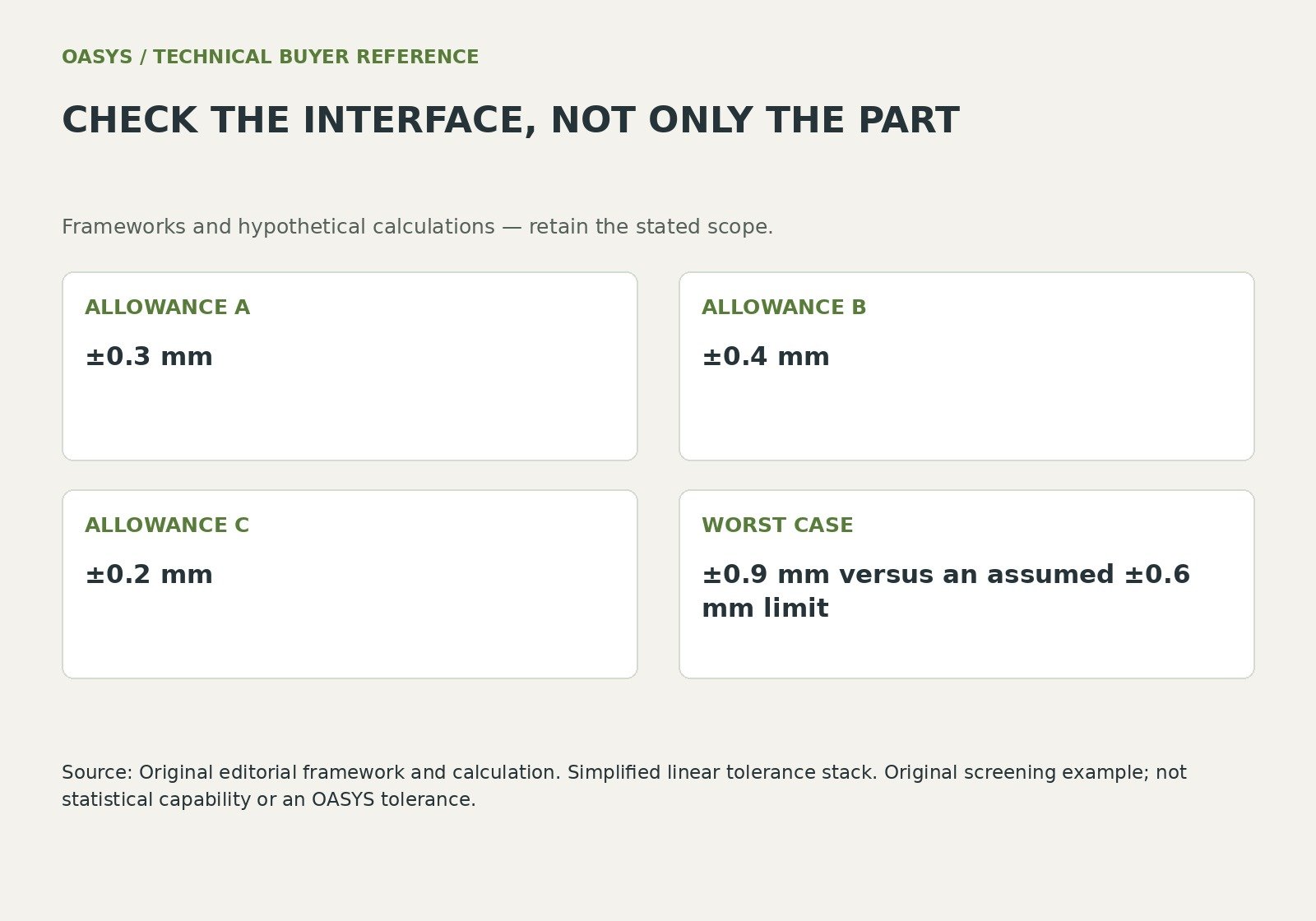
Consider a simplified hypothetical linear stack with three independent drawing allowances of plus or minus 0.3 mm, 0.4 mm and 0.2 mm. The conservative worst case stack is plus or minus 0.9 mm.
If the assembly permits only plus or minus 0.6 mm, the design team has an interface issue even though every individual allowance may look reasonable. This arithmetic is a screening illustration, not a statistical capability assessment or a proposed OASYS tolerance.
Statistical methods require a justified model and process evidence.
There are several engineering responses: change the datum scheme, alter the joining arrangement, create deliberate adjustment, or improve control of a critical feature. Obtain the cost and validation consequences of each response. Reducing one dimension may add inspection effort without solving the actual stack. A production release should explain which response was selected and how the final assembly will be checked.
| Hypothetical feature | Drawing allowance mm |
|---|---|
| Seat support reference | 0.3 |
| Bracket feature | 0.4 |
| Mechanism interface | 0.2 |
| Worst case stack | 0.9 |
| Illustrative available allowance | 0.6 |
Discuss your office chair project with OASYS
Share your target market, application, proposed configuration, quantity and launch requirements with OASYS. A useful inquiry identifies which requirements are approved and which need engineering or commercial input.
Explore OEM and ODM services · Review manufacturing capabilities · Contact OASYS
| Approval field | Record before release |
|---|---|
| ALLOWANCE A | ±0.3 mm |
| ALLOWANCE B | ±0.4 mm |
| ALLOWANCE C | ±0.2 mm |
| WORST CASE | ±0.9 mm versus an assumed ±0.6 mm limit |
Close the approval record
- Define the prototype purpose before deciding what it proves.
- Review the final assembly interface after forming and finishing.
- Use production-intent parts in the pilot where consequential.
- Release drawings, inspection references and packing instructions together.
Questions buyers ask
Does a finished prototype authorize mass production?
A prototype can support a defined appearance, fit or function decision. Production release additionally needs appropriate evidence, repeatable references and a workable manufacturing and inspection route. Record exactly what was approved and which conditions remain open.
Should every tolerance be made tighter?
Tighten a requirement only where the function and process justify it. Review interface allowances, datums, measurement and finishing effects first. Blanket tightening can add cost without correcting the cause of an assembly mismatch.
Connect the review with your purchasing brief
Use Office Chair RFQ Checklist for Accurate OEM and ODM Quotations; Mesh vs Fabric vs PU Office Chairs Material Performance and Lifecycle Cost; Office Chair Mechanisms Synchro Tilt Self Weight and Tilt Lock Explained to connect this decision with the configuration and supplier review.
References
BIFMA (n.d.). BIFMA Compliant. Retrieved October 11, 2026, from https://www.bifma.org/page/bifma-compliant