

Cover image source: AI-generated conceptual editorial illustration; not a verified OASYS model, facility or test. Technical figures are separately attributed.
What does the load claim mean?
A chair rating needs the manufacturer’s precise intended-use statement and the supporting technical basis. Occupant mass, component ratings and test conditions describe different things.
| Statement | Evidence needed | Unsupported shortcut |
|---|---|---|
| Intended occupant mass | Manufacturer statement for the chair version | Copying a test value into a user limit |
| Component designation | Part identity and relevant scope | Applying one component value to the chair |
| Test condition | Full method and reported sample | Dividing a test load by an invented factor |
| Order coverage | Configuration and change assessment | Assuming a shared model name is enough |
Define the statement before reviewing the number
Ask what the supplier means by load rating. The statement may refer to intended occupant mass, a component designation, a static test condition, or another defined property. Those meanings should not be treated as interchangeable. Record the wording, units, configuration, and operating conditions before comparing proposals.
A useful product statement identifies the chair version and the use for which the rating is offered. Ask where that statement appears in instructions, technical information, or other manufacturer documentation. If the sales page and user guide differ, resolve the discrepancy through the responsible technical contact. The buyer should not choose the higher figure simply because it appears commercially attractive.
Separate the claim from its evidence. The claim describes what is being offered; the evidence supports a defined conclusion. A report may contain many values that serve different procedures. The reviewer should identify which records are relevant to the manufacturer’s statement and what limitations apply, rather than extract one number without context.
Identify the complete chair configuration
Prepare a record of the seat, back, mechanism, lift, base, casters or glides, arms, and other relevant assemblies. Include codes and revisions where available. Load related claims should be connected to that record. A model family can contain versions whose construction differs, so the retail name alone is insufficient for technical review.
Compare the proposed order with the tested sample. Differences should be listed and assessed by qualified personnel. A larger base or another lift may look reassuring, but visual judgment does not establish the rating of the complete chair. The buyer needs an explanation of applicability and any further evaluation required.
Keep the configuration current through reorders. If a component changes, review the affected claim before the new version enters supply. The service team should also know which approved replacements preserve the intended construction. A rating becomes difficult to defend when installed chairs gradually accumulate unreviewed components.
Distinguish occupant mass from test loads
A report’s test condition can involve a stated load, force, impact, or repeated action under a defined method. A published occupant limit describes another type of statement. Do not assume that the two values are equal or related through a simple multiplier. Their relationship needs the applicable method and competent engineering interpretation.
Review units and terminology carefully. A document may state mass in kilograms or pounds, while another describes force using different units. A correct unit conversion does not establish an intended user rating. The purchasing team should preserve the original method context and ask the reviewer to explain consequential differences.
Avoid improvised safety factors. Dividing a test load by an arbitrary number does not produce a supported safe user limit. This paper deliberately provides no formula for doing so. Buyers should obtain the manufacturer’s intended use statement and the technical basis appropriate to the product, application, and relevant requirements.
Understand why test conditions matter
- Test conditions define what the evaluation actually does.
- Ask whether the report records departures, limitations, or qualifications.
- Retain the full relevant record.
Sample preparation, load application, orientation, sequence, duration, repetitions, and evaluation criteria may each affect interpretation. A short public summary cannot replace the full applicable method. The reviewer should consult the appropriate standard and report rather than reconstruct a procedure from marketing content.
Determine their relevance through competent review. A pass statement can be useful only when the scope is understood. The buyer should know which requirements were evaluated and whether the ordered configuration falls within the accepted conclusion.
A cropped page showing a large load or a favorable result may omit the sample and method information needed for review. If disclosure is limited, agree on another verification route that still satisfies the buying requirement. The evidence question should remain visible until resolved.
Select the applicable standard through expertise
BIFMA publicly lists separate standards for general purpose office seating and general purpose large occupant office seating (BIFMA, n.d.-a). That distinction supports a discussion of application and scope. It does not mean the buyer can determine a chair’s rating merely by seeing one standard designation on a sales page.
Ask qualified personnel which standard and edition are appropriate for the intended product. Novel movement, unusual construction, or a different application may require further interpretation. Record the decision and the evidence needed. The procurement brief should identify the requirement clearly enough that suppliers respond on a comparable basis.
Avoid applying a large occupant designation as a universal quality upgrade. Structural requirements and dimensional fit address different questions. A broader seat or another construction may serve one application and create a mismatch in another. The buyer should select the chair through intended users, tasks, evidence, and accommodation needs together.
Verify the manufacturer's rating basis
Request the technical basis for the published statement in a form the manufacturer can disclose and the reviewer can assess. This may involve relevant reports, design information, and intended use conditions. The buyer need not demand unrelated proprietary calculations, but it should obtain enough evidence to support the purchasing requirement and public claim.
BIFMA’s FAQ directory includes dedicated guidance on chair weight limits and load ratings (BIFMA, n.d.-b). Consult that guidance and appropriate technical support where needed. This paper does not summarize an inaccessible full memo as though it had independently resolved every rating question. Its recommendation is to use an authoritative interpretation route for consequential issues.
Record the conclusion and limits. If the basis supports only one configuration or application, preserve that scope. If information remains incomplete, identify the action required before approval. Commercial urgency should not convert an unresolved rating into an accepted fact through repeated quotation wording.
Separate static evaluation from repeated use
A static condition and a repeated action address different aspects of performance under their respective methods. One favorable result should not be treated as proof of every use pattern. Ask the reviewer to explain what the relevant evidence establishes and what remains outside its scope.
Do not translate repetitions directly into years of service. Actual use involves a defined application and variable conditions. A cycle count in a laboratory method has its own meaning. The buyer should describe the tested property accurately and keep lifespan or warranty statements separate unless an appropriate basis supports them.
When comparing proposals, use the same purchasing requirement. A supplier presenting one static result and another presenting a broader report may not be offering equivalent evidence. Normalize the scope before comparing commercial value. The highest number should not automatically outweigh more relevant and complete documentation.
Keep the rating usable after the first installation
Service replacements can change the supplied construction. A lift, base or caster set with a reassuring component description should not enter the chair solely because its separate rating is higher. The technical reviewer needs compatibility and the relevant basis for the complete assembly. Keep approved replacements identifiable through part and configuration records.
The buying file should also distinguish structural evidence from dimensional accommodation. A broader chair is not automatically the right workstation fit, and a higher stated occupant limit does not resolve desk access or control reach. Use the relevant application and user review alongside the rating check. This creates a clear route for a general fleet and for individual requirements without converting a test designation into a universal suitability claim.
Review impact and movement claims cautiously
Impact and movement procedures should be interpreted through the applicable method and report. The buyer should not assume that a stated impact condition authorizes uncontrolled use or that a movement test covers every way a chair might be handled. Intended use and instructions remain relevant.
Ask about the chair’s movement design and operating conditions. A conventional task chair, a high stool, and a motion seating product may require different scope decisions. Qualified review should identify the relevant evidence. A shared term such as office chair should not conceal a materially different construction or application.
Keep customer communication specific. Describe the intended functions and any operating limitations supported by the manufacturer’s documentation. Avoid broad phrases such as withstands anything. A clear statement helps customers select and use the product without turning a laboratory result into an unlimited promise.
Do not infer the complete rating from the gas lift
A lift is one component within the chair. Its designation or report can be relevant, but it does not establish the performance of the seat, mechanism, base, attachments, or complete assembly. Ask how component evidence contributes to the product’s rating basis and have the relationship reviewed by qualified personnel.
If a supplier proposes another lift, review compatibility, geometry, operation, and affected evidence. A similar length or mounting appearance does not establish equivalence. The change record should identify the approved part and implementation boundary. Procurement should not accept a substitute solely because it carries a higher sounding category label.
Service replacements need the same discipline. Use current manufacturer instructions and approved compatible parts. Operations outside routine user adjustment should be performed by appropriate trained personnel. A general article should not provide an improvised procedure for disassembling a load bearing assembly.
Review base and caster options through the system
Ask which base and caster configurations are included in the intended use statement and evidence. The relationship with floor conditions should also be considered through the manufacturer’s guidance. A base material name or caster diameter is not a standalone rating for the complete chair.
Evaluate changes through their actual differences. Another base may alter interfaces, geometry, or other requirements. Qualified personnel should determine whether existing evidence remains relevant. The buyer should preserve the decision and avoid treating a visually larger component as automatically safer or suitable for a higher occupant mass.
Record options in quotations and product pages. If the stated rating applies to a particular base or caster set, make that condition visible. Customers should understand which version they receive. Accurate option communication supports purchasing, installation, and service as well as claim verification.
Keep fit separate from structural suitability
Structural evidence does not establish dimensional fit for every user. Review seat width, usable depth, height range, arm spacing, and the workstation relationship. The chair may need an individual trial or specialist assessment even when the relevant performance evidence is accepted.
Do not assume that a chair intended for a larger occupant suits all smaller users equally well. The application should guide selection. A corporate program may require several approved configurations and an exception route. The goal is to accommodate actual requirements rather than assign one model to everyone because its rating appears broad.
Record fit observations separately from report conclusions. A user preference trial answers different questions from structural testing. Both can inform procurement when their limits are preserved. The selection rationale should explain the evidence and the accommodation process without promising universal comfort or medical outcomes.
Consider the actual use pattern
Describe whether the chair is individually assigned, shared, used across shifts, or moved frequently. Identify the task and environment. These conditions help qualified personnel assess the proposed product and support arrangements. The buyer should not alter a published rating independently to account for use intensity.
Ask the manufacturer for intended use guidance relevant to the application. If the planned use differs from the documented scope, request a specific assessment. Do not assume that a commercial office label covers every specialized environment. Keep the question visible in the RFQ and approval record.
Review maintenance and inspection arrangements as part of the program. The organization should know how users report faults and how affected chairs are assessed. This is an operational recommendation, not a technical prescription for a universal inspection interval. The actual plan should follow manufacturer guidance and the facility’s needs.
Build a rating review worksheet
The worksheet should record the proposed statement, units, configuration, intended application, supporting documents, reviewer, and decision. Add fields for tested sample differences and open actions. This original template organizes evidence while leaving technical interpretation with competent personnel.
Distinguish verified information from assumptions. If the report does not identify a component, mark the information unclear and request clarification. Do not fill the gap from the current catalog. If the manufacturer provides a separate rating statement, link it to the evidence review rather than assume the statement is self validating.
Preserve the worksheet with the order and product content record. It should show why the claim was accepted and which conditions apply. When a component or application changes, use the worksheet to identify the review needed. This makes the rating manageable as part of an ongoing product program.
Use a hypothetical high number example
Consider a hypothetical report containing a test load higher than the occupant limit stated in the user guide. The buyer should not replace the user limit with the test value. The reviewer should explain what the procedure evaluated and how the manufacturer supports its intended use statement.
Now consider a sales page using the test value as a weight capacity. The editorial team should pause that wording and obtain a supported claim. The issue is the relationship between the evidence and statement, not whether the number looks impressive. The correction should identify the actual configuration and approved scope.
The hypothetical example illustrates a common reasoning error without alleging it occurred at OASYS. It shows why claim review must involve more than extracting numbers. A defensible product statement remains connected to its technical basis and does not exceed what that basis establishes.
Use a hypothetical option mismatch
Consider a hypothetical buyer ordering a chair with another mechanism and base from those shown in the report. The supplier says the model name is unchanged. The buyer should record the differences and request qualified assessment of applicability. The name alone does not resolve the construction question.
The assessment may support existing evidence, require additional records, or identify further evaluation. This article does not prescribe one outcome for every difference. The decision should state its basis, affected configuration, and conditions. Procurement should update the quotation or release plan accordingly.
After approval, preserve the version boundary. Service and reorder teams should know which components belong to each configuration. If published claims differ by version, make that distinction visible. The example demonstrates why configuration control is part of rating management rather than a separate administrative concern.
Handle uncertainty before order release
If a rating basis remains unclear, define the open question and responsible reviewer. Ask the supplier for the missing record or clarification. A mandatory requirement should remain a release condition until resolved or changed by an authorized decision maker. Repeated sales assurances do not replace the evidence review.
Avoid unsupported accusations. An incomplete file may reflect a disclosure or administrative issue. Establish the facts through the appropriate manufacturer, laboratory, or issuing organization. The buyer can decline an unresolved proposal without claiming the supplier’s statement is fraudulent. Precision supports a productive technical discussion.
Keep commercial alternatives visible. Another configuration or evidence route may satisfy the application. Evaluate it transparently through the same requirements. The objective is to select a supported product, not to force an unsupported claim onto the preferred design because the project has already invested time in it.
Publish a precise load statement
Use the wording accepted by the responsible technical reviewer and supported by current manufacturer documentation. Identify relevant configuration and conditions. Keep units consistent and explain distinctions where readers might confuse a test condition with intended use. Do not add an arbitrary safety factor or broaden the scope during copy editing.
Review images, tables, downloadable sheets, and distributor materials together. A precise sentence can be undermined by another page displaying an unsupported capacity. Establish an editorial source of truth and a review owner. The claim should remain consistent as it moves through sales channels.
Compare statements using a scope table
A scope table can prevent misleading comparison among supplier numbers. Give each proposal a row and identify the statement type, units, chair configuration, intended use, supporting record, and review status. If one row describes occupant mass and another describes a test force, mark them as different statements. Do not rank them as though they were competing versions of the same property.
Add a field for the unresolved question. One supplier may need to provide the user guide, another may need to identify the tested base, and another may need a technical applicability decision. These actions have different purposes. The table should show what will make each proposal comparable and which requirement it must satisfy.
Use the completed table during commercial approval. A lower price or higher visible number should not compensate automatically for a missing mandatory basis. Once relevant claims are supported, the buyer can compare fit, service, delivery, and cost. This order of review keeps the purchasing decision connected to the application and avoids rewarding the most ambiguous statement.
Keep user information respectful and practical
Where an organization selects seating for a varied population, it should establish an appropriate accommodation process. Purchasing may need configuration requirements without needing sensitive personal information. Qualified staff can identify the relevant product needs and communicate them through the organization’s normal privacy and assessment procedures.
Avoid public labels that stigmatize users or imply that a weight category describes every aspect of fit. A person may need another seat width, depth, height, or control arrangement for several reasons. The furniture program should provide a practical route to suitable options and explain support in neutral product language.
The manufacturer inquiry can focus on the intended configuration, application, and evidence requirement. The internal accommodation record can remain with the appropriate team. This proposed separation helps purchasing obtain relevant technical information while preserving a respectful process for individual users. It also reinforces the central distinction: structural suitability and personal fit require related but separate decisions.
Maintain the claim through service and change
Review component, design, and process changes for their effect on the rating basis. Qualified personnel should determine the required assessment. Update evidence, instructions, and public content where necessary. A familiar product name should not conceal a changed construction.
Use approved service parts and retain compatibility records. If a replacement alters geometry or function, the organization should know which review supports it. The installed chair needs to remain identifiable so a future question can be answered from records rather than guesswork.
The strongest rating claim is one the buyer can trace from statement to configuration and evidence. For an OASYS inquiry, describe the application, request the exact proposed version, and obtain competent review of the supporting basis. That process gives the published number a clear meaning and keeps it useful throughout the product’s commercial life.
Keep mass force and occupant suitability in their own fields
A kilogram statement identifies mass, while a force measurement uses a unit such as newtons. In a simplified static conversion, 150 kg multiplied by the standard acceleration value 9.80665 metres per second squared corresponds to approximately 1,471 newtons. This arithmetic does not convert an occupant rating into a prescribed laboratory test or establish a safe capacity. Test procedures define their own loads, fixtures and conditions.
The whole chair also includes load paths through the seat support, mechanism, column, base and castors. A component supplier’s rating cannot establish the complete product’s occupant rating. Record the manufacturer statement and the evidence reviewed by the responsible technical personnel, then check the exact optional parts ordered. Geometry and fit remain separate questions even when the structural basis is appropriate.
When a reinforced version carries a price premium, request the changed assemblies, intended application, validation scope and service consequences. Do not pay for a larger marketing number without understanding what changed. The commercial comparison should include the complete quoted configuration and the evidence that supports its intended use, rather than multiply a capacity statement into an assumed durability benefit.
| Statement | What it describes |
|---|---|
| Occupant mass rating | Manufacturer intended user statement |
| Test force | Defined procedure load and conditions |
| Component claim | A specific component under its stated basis |
| Fit range | User and workstation relationship |
| Complete chair suitability | Configuration and evidence review |
Discuss your office chair project with OASYS
Share your target market, application, proposed configuration, quantity and launch requirements with OASYS. A useful inquiry identifies which requirements are approved and which need engineering or commercial input.
Review quality and testing · Explore furniture resources · Contact OASYS
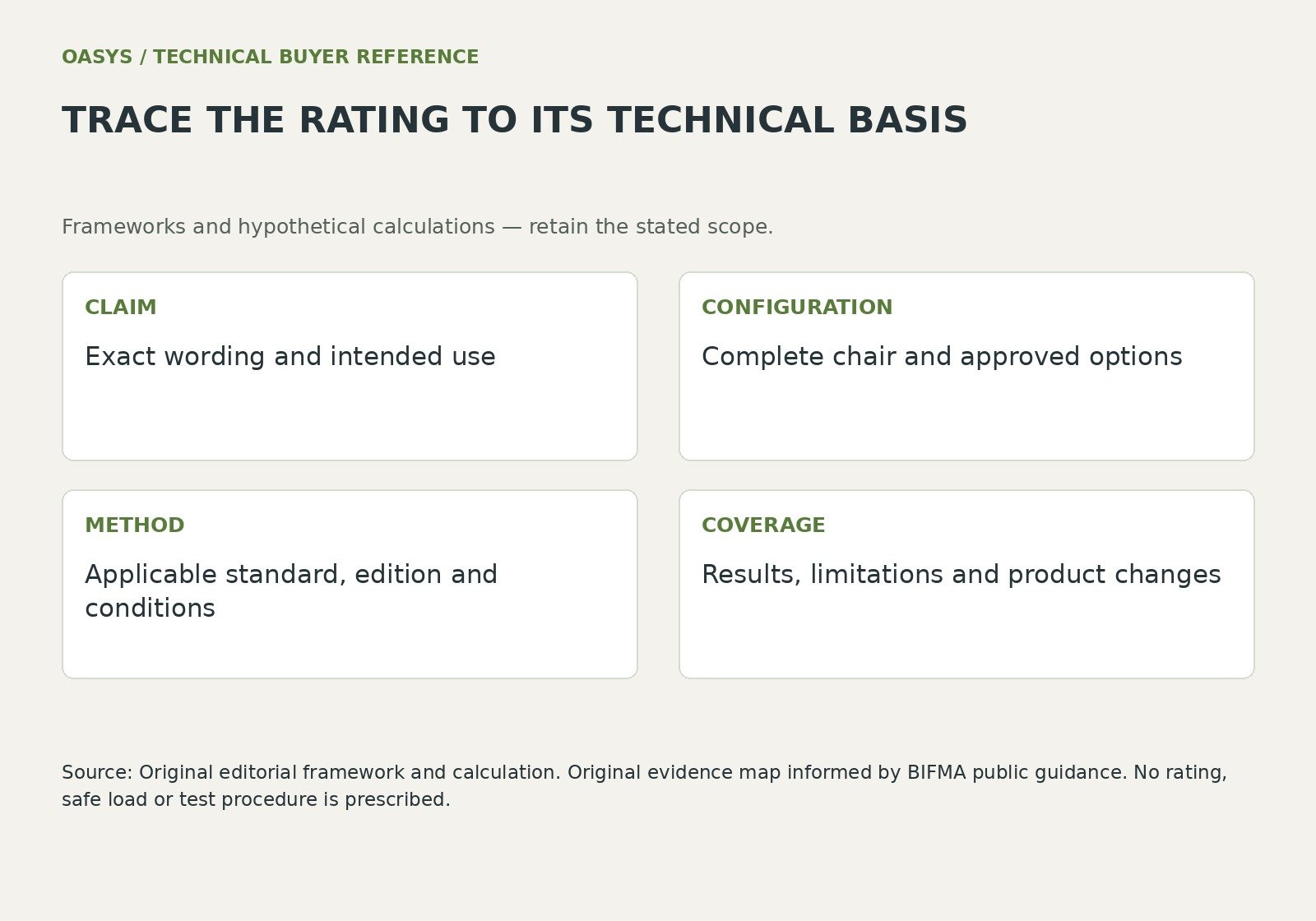
| Approval field | Record before release |
|---|---|
| CLAIM | Exact wording and intended use |
| CONFIGURATION | Complete chair and approved options |
| METHOD | Applicable standard, edition and conditions |
| COVERAGE | Results, limitations and product changes |
Close the approval record
- Preserve the manufacturer’s wording and original units.
- Match the complete supplied version to the supporting record.
- Assign qualified review of method and applicability.
- Approve compatible service parts through the same configuration record.
Questions buyers ask
Can a test load be converted into a user rating with a safety factor?
An improvised multiplier or divisor does not establish an intended-use limit. Obtain the manufacturer’s statement and qualified interpretation of the applicable method, configuration and evidence. Keep a unit conversion separate from a suitability conclusion.
Does a stronger component automatically raise the chair’s rating?
A component value applies to its stated scope. The complete chair includes interfaces and other assemblies. Review the proposed replacement and its supporting evidence before changing a whole-chair statement.
Connect the review with your purchasing brief
Use Office Chair RFQ Checklist for Accurate OEM and ODM Quotations; Office Chair Mechanisms Synchro Tilt Self Weight and Tilt Lock Explained; How to Choose an Office Chair OEM and ODM Manufacturer in Taiwan to connect this decision with the configuration and supplier review.
References
BIFMA (n.d.-a). Standards descriptions. Retrieved October 11, 2026, from https://www.bifma.org/page/StandardsShortDesc
BIFMA (n.d.-b). Standards FAQs. Retrieved October 11, 2026, from https://www.bifma.org/page/FAQS
BIFMA (n.d.). BIFMA. Retrieved October 13, 2026, from https://www.bifma.org/page/bifma-compliant